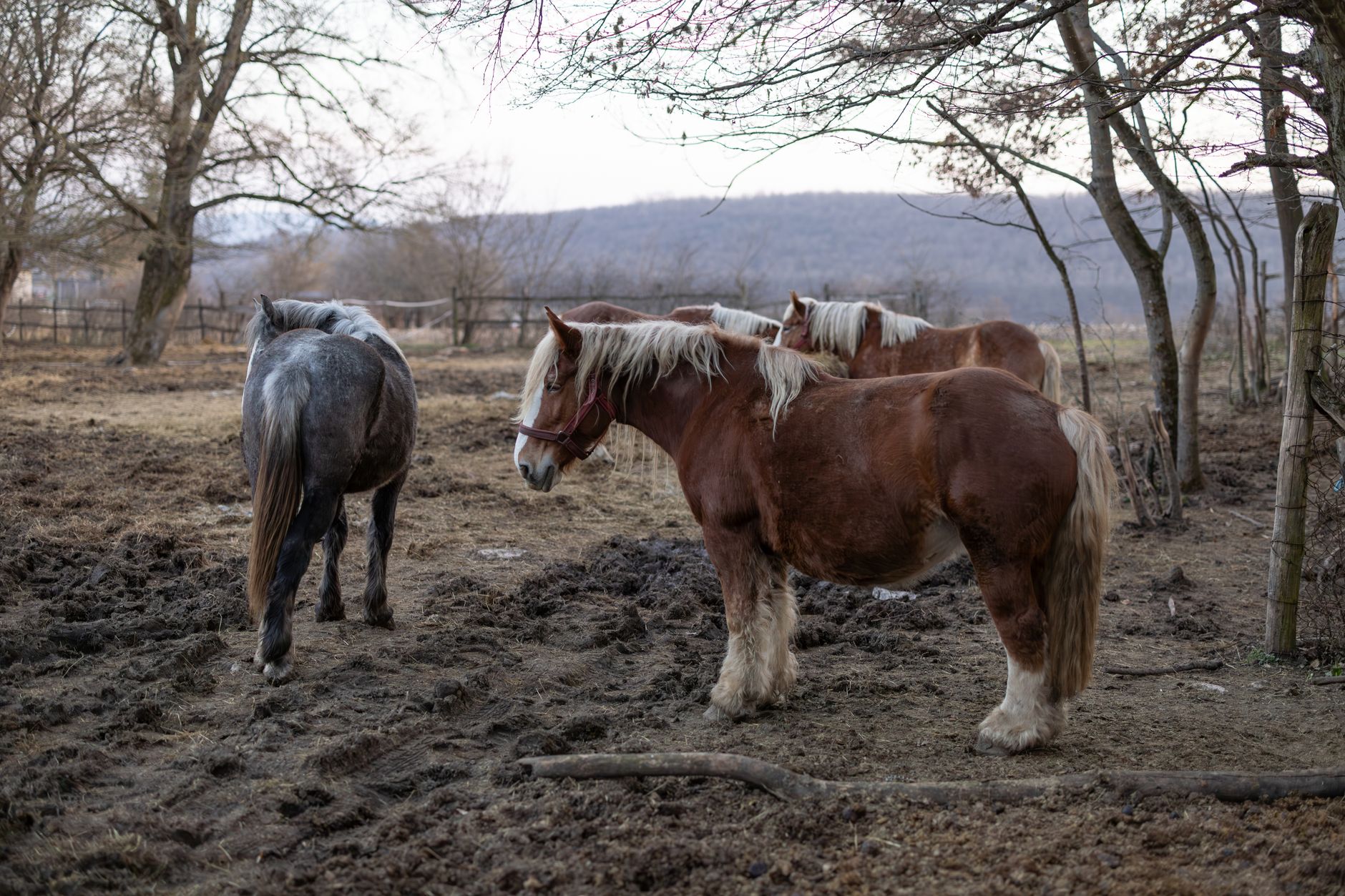
The Mare I Promised Never to Sell
I did not touch them. I watched Mr. Brandt look at the gloves, and then at me, and then lift the harness off the pegs around them so they stayed where they were. He did not say a word about it, and I have thought about that more than I can tell you.
I held Bess’s head while he did it. I felt her trembling. She had known the smell of that harness for twelve years, and she stood still as a post and let him settle the collar over her neck, and then she let out a breath that went on and on.
He hitched her beside Duke to the old stone boat, a flat sled for hauling rock, that Ray had left in the grove, and he spoke to them, low and flat, and he clucked.
And she moved.
I do not know how to tell you what it was. For eight months I had watched that mare cross the lot with her head low and her feet dragging, as if she carried something. I had thought it was her age, or the weather, or grief, or me.
She went across that yard like a young horse. Her head came up. Her neck arched. Her feet came down together with Duke’s, and the traces went tight, and the stone boat slid across the frozen ground with a hiss, and the bells rang, and she looked ahead, with her ears pricked, the way she had looked at the end of the lane every winter morning.
Mr. Brandt drove them out to the road and back, a quarter of a mile, and when he pulled up in front of me the horses’ sides were heaving and Bess’s eyes were bright. She looked like a different horse.
“She’s a natural,” he said finally. “The best-broke mare I’ve had the lines on in fifteen years.”
I put my hand on her neck. It was wet and hot. She turned her head and pushed her nose against my coat.
“You see it, though,” Mr. Brandt said. “Don’t you? You can see she’s missed it.”
“I see it.”
“I won’t say anything else.” He got down and began to unhitch her, slow and careful. “The offer stands till the twentieth. I’m sorry for what I said about kindness. It’s not my business. I just can’t stand to see a good animal stand idle.”
When he left I stood in the lot and held on to Bess, and she let me.
The numbers
That night I called Gene Pollard at home, which I had never done in my life.
“I wanted to ask if there is anything,” I said. “Anything at all. Any way to do part of it.”
He was quiet for a moment. “Arlene, I’ve been waiting for you to ask me that. Yes. If you can show me income coming in, and bring me a good-faith payment, I can write something up for the main office.
“I can’t promise what they’d say. But a paper that says there’s a plan is a lot different from a paper that says there isn’t.”
“How much of a payment?”
“Half would do wonders.” He cleared his throat. “Forty-six hundred.”
I wrote it on the back of an envelope. Forty-six hundred. Half of nine thousand two hundred.
I stared at that number for a long time. But I had no cattle, no baler, and no income but Ray’s Social Security and mine, and the hospital took eighty-five dollars of that every month.
I had a mare and eighty acres and a promise.
I would not ask my children. I told myself that for three more weeks.