The Mare I Promised Never to Sell
My son parked his pickup behind the machine shed so I would not see it from the kitchen window, and that is how I knew something was wrong.
It was the third Wednesday of October, a bright, windy morning eleven miles outside Garnett Bend, with the cottonwoods along the creek gone yellow and shedding. Kevin lives three hours away in Omaha and does not come on a Wednesday. He comes on Sundays, with a casserole his wife made and a look on his face like he is checking a pot for boil-over.
I saw the second truck only because I went out to shake the rug. It was a white Ford with a gooseneck behind it and a name painted on the door in plain black letters. Brandt Draft and Sleigh, Callaway, Nebraska.
Two men stood at the pasture fence with their boots on the bottom rail. One was my son in his good jacket. The other was a stranger in a canvas coat, about sixty, with a gray mustache and his hat in his hand, which is a thing you notice about a man.
Neither of them was looking at the house. They were looking at Bess.
She had come to the fence to see who it was. She does that. She stands with her ears forward and her big head over the top wire like a woman at a parade, and she waits to find out if you have anything for her.
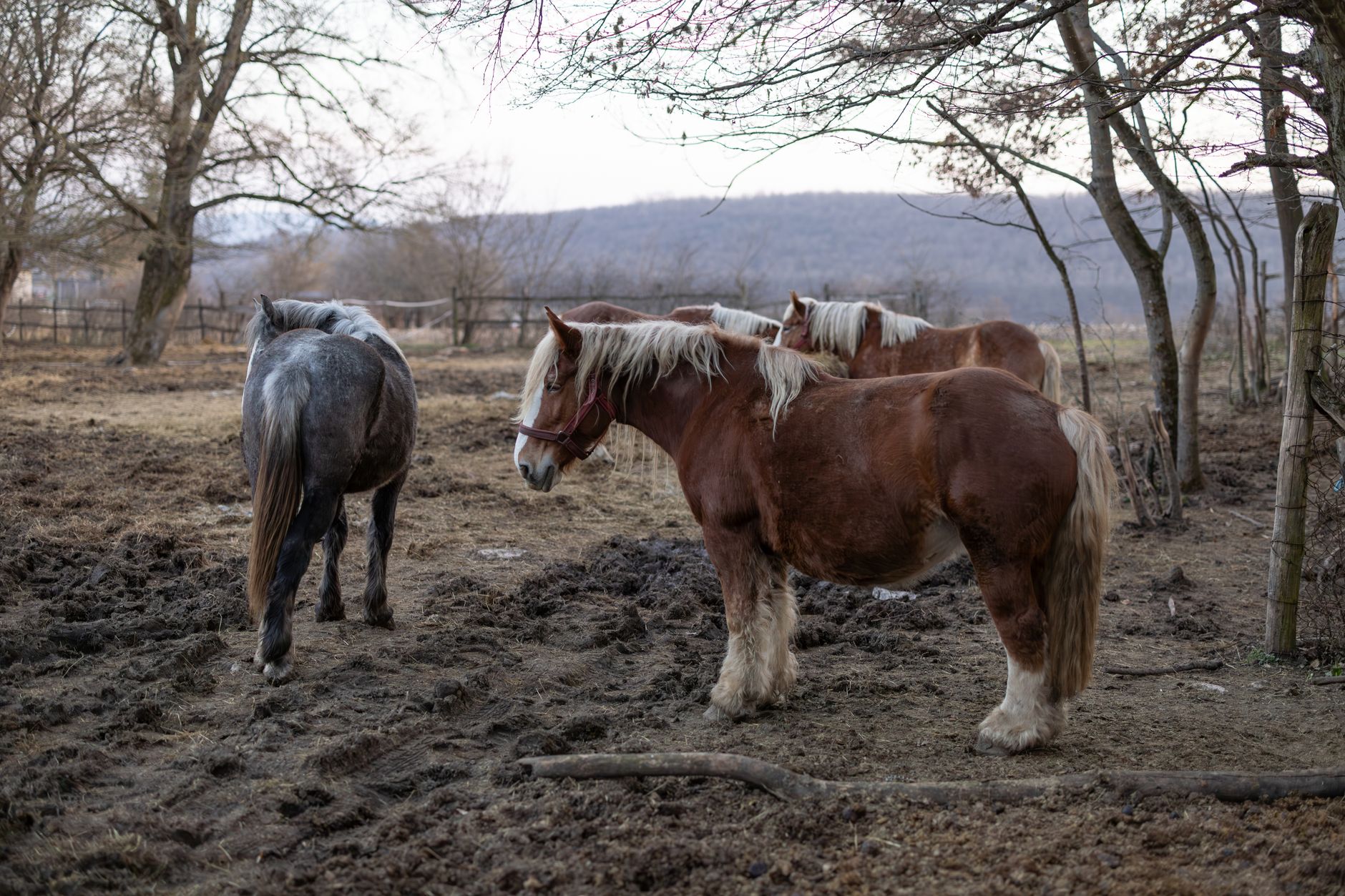
Seventeen hands high, gray as a thundercloud, with a white blaze Ray used to say looked like somebody spilled a cup of milk down her face. She weighed eighteen hundred pounds. She was twelve years old. She was the last living thing my husband put his hands on every day of his life.
I stood on the back step with a rag rug in my fists and watched a stranger walk his hand down her neck.
“Kevin,” I said. I did not say it loud. The wind took most of it.
He turned around. I have known that face for forty-four years, and I have never once seen it look so much like his father’s when his father had done something he thought was for the best.
The promise
Ray died on the ninth of February, in the front room, in a rented hospital bed we had pushed in beside the window so he could see the pasture.
He had that window open an inch the whole last week, in the cold, with a quilt tucked up to his chin, because he wanted to hear the mare. She came to the corner of the lot nearest the house at five-thirty every morning and stood there, the way she had stood waiting for him every morning of her life.
Four days before he went, he asked me to help him to the door. He could not walk by then. The hospice nurse and I got him into the wheelchair and his barn coat, and Janice, our daughter, drove up from Grand Island in the middle of her shift to carry the oxygen bottle.
We rolled him out onto the back step at dawn. It was nine degrees.
Bess came across the lot at a walk. She stopped in front of him, and she lowered that great gray head and set it against his chest, right on the buttons of the coat, and stood there. She did not move. She breathed out through her nose and it smoked over his lap.
Ray put his hand flat on her forehead, between the eyes. He did not say anything to her. He didn’t need to. He had been saying it to her for twelve years.
Janice went inside. I stayed. I can still see the oxygen tube moving in the cold.
The promise came on the last night he could talk. It was past midnight, and the furnace was running. He woke and turned his head on the pillow, and he said, “Arlene.”
“I’m here.”
“Don’t sell Bess.”
I thought he meant he was worried about the cattle, or the sled, or the work. Ray was always worried about the work. “We’re not going to think about that right now,” I said.
“No.” His hand found my wrist, and it was very light. “Whatever they tell you. Whatever it looks like. You don’t sell her.”
“Ray.”
“Say it.”
I said it. I said, “I won’t sell her.” Then he made me say it again, plainer, and I said, “I promise I will not sell Bess,” in a kitchen voice, like I was agreeing to a price on eggs.
He let go of my wrist. He slept. Four days later he was gone, and I had never asked him why.