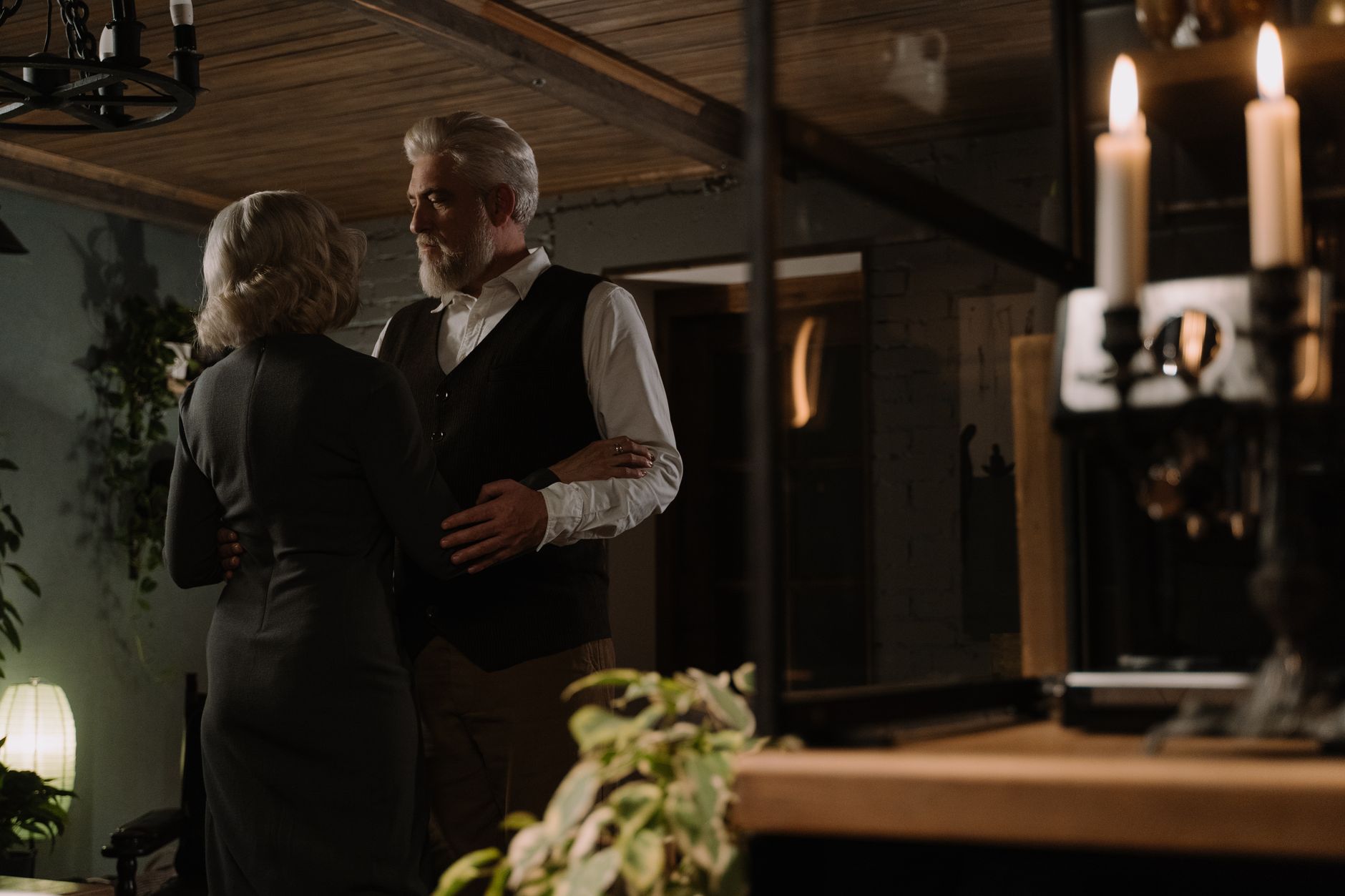
The Last Waltz I Saved for Vonnie
All of them, a hundred and fifty or so, one by one and two by two, off the maple and onto the brown carpet beside the aluminum strip. They stood in a ring around the whole floor, shoulder to shoulder, in the exact place where I had been standing for eighteen months. Every one of them stood the way I stood, hands in front, toes behind the line.
And in the middle, bare and shining under the half dark, was the floor.
Nobody was on it. It was a maple floor, scuffed from sixty years of boots and church shoes, and it looked enormous.
The people on either side of me stepped back. Not far. Enough to say: go on.
I want to tell you what I thought, and it is nothing noble. I thought: I can’t. I thought: my knee. I thought: I have never known how, she was the one who knew how.
Elton Neufeld played four notes on the steel.
A pedal steel doesn’t play a note so much as slide up into it, and the way that tune begins is with a long, low, sliding climb, a sound like a screen door in the house you grew up in. Then the fiddle came in under it. Marlin played from his chair. Bonnie’s bass found the one. Brady Funk brushed the snare so softly I had to lean toward it.
One, two, three.
And it came to me, standing there with that sound in the air, that the whole county had been waiting on me. Not for me to dance. For me to be done standing.
I do not know how long it was before I moved. Maybe ten seconds. I put my hat down. I want you to hear that, because it matters. I set my hat on the maple floor, just past the strip, because there was no chair near enough and I had nowhere else to put it. For fifty-six years she had taken it out of my hands, and this time I had to set it down myself.
Then I walked out onto the floor.
My left hand went up to the height of her eyes. I didn’t decide that. It went there. My right hand went to the middle of a back that wasn’t there, between the shoulder blades, where she was always a little warm. I stood in the center of that hall with my arms around the air, and I heard her. I can’t tell you that I did, but I did. She said, “Don’t count out loud.”
So I counted in my head. One two three. One two three.
I had never in my life gone first. For fifty-six years she led and I followed and told her she was wonderful. It had never once occurred to me that if she were not there, somebody would have to lead, and the somebody would be me. I stepped forward on the one. My knee complained. I stepped to the side on the two. I brought my foot over on the three.
It’s a box. That’s all it is. Forward, side, together. Back, side, together. I had done it behind a machine shed with a mop in 1968, and I had done it in front of a hundred and fifty people for decades, and I had never once done it alone.
I went around.
I didn’t look at the faces. I went around that floor in a slow ring with my arms held out around nobody, the way you would carry a sleeping child across a yard, and I did not step on anyone’s foot. There was no foot to step on. The only sounds in the hall were the band and my shoes and, once, off to my left, Gus Adler clearing his throat.