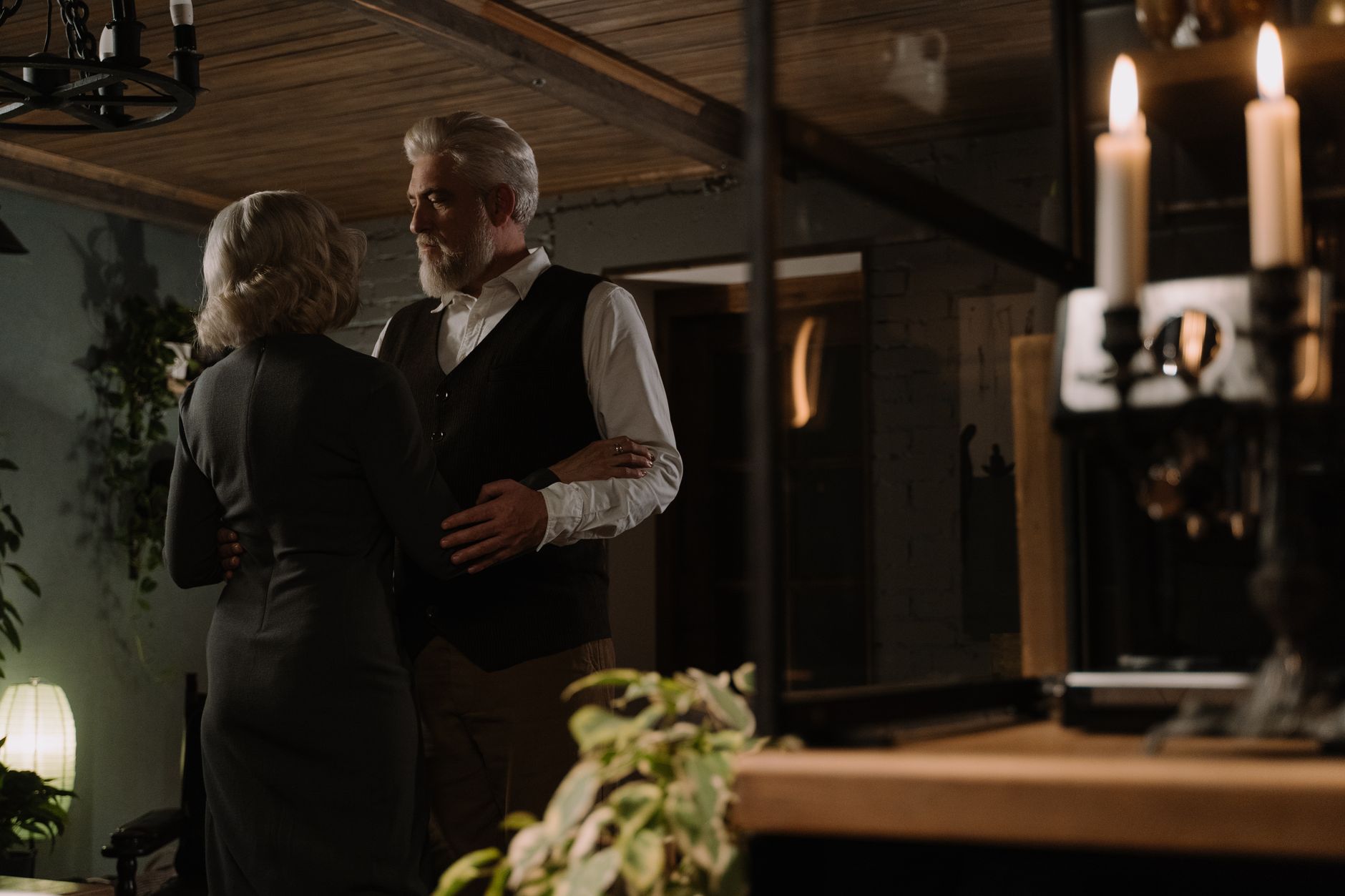
The Last Waltz I Saved for Vonnie
I will tell you what I was holding the spot for. To tell it I have to go back to the summer of 1967.
I was twenty-one that August, with my draft notice folded in my shirt pocket. I was due to report for induction in Kansas City the second week of September. There was a Saturday dance at the old Grange hall on the section road, four miles east of town. The Grange is gone now. There is a soybean field where it stood.
I was not a dancer. Let me say that plainly, since it matters later. I could rebuild a carburetor in the dark. My mother had tried to teach me in the kitchen and gave up when I stepped on her foot in the middle of a polka.
I went that night because I wanted to look at a girl I had seen at Salem Lutheran. She was nineteen, with red-brown hair pinned up in the back, a Gustafson from the Swedish side of the county. Her name was Lavonne. I had spoken to her exactly twice, both times in the church basement, both times about coffee.
I stood against the wall for about two hours.
She came and stood next to me. Just like that. She didn’t ask me anything. She watched the floor, and after a while she said, “You’re going to hold that wall up all night, Loyd Tiemann, or you’re going to dance with me.”
I said I didn’t know how.
“I know,” she said. “I’ve watched you not know how for two hours. It’s very restful.”
Then the band, a country outfit from McPherson with a steel guitar player in a straw hat, started a waltz. It was Waltz Across Texas. It had been out two years then, a slow rolling tune in three-four time, the kind that sounds like a train in no hurry to get anywhere.
She took my right hand and put it on her back. She took my left and held it up at the height of her eyes. Then she said, quietly, so nobody would hear, “Don’t count out loud. Just let me lead.”
So she led. For three minutes and some seconds a nineteen-year-old girl led a clumsy draftee around a plank floor, one two three, one two three, and I did not step on her foot even once. I have never understood it.
When the song ended I did not let go of her hand. I told her I was shipping out in three weeks. She said she knew. It was a small county.
“Then you’ll write,” she said. “And you’ll come home. And when you do, you’ll ask me to dance that one again, and you’ll do it right this time.”
I said I thought I had done it right.
“You did,” she said. “That’s what’s so frightening.”
That was our song. I am not going to tell you it was a famous love song, because it isn’t. It is a plain tune. But it was ours.
I spent thirteen months in Vietnam as a truck mechanic in a motor pool. I fixed trucks and I wrote letters, and she wrote back every week. I have her letters in a Folgers can in the closet, a hundred and four of them, with a rubber band that has rotted through twice.