The Workbench Nobody Was Allowed to Touch
I saw the light at eleven twenty on a Tuesday night in October, a thin yellow line under the garage door, and I stood at the kitchen sink in my socks for a full minute before I let myself understand what I was looking at.
It was not the first time. It was the third. The first two times I went back to bed and lay there listening to my wife breathe, telling myself it was the bulb, or the wiring, or a mouse in the switch.
I am sixty years old. I run the scale house and the grain accounts at the co-op elevator west of Owatonna, Minnesota, and I have never once in my life been afraid of a garage.
But that garage held my father’s workbench, and I had spent four years making sure that nothing in it ever changed.
Let me tell you what I mean by that, because I know how it sounds when I say it out loud.
The bench
My father was Anton Hanzlik, though everybody in town called him Tony. He was a tool and die maker at the tool company on the east side of Owatonna for thirty-eight years.
He made the dies that stamped out parts for other people’s machines. It was work where a thousandth of an inch decided whether you had a good part or a pile of scrap, and it shaped him right down to the bone.
He measured twice and spoke once, and he generally saved the once for the Twins.
The bench stood in the single-car garage behind the little house on Third Avenue where I grew up. He built it himself in 1963, three years before I was born.
The top was seven feet of hard maple, glued up from four-inch strips and planed so flat you could set a marble on it and trust it to stay put.
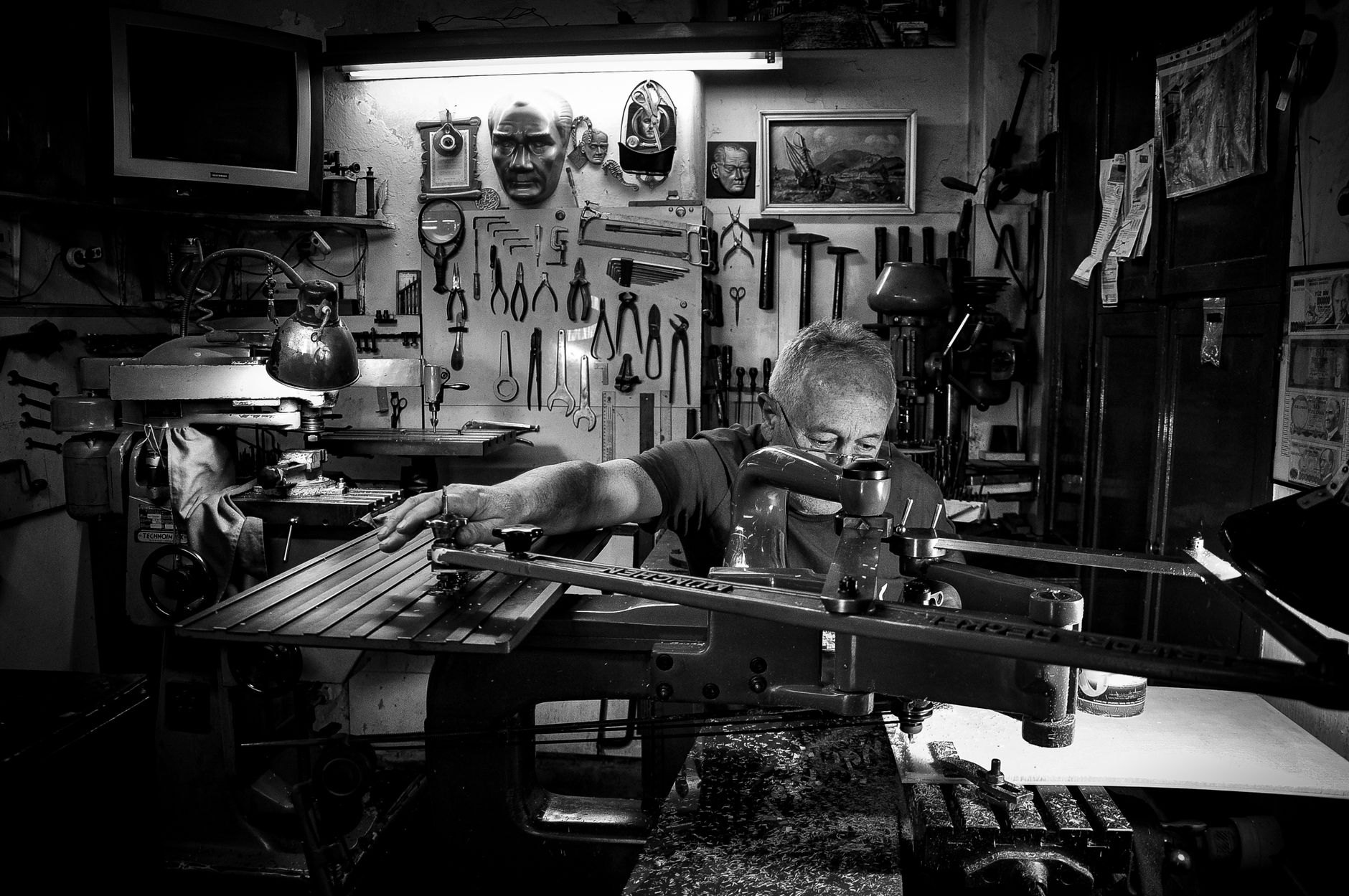
A leg vise on the left end. A row of drawers underneath with brass pulls he had turned on a lathe at work, one at a time, on his lunch hour. And on the wall behind it, a sheet of pegboard.
The pegboard is the part people do not believe until they see it.
My father drew around every tool he owned. With a black marker and a draftsman’s steady hand, he traced the outline of each chisel, each plane, each square and file and hammer onto the board, so that every tool had a shape waiting for it.
Forty-one outlines. If a tool was missing, you could see the black shadow of it from across the garage.
He told people it was so he would never lose a tool. I think it was so he would never lose track of where anything was, himself included.
On the right end of the bench, near the vise, a pair of drugstore reading glasses lay folded on top of a flat carpenter’s pencil. He set them down there on his last afternoon of work, the Friday before the stroke, and nobody ever moved them.