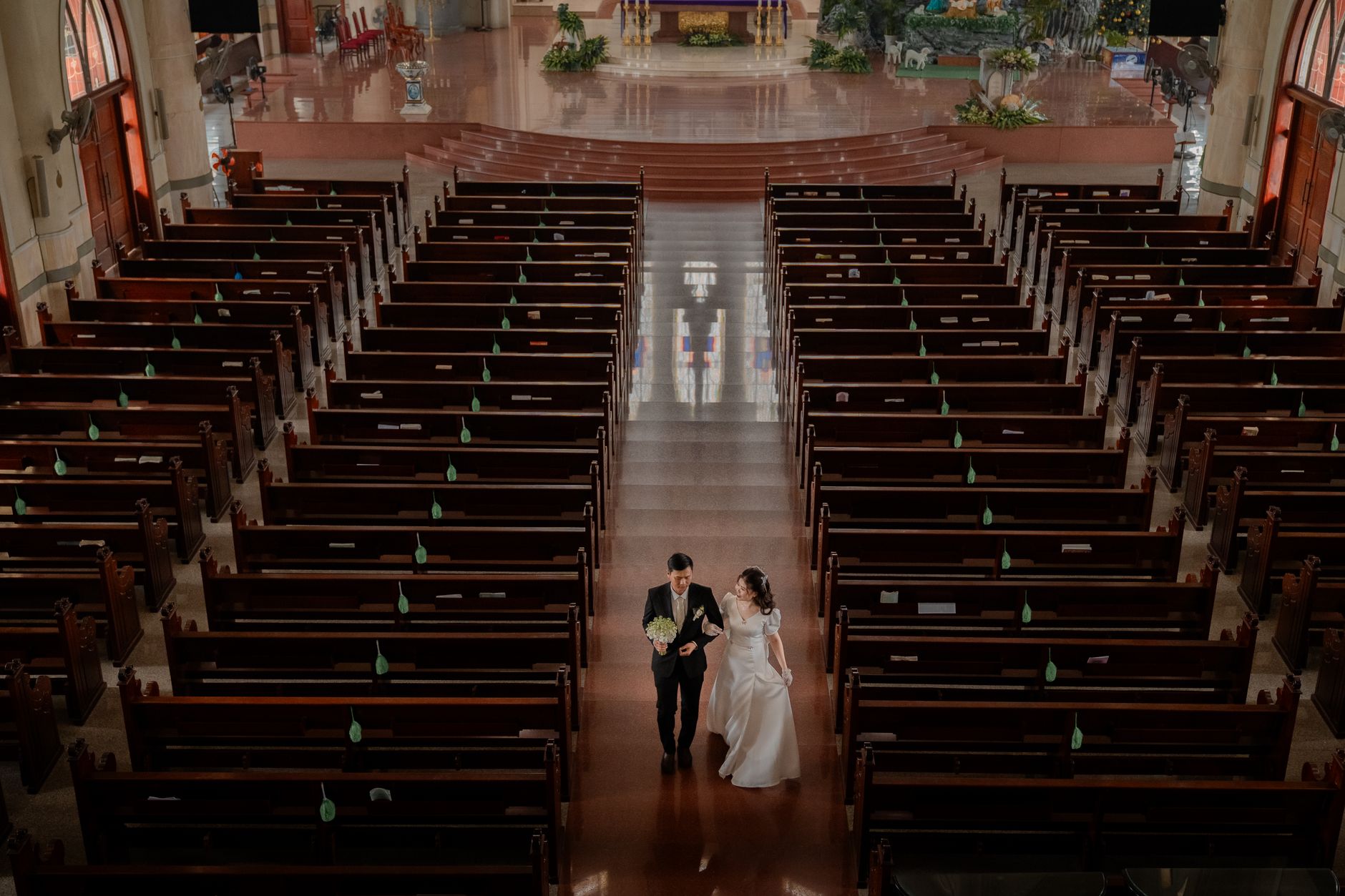
The Day I Set Down My Cane
I thought about the blue saucer by my sink. I thought about my wife’s wet hands. I thought: Well, Lorraine. She could look at you after all.
I did cry then. I am not ashamed of it. An eighty-one-year-old man in the front pew with his hands on his knees, and the tears going down into his collar, and nobody looked.
The reception was in the fellowship hall below the sanctuary, which is how things are done at Bethel. Folding tables with white paper, the church ladies at the long kitchen window. There was ham, scalloped potatoes, three kinds of green bean casserole, deviled eggs, Jell-O salad, and a sheet cake from the grocery in town with Codi and Nate iced on it in blue.
The head table had a white cloth and a mason jar of asters. Bride. Groom. Nate’s parents. Me. And one more chair at the end, beside mine, that Codi had not given to anyone.
I looked at it a while. Then at Codi, who stood three feet off with a cup of lemonade, watching my face.
“Leave it,” she said. “I’m not doing it to hurt her, Grandpa. I want the door open.”
“I wasn’t going to say a word.”
A hundred and sixty people moved around that hall all afternoon with plates in their hands, and nobody sat in it.
People came by my chair one at a time through that afternoon, some with a hand on the shoulder, some with a word. A man whose beans I’d graded for twenty years. A woman whose pickup I’d jump-started in a snowstorm in 1991 and never mentioned since. And a boy of nine in a clip-on tie, who stood in front of me a long moment and said, “Sir, I saw you walk.”
“Did you.”
“It was slow,” he said, very seriously. “But you did it.”
“I did.”
“That’s the best part,” the boy said, and ran off to find his mother.
Near three o’clock, Nate’s father Jeff stood up with a glass of lemonade, because he’s a farmer and has never made a toast in his life, and said three sentences. He said the Becks had never been prouder to take in a daughter. He said he’d asked to walk her and she had said no, and now he understood why. He said it was Elwood’s place and nobody else’s.
I stood up, and I had to hold the table with one hand.
“I don’t have a speech,” I said.
“Good,” somebody called, and they laughed.
“I ran the scale at the elevator thirty-one years. Most everybody in this room has stood on it with a truck full of something and a hope about what it weighed.” More laughter. “I’ll tell you what I learned. A scale doesn’t care what you hoped. It tells you what’s on the truck.”
I looked at Codi.
“That’s all I’ve got. She’s the truest thing that ever came across my scale. Thank you for coming. Eat.”
They applauded for a good while, and I sat down wrung out and about ten feet tall.
Codi came and knelt by my chair. She did not say anything. She leaned her head against my shoulder, her veil falling over my sleeve, and stayed there, with the entire county pretending not to look.
“You forgot your cane,” she whispered.
“I know where it is.”
“Not yet,” I said. “Let me do without it a while.”