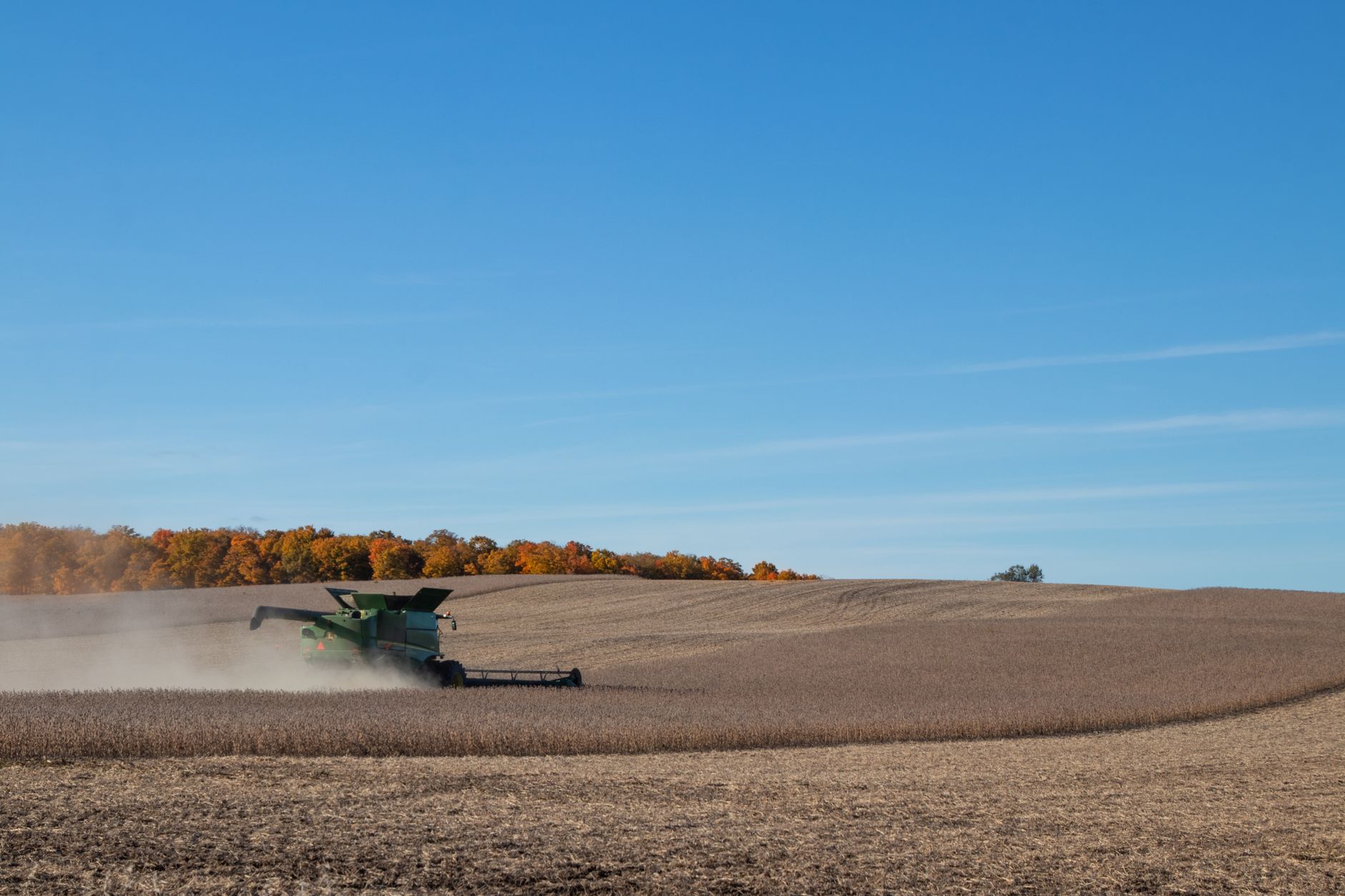
The Empty Seat in Merle’s Combine
Her boots did not reach the pedals. She stared down at them for a second. Then she found the bar that slides the seat forward on its rails and pulled up as far as it would go, and she sat on the front four inches of the sheepskin with her toes on the pedals like a child on a high chair.
Something happened in my chest that I will not try to describe.
“Gram,” she called down. “Can I move the cushion?”
I took a breath. “It’s yours to move.”
She folded the sheepskin in half and put it behind her back. It was the first time in thirty-three years that anything in that cab had been put in a different place.
I did not say a word. I climbed the ladder myself, lowered the little fold-down seat, and sat in it. And from there I watched somebody else drive my husband’s combine.
We practiced for nearly three weeks without cutting a plant.
We drove the old girl, header up, down the field road and along the grass waterways. I taught her to feel how wide the machine was, which is the hardest thing to learn. The header is twenty-five feet wide and rides out in front of you, past where your eye wants to judge it, and there is a fence post at the end of every field that has been waiting its whole life to be hit.
“Don’t look at the post,” I told her. “Look where you want to go. The machine will follow your eyes.”
“That’s what Grandpa told me about the four-wheeler,” she said.
“It’s what he told me about the tractor in 1974.”
She learned the header lever, the tilt switch, and the reel that spins out in front of the knife and sweeps the beans into the cut. She learned to run the reel a hair faster than the ground speed, so it laid the plants gently onto the table instead of whipping them. We practiced the turn at the end of a pass: header up, swing the corner, drop the header, line up on the next swath.
She was bad at it for four days. She hit a cattail clump in the waterway, then a hay bale, then the shed door. Not hard. Hard enough that she climbed down and put her forehead against the cold red side of the combine for a minute.
She did not cry, and she did not swear, and she did not quit. She stood there breathing, and then she climbed back up and said, “Again.” She did it ten times in a row until she could put that header through the shed door with six inches to spare on each side.
The beans came in on the first Saturday of October. They had been drying all week, and the north wind came up Friday afternoon and took out the last of the green. By Saturday morning the pods rattled.
At ten o’clock Abby and I walked out to the north eighty. She picked a pod and shelled it into her palm and bit one of the beans in half, which is how Merle tested moisture, and which I had not seen her do, and which neither of us mentioned.
“It’s too tough yet,” she said.
“The dew is still on,” I said. “You want them near thirteen. Too wet and they heat in the bin. Too dry and the pods shatter on the header and you leave them on the ground.”
We had a little meter Merle bought in 2009. She ran a sample through twice and wrote the number on the back of her hand with a pen. Sixteen at ten o’clock. Fifteen at eleven. At twelve-forty, the little screen read thirteen point two.