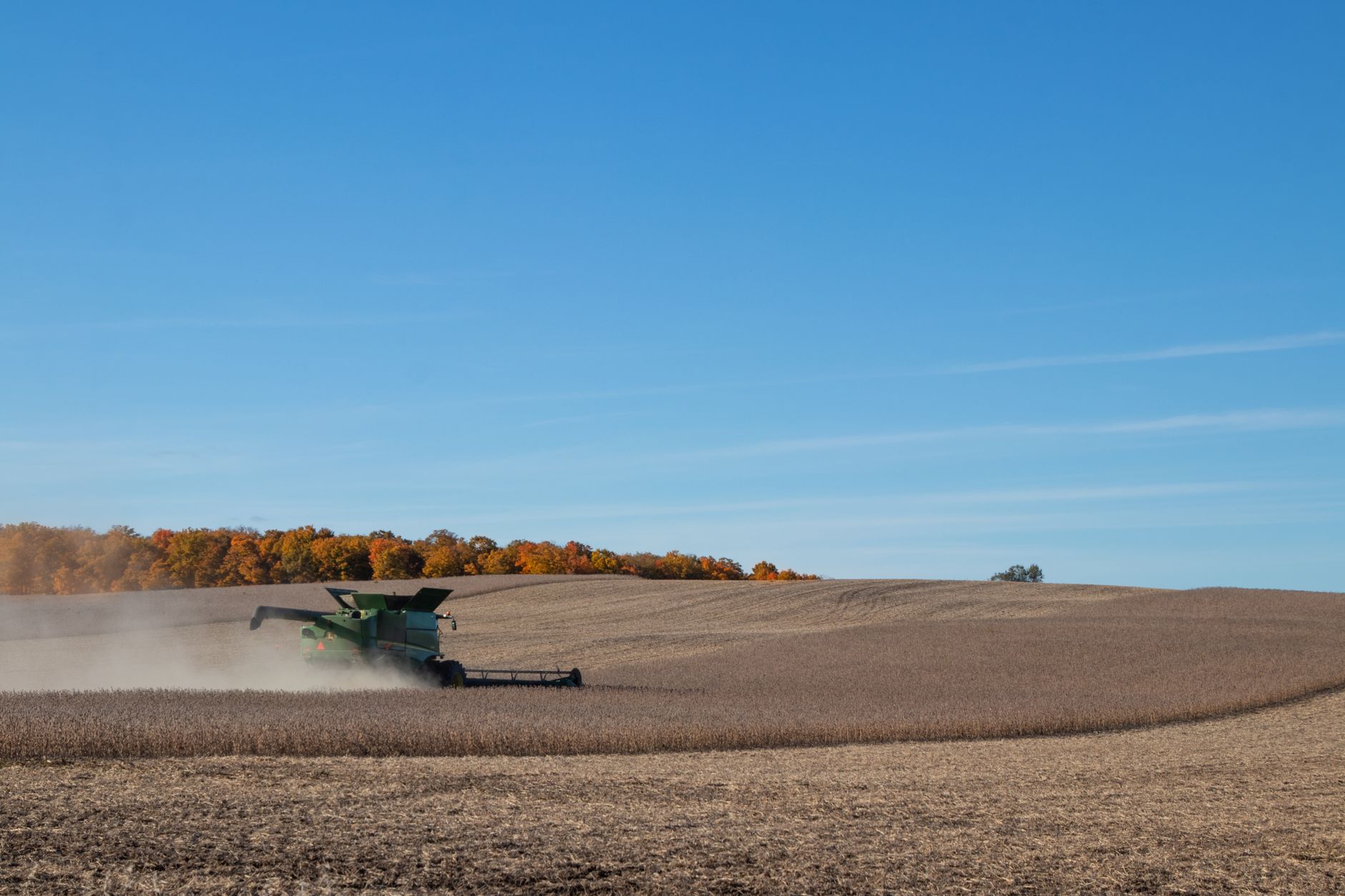
The Empty Seat in Merle’s Combine
The seat in my husband’s combine was gray vinyl, split along the left edge, with a sheepskin cover I sewed for it in the winter of 1994. By the first Saturday of September, four weeks after we buried him, it still held the shape of him.
I know because I went out to the machine shed that evening and stood on the third rung of the ladder and looked at it for the better part of an hour.
Our farm is 320 acres, ten miles northeast of Aberdeen, South Dakota, just outside a town called Tolstad that has an elevator, a Lutheran church, a bar, and a post office that closes for lunch. Merle’s father bought the home place in 1951. Merle took it over in 1972, and I married him two years later, when I was twenty-one.
The combine was a red Case International 2188 that Merle bought used in 1993 from a man near Frederick who was retiring. Thirty-three harvests it had cut for us. He called it “the old girl” to her face and a few other things behind her back when she plugged.
Every fall of those thirty-three, I rode in the little fold-down seat beside him with a thermos between my feet. I rode there when we were young and fighting about money. I rode there when Kurt was a baby and slept in a laundry basket on the cab floor. I rode there last fall, when Merle’s hands were already starting to shake on the wheel and neither of us said so.
I knew every sound that machine made. I had never wanted to sit in the other seat. Not since 1998, anyway.
That Saturday in the shed, I understood that I was going to have to.
Merle was diagnosed in March. Pancreatic cancer, which is the one you do not want, and the doctor in Aberdeen was kind enough not to dress it up. He said “months” and he said it looking at Merle, not at me, which I have thought about since. He understood that Merle would be the one who needed to hear it plain.
We drove home along the county road with the winter wheat just greening up in the ditches. Merle did not say anything for eleven miles. Then he said, “Well, I’d better get the planter ready.”
So that is what he did.
He planted the last crop of his life that spring on borrowed strength. Beans on the north eighty and the east eighty, corn on the home eighty and the south eighty. Kurt took a week of vacation from the co-op and ran the tractor while his father rode in the cab beside him, giving directions nobody needed. Dwight Fosheim, our neighbor to the west, sent his hired man over with the drill without being asked and without sending a bill.
By July, Merle weighed about what I did.
On the twelfth of July, a Sunday, he went out to the machine shed after church and spent the whole afternoon greasing the combine. I watched from the kitchen window. Every zerk, every bearing, the feeder house chain, the header drive. He sat down on an upturned pail between each one. He changed the knife sections on the platform and checked every belt.
I did not go out and tell him to quit. I want that written down somewhere. I stood at the sink with my hands in cold dishwater and let him get ready for a harvest we both knew he would not see.