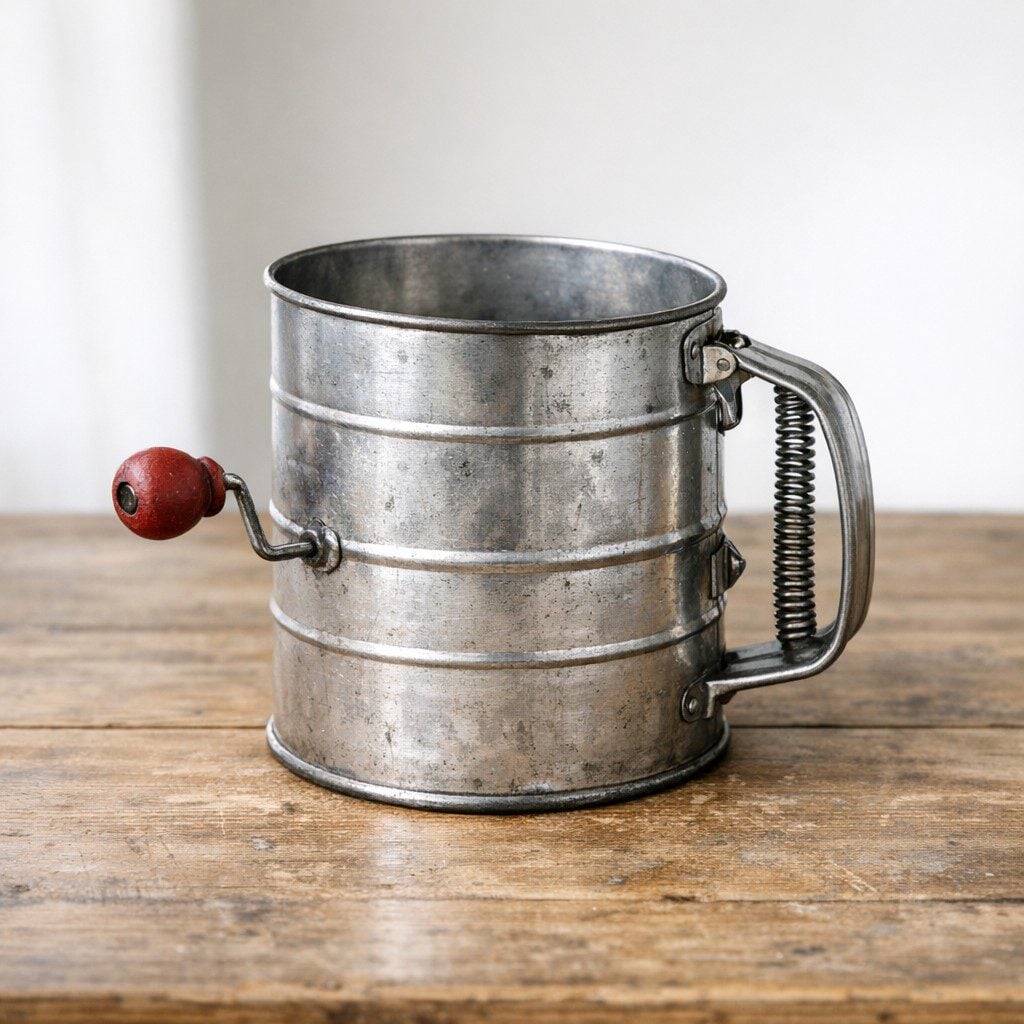
The Flour Sifter They Left Me
The blue ribbon, again
The county fair still runs the third week of every August, the same as it has since before I was born, out at the fairgrounds with the tractor pull and the 4-H rabbits and the quilts hung up in the exhibition barn and, in the corner, the baked goods on long white tables under the fluorescent lights.
I had never put my own name on a fair card. I had helped Della enter in her last years, carrying her pies in when her hands could not be trusted to carry them, but never my own name. That August, the second summer of the stand, I decided it was time.
I was not calm about it. I was sixty years old and my hands shook that morning like a girl’s, and I made three crusts and threw two out because they were not hers, and the third one I felt come together under my hands the way a thing comes together when you have stopped trying and started paying attention, and I knew before I rolled it out that it was the one. Sour cream raisin. Her pie. Sifted three times through her sifter with my thumb in the worn place, at four in the morning with the radio off and the window open to the crickets.
I carried it to the fairgrounds and filled out the card, and where it said name I wrote Ruth Ann Calloway, and then I added under it, in smaller letters, “Della Hartley’s recipe.” Because it was. Because she should be on that card. Because I would not let anybody think I had done it alone.
They judge the pies behind a curtain, and you are not allowed to watch, which is a mercy. I walked the exhibition barn twice and looked at quilts I did not see and rabbits I do not remember, and when they opened the curtain I made myself walk slow, and I came around the end of the long white table, and there on my pie, tucked under the edge of the plate, was a ribbon.
It was blue.
I did not jump up and down. I did not cry, not right away. I stood there in that hot barn with the fluorescent lights buzzing and the smell of straw and other people’s pies, and I looked at that blue ribbon on Della Hartley’s crust with my name and her name on the card, and I felt her there, the way you feel somebody standing just behind your shoulder, the way I used to feel her in the kitchen saying “There, you see, your hands remember.” And I said, quiet enough that nobody heard me over the noise, “There. You see. I kept it.”
And then I cried, a little, and Charlene Buford, who was a judge that year and is not supposed to tell but told me anyway, said the vote had not even been close.
What I built with a sifter and a name
That was five years ago now. I am sixty-two, and I want to tell you where it all ended up, because you deserve a finished story and not a cliffhanger, and because I promised myself when this started that I would see it all the way through, the way Della saw a pie all the way to gold and not one minute past.
Hartley’s is a real thing now. Not a table at a market anymore, though I still do the market on Saturdays in summer because I like the people and the light. There is a little shop now, on the main street of my town, in the storefront that used to be the Rexall drug, and it has HARTLEY’S painted on the window in the same red as a county-fair ribbon, and it is not fancy and never will be. Pies in the case. Biscuits in the morning, sold by the half dozen in a wax-paper sleeve, gone by ten most days. Bread on Fridays. A pot of coffee that anybody can have for free if they are old enough to remember Della, which is my own rule and I do not explain it to the young ones.
I have two women who work with me, and here is the part I am proudest of. I am teaching them the crust. Not out of a book. The way Della taught me, one piece at a time, over years, watching their hands, saying “not like that, like this” about four hundred times a year, testing whether they will keep coming back. One of them, a young woman named Kayla with a baby at home and a hard road behind her, has the hands for it. She does not know yet how good she is going to be, the way I did not know at nine. But I know. And someday, when my hands get unsteady, the crust will move out of my hands and into hers, and it will not die with me any more than it died with Della, because that is the whole point of a thing like this. It is not supposed to be a secret. It is supposed to be a chain.
The sifter sits on a shelf behind the counter, up on a little wooden stand I made, next to the photograph of Della young and unsmiling with her ribbon, which I got back, but I will tell you how in a minute. Every crust that comes out of that shop goes through that sifter first. Every one. I have a modern one too, for when the tin one is being wiped, but the tin one does the work that matters, and I keep my thumb in the worn place, and the dark seam of my great-grandmother’s flour is still ground into the joint where the screen meets the wall, and I have never once washed it.