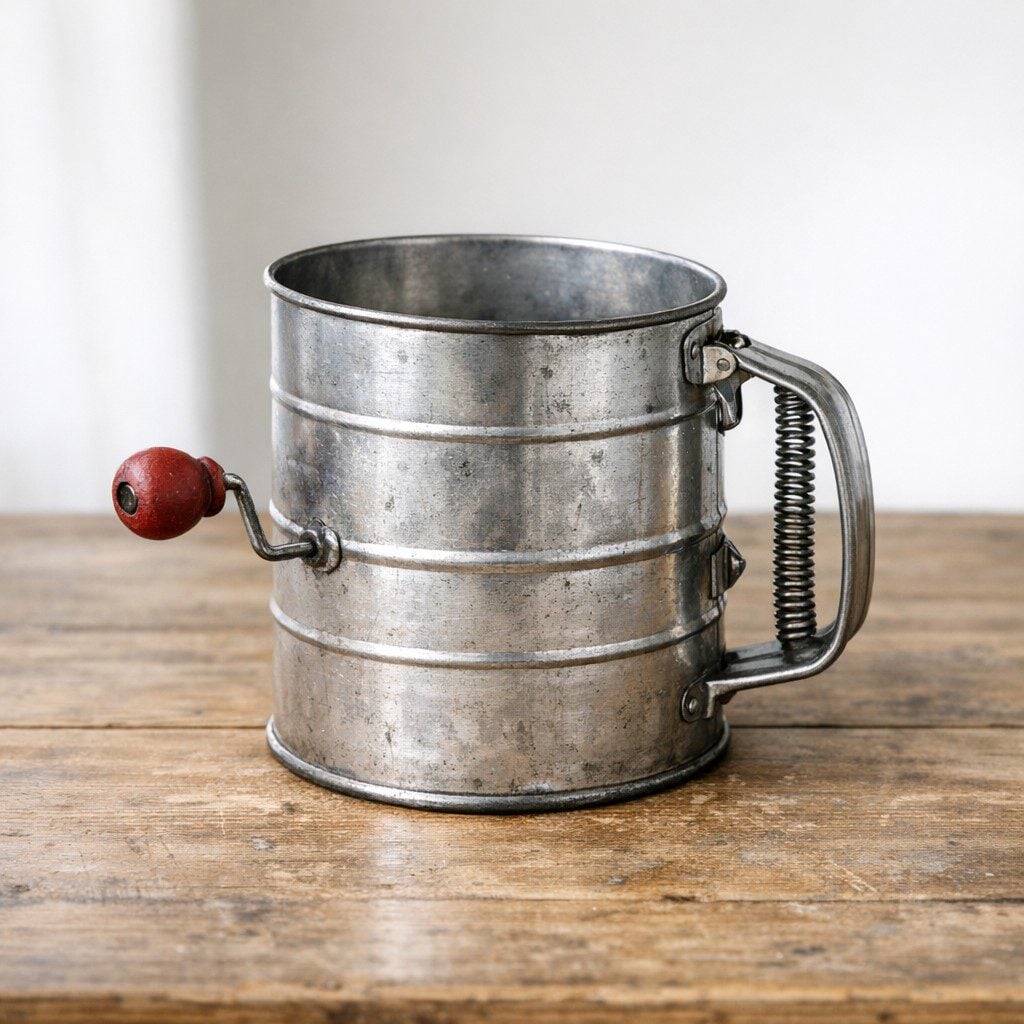
The Flour Sifter They Left Me
Driving home with a tin sifter on the seat beside me
I did not cry in the office. I want that on the record. I said thank you to Prewitt, who was the only one in the room who had been kind, and I put on my coat and walked out to my truck and set that little cardboard box on the passenger seat like it was riding shotgun, and I drove.
It is about forty minutes home from the county seat, most of it two-lane, past the Berger place and the old Lindquist dairy that went under in the eighties and the long stretch of nothing where the corn had already been cut and the fields lay stubbled and brown. And somewhere out on that road, past the point where anybody could see me, I did cry. I cried the way you cry when the grief and the insult get tangled together and you cannot tell one from the other anymore. I cried because she was gone, and because they had laughed, and because for one ugly minute I believed them, I believed that all I had ever been to that family was the help.
And then I pulled over onto the gravel shoulder, because I could not see the road, and I unwrapped the newspaper with my hands still shaking, and I held the sifter.
I had held it a thousand times but I had never really looked at it. It was a Bromwell’s, the kind they made before the war, a straight tin cylinder about the size of a big coffee can, with a fine mesh screen in the bottom and a curved crank handle that turned a wire agitator to push the flour through. The tin was dull silver, dinged and dented, with a dark seam of old flour ground permanently into the joint where the screen met the wall, flour that had been my great-grandmother’s and my grandmother’s, that no amount of washing would ever get out, and that Della said you were not supposed to try to get out, because a sifter should never be washed, only wiped, or you would rust the screen and ruin the season of it.
The handle had been painted red once, county-fair red, and it had worn down to bare wood where her thumb had ridden it. Right there was the shape of her hand. Fifty years of the same thumb in the same place had worn a smooth pale hollow into that wood, and when I put my own thumb there it fit, because my thumb had learned to ride where hers rode. I sat on the side of the road and held the one thing in the world that fit my grandmother’s hand and my own both, and I stopped feeling like the help and started feeling something else. I could not have named it yet. But it was the beginning of the rest of my life.