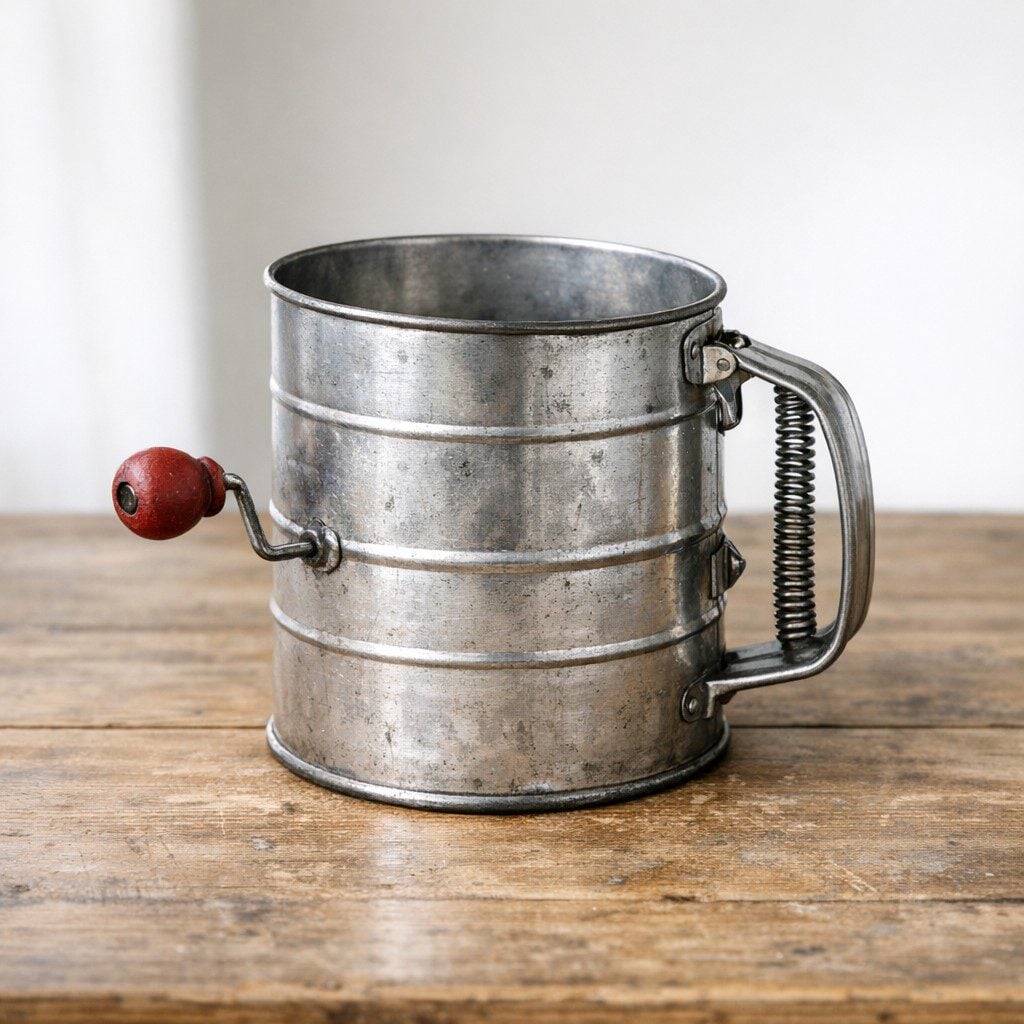
The Flour Sifter They Left Me
What my grandmother’s hands knew
Della Hartley could bake. That is the plainest way to say it, and it does not begin to say it. She could feel when a biscuit dough had been worked one turn too many, the way a mechanic can hear a bearing about to go. She knew the exact minute to pull a pie so the crust went to gold and stopped there, and she never once owned a timer that worked. She kept her lard cold and her hands colder, running her wrists under the pump water in summer so the fat would not melt into the flour before its time. She sifted her flour three times for a cake and once for biscuits, always by hand, always with that same red-handled sifter, and if you asked her why she did not just buy the pre-sifted kind at the IGA she would look at you like you had asked why she did not marry a stranger off the highway.
“Sifting is not about the lumps,” she told me once. I could not have been more than nine. “Sifting is about paying attention. You cannot rush a thing you are paying attention to.”
I did not understand that for forty years. Now I understand it better than almost anything.
Her pie crust was the thing people talked about. In 1971, before I was even born, she had taken the blue ribbon at the county fair for a sour cream raisin pie, and she took it again in 1972, and 1974, and by 1978 the fair board had quietly stopped entering her in the open division and started asking her to judge it instead, because nobody else could win as long as she competed. There was a photograph of her from one of those years, a young woman with her hair pinned up and flour on her apron, holding a pie and a ribbon and not quite smiling, because Della never trusted a camera. That photo hung in her kitchen my whole life.
The crust was a secret, and she guarded it like the recipe was the last of its kind, which in a way it was. It was not written down. She had learned it from her own mother, who had learned it in a soddy in Kansas from a woman who came over from the old country, and Della had changed it over the years the way you change a thing you actually use, a little less sugar here, a splash of cider vinegar there, a trick with the water temperature that she would not explain to a living soul.
Except me.
She taught it to me over about fifteen years, one piece at a time, never all at once, testing whether I would keep coming back. She would let me do the sifting while she watched my hands, let me cut the fat in while she corrected my wrist, saying “Not like that, like this” about four hundred times a year, and slowly the thing moved out of her hands and into mine. By the time she was in her eighties and her own hands had gotten unsteady, I was the one rolling out the crust at Thanksgiving, and she would stand behind me and say, “There. You see. Your hands remember even when your head forgets.”
None of the others ever learned. Denise did not bake. Brett did not bake. Aunt Carol bought her pies from the Walmart in a plastic clamshell and put them in her own dishes before the church potluck so nobody would know. This is not me being cruel. It is a fact, and it matters, because it means that when Della died, there was exactly one person alive who could make her crust, and that person was sitting in Prewitt’s office in her good coat, waiting to find out that she had been made a fool of.