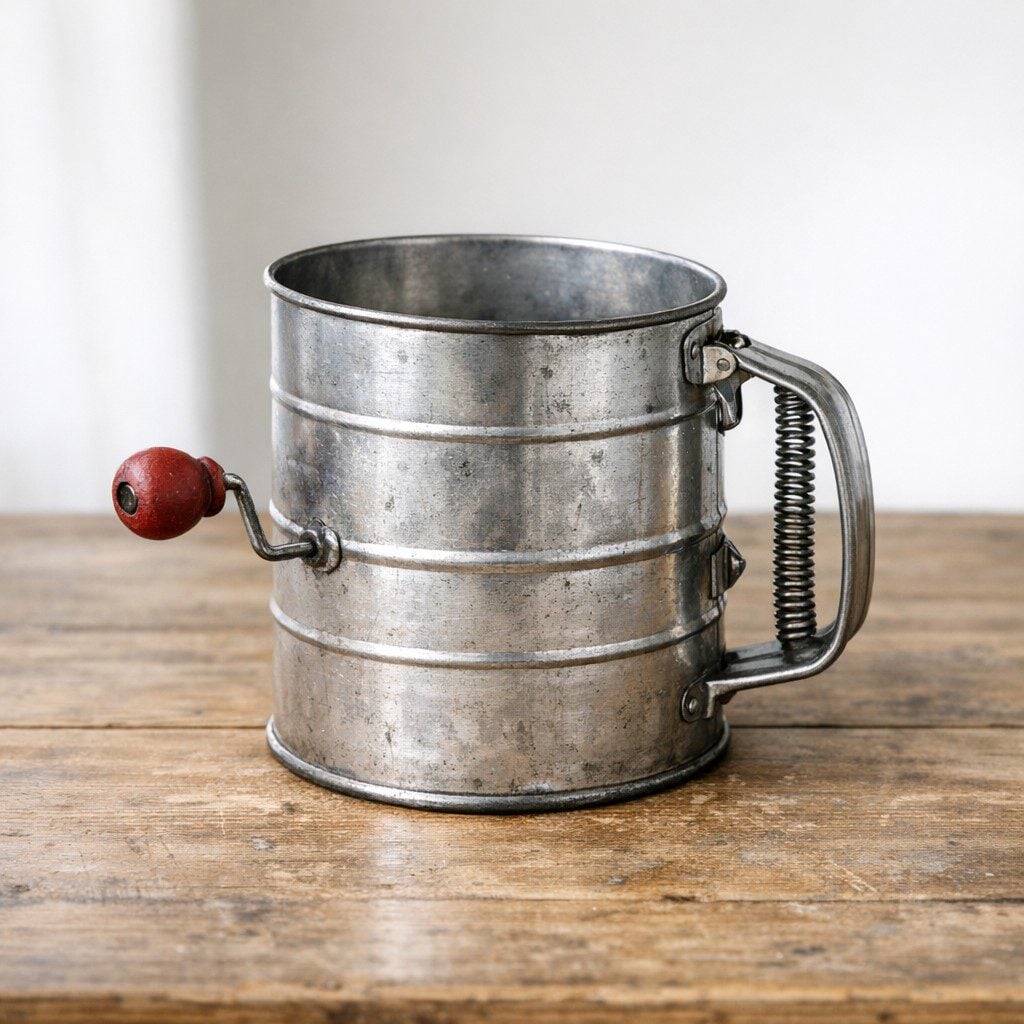
The Flour Sifter They Left Me
The initials under the crank
It was that night, at my own kitchen table, that I found it.
I had brought the sifter inside and set it on the table under the good light because I wanted to look at it properly, the way you look at a photograph of someone after a funeral, trying to keep them a little longer. I turned it over in my hands. And on the underside of the tin base, in the shallow curve of metal where the screen was crimped in, somebody had scratched something with the point of a knife or a nail, long ago, the letters gone dark with age.
D M H. And under that, R A C. And under that, one word. MINE.
Della Mae Hartley. Ruth Ann Calloway. My initials scratched under hers, on the bottom of a flour sifter, where nobody would ever look unless they cared enough to turn the thing over. She had done it herself. I knew her hand even in three scratched letters. She had marked this thing for me, deliberately, sometime in the last years, when her fingers could barely hold a pen but could still hold a nail long enough to say the one thing she wanted said.
I understood it then, all at once, sitting alone at my table. She had not forgotten me. She had left the others the money and the land and the china because that was all any of them could see, a pile of things that would be gone in a few years the way things always go. And she had left me the one object in that house worth more than all of it put together, because I was the only person alive who knew what to do with it. She had not left me a sifter. She had left me the work. She had left me her whole life’s skill in a form the others were too blind to even want, and trusted me to know the difference.
That word. MINE. I think she meant it two ways. The sifter was hers. And it was mine now. And I think, if I am honest, she meant a third thing too, the thing she could never have said out loud in front of Aunt Carol and the others. She meant: of all of them, you were mine.
I did not cry again that night. I had done my crying on the road. Instead I got up and found the flour and made a batch of biscuits at nine o’clock at night, sifting through her sifter with my thumb in the worn place, and I ate two of them hot with butter standing over the sink, and I want to tell you they were the best biscuits I have made in my life, and I do not think that is grief talking. I think my hands finally knew whose they were.
The winter I decided not to be small about it
Now, I could have stopped there. I could have kept that sifter on a shelf and been quietly proud and let the family go on thinking they had won. My husband Merle, God rest him, had passed four years before, and I was alone in the house with a good pension from thirty years at the school cafeteria and no need to prove anything to anybody. I could have been a woman with a secret and a sifter and left it at that.
But something had woken up in me on that gravel road, and it would not go back to sleep. I kept thinking about that photograph of her young and unsmiling with her ribbon, and how the whole county still talked about her pie thirty years after she had stopped baking it for anybody but family. And I kept thinking, with a slow, warming anger that surprised me: I am the only person on this earth who knows how to make that pie. And they left me the sifter as a joke.
Well. All right. I would take the joke and I would make it mean something.
It started small. That December the church was doing its Christmas bake sale to raise money for the roof, which had been leaking over the choir loft for two years, and I signed up to bring pies. I made six of them, the sour cream raisin, Della’s crust, and I did not tell anybody whose recipe it was. I did not have to. They sold out in eleven minutes. Charlene Buford, who runs the sale every year and has forgotten more about baking than most people ever learn, found me at the coffee urn and took my hand and said, “Ruth Ann, where in the world did you get this crust. I have not had a crust like this since Della Hartley.”
And I said, “It is Della Hartley’s.”
Charlene got tears in her eyes, right there by the coffee, and said, “Well thank the Lord somebody kept it. I thought it went in the ground with her.”
I did not sleep much that night. Not from grief. From an idea.