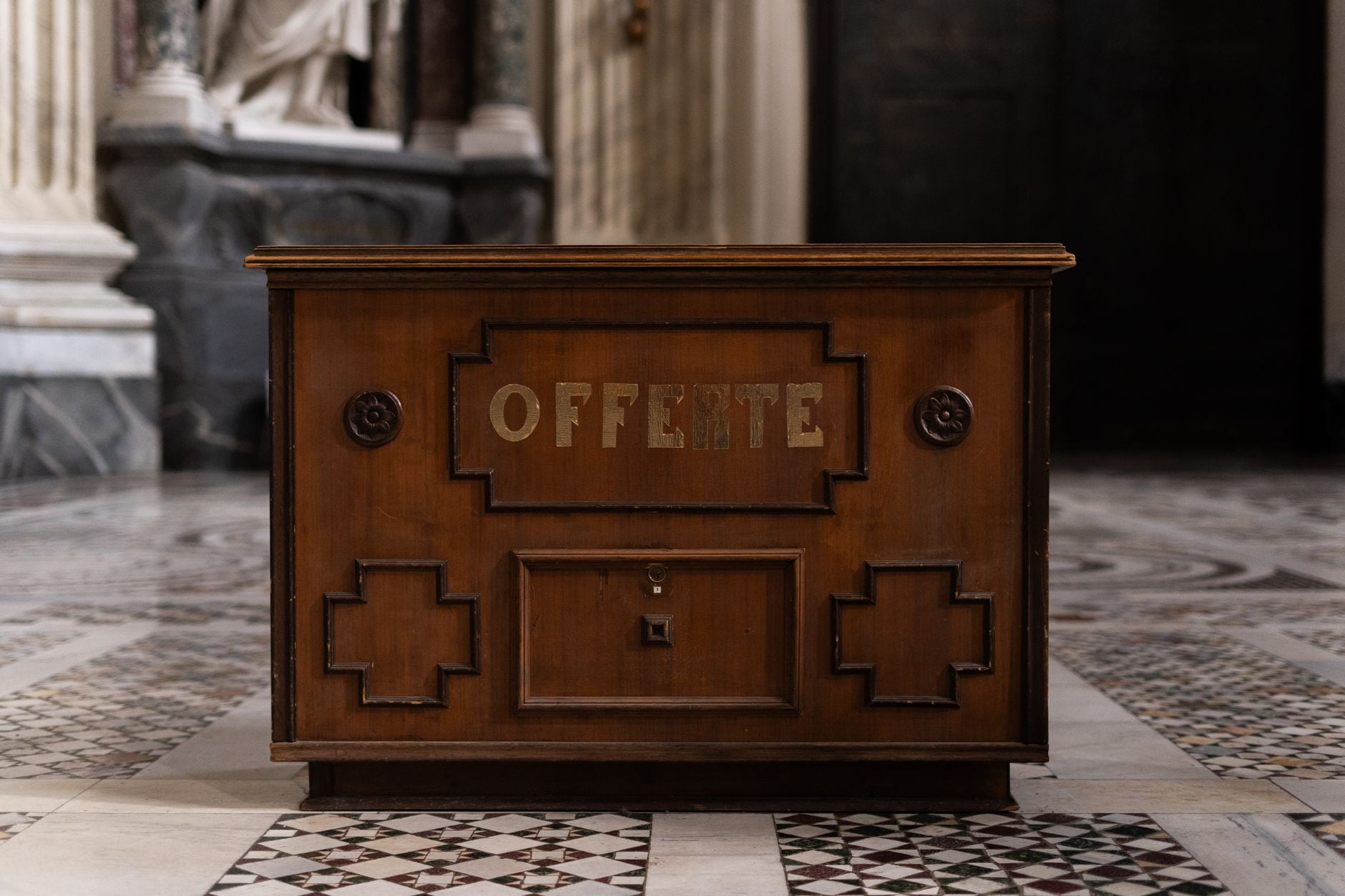
Thirty Christmas Eves in the Poor Box
Father Ted met me in the sacristy at ten minutes till seven with a cigar box under his arm and a look on his face I had only seen once before, at the funeral home, when he stood over my father and said out loud, to nobody, “Well, Bert.”
“Sit down, Dale,” he said now.
I sat on a folding chair beside the rack of green and white vestments. Through the wall I could hear the church filling up for the seven o’clock, which is the late Mass in our parish, since the family Mass is at four. Boots on the old oak floor. Somebody’s baby fussing. Mrs. Pfeiffer working through the first bars of “O Come, O Come, Emmanuel” on the organ, the same two bars over and over, because she had never once in forty years trusted herself on the third.
My father had been dead thirty-five days.
Father Ted set the cigar box on the counter by the sink where he rinsed the chalice. It was a Roi-Tan box, the kind my grandfather used to keep nails in, and it was gone soft at the corners from being handled. He did not open it. He rested one hand flat on the lid, the way you rest a hand on a dog that is thinking about getting up.
“I want to tell you how I came to have this,” he said, “and I want you to let me get through it. Can you do that?”
“Yes, Father.”
“You’ve got his habit of saying yes when you mean not yet.”
That nearly got a laugh out of me. It was the first near-laugh in five weeks.
I am Dale Rasmussen. I am fifty-five, and I drive a propane bobtail for the co-op in Tabor Creek, Nebraska, a town of four hundred and eleven people. My wife Karen works the day shift at the nursing home. I was raised four miles north of town on a cow-calf and corn place, and my father, Bert Rasmussen, ran it for sixty years and was not once, to my knowledge, late on a note or short on his word.
He was a man who paid. When I was nine I took a pack of Juicy Fruit off the counter at the Cenex, and he drove me back to town that same night and stood behind me while I put a quarter on the counter and told Mrs. Jennings what I had done. He did not yell. At the yard gate he said, “Now it’s done,” and that was the entire sermon, and I have not taken so much as a paper clip since.
“Your father came to see me in the hospital,” Father Ted said. “At Norfolk. The Sunday before he passed.”
“I was there that Sunday.”
“You went down for coffee.”
I had. The machine ate my dollar. We had been up two nights, and my father had been in that bed nine days with his heart. I came back up with two cups and found Father Ted in the chair by the window, and Dad awake, which he had not been all day, and neither of them saying a word.
“That’s when he asked me,” Father Ted said. “He asked me to hold something for you until Christmas Eve. Not before. He was particular. He said he wanted you to have a month without him first, that you’d ask him a hundred questions if you knew while he was still breathing, and he didn’t have a hundred answers in him.”