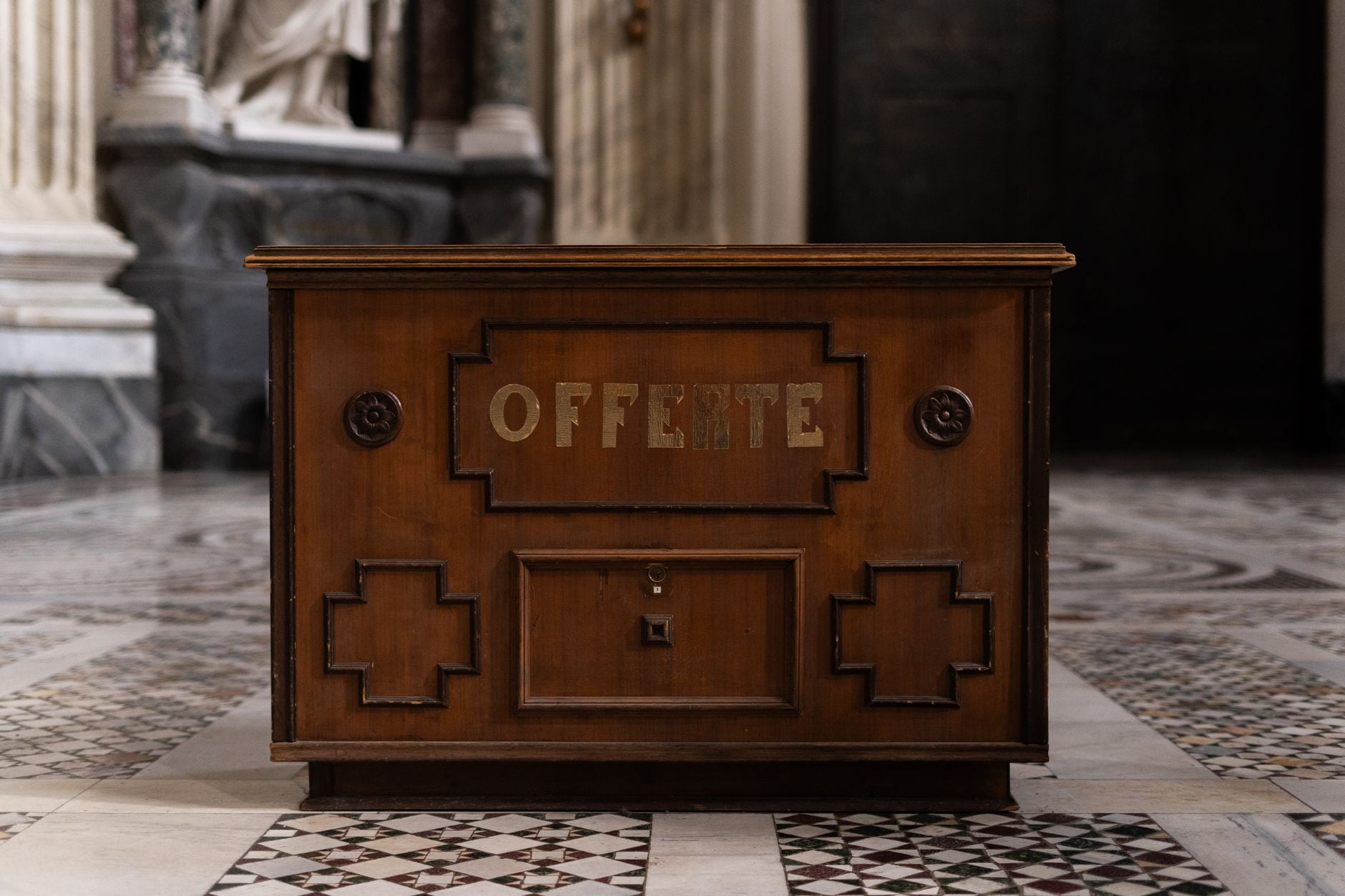
Thirty Christmas Eves in the Poor Box
“That was the week he decided he was done owing,” said Father Ted. “He’d owed somebody all his life, and now, for the first time, he had something extra. I think it was the first twenty dollars he had ever had that wasn’t already spoken for. And he came to this church on Christmas Eve and put it in the box.”
“But the box was whole. Didn’t you tell him he could quit?”
“I told him the second year.” Father Ted let out a breath. “I caught him in the vestibule that night, after the others went down for coffee. I said, ‘Bert, I know what the twenty is for. The box was made whole in 1952. You owe the parish nothing.'”
“What did he say?”
Father Ted looked at the slip in my hand, and he did not look at me when he said it.
“He didn’t say anything for a good while. Then he said, ‘I know it, Ted. It was never the box.’ And I said, ‘Who, then?’ And he said, ‘The man who drove four miles of drifted road on chains for a boy with a handful of nickels. And I can’t find him. Vandiver is thirty years in the ground, and his people left the county. So I’ll pay it where it’ll do what he did.’ And then he said, ‘Just keep taking it, Ted. Put it where it’ll reach a boy at somebody’s door.'”
“I did,” Father Ted said quietly. “Thirty Christmas mornings I counted that box alone in the church, and I put his twenty with the St. Vincent de Paul money. That is where the coal fund comes from, and the grocery cards the Altar Society hands out at the back door in January. A woman out on County Road 14 had her furnace fixed one winter on his twenty and part of somebody else’s. A boy at the school got his glasses. I will not tell you every one. And he told me, in that hospital room, ‘Ted, you kept your mouth shut when you were ten, and I knew it, and I have been grateful my whole life.'”
“You never told him it was all right,” I said.
“I tried. In ninety-five. In two thousand, when his wife Ramona was sick. In two thousand nineteen, at her funeral. He would nod. He would say, ‘I know what I owe, Ted.’ And the next Christmas, there it was.”
I held up the slip. “It was never about three dollars.”
“No.” Father Ted touched my sleeve. “You don’t pay back the kind of thing he was given, Dale. You just keep a little of it moving.”
There was a knock on the sacristy door. The altar server, a seventh-grader named Jared Gifford, put his head in with eyes as big as saucers and said it was time, Father, the people were all in.
Father Ted stood up. His knees cracked like kindling.
“There is one more thing,” he said, “and then I have to say Mass. And then you do what you decide to do.”
He took out the flattened barn card from the bottom of the cigar box and gave it to me. I opened it. I knew the handwriting before I saw a word of it, because it was the hand that had signed every report card and every permission slip of my childhood, and it was not the pencil this time. It was blue ink, a little shaky. Written that last Sunday, in the hospital, in Father Ted’s cheap ballpoint.