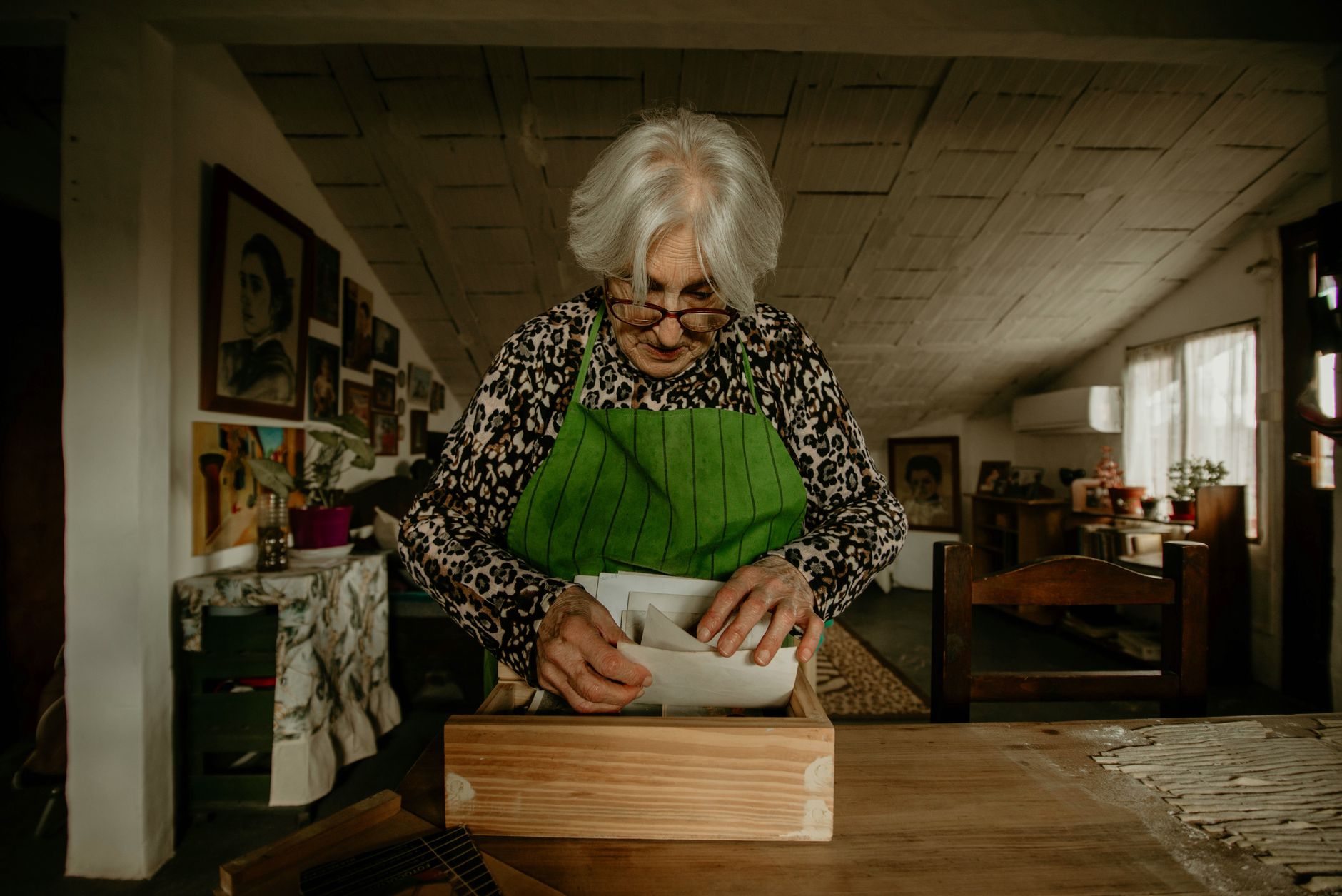
The Recipe Box That Came Back
The man on my porch was holding my mother’s recipe box in both hands, level, the way you carry a full cup of coffee across a church basement.
I knew the box before I knew the man.
Walnut, about the size of a loaf pan, the brass hook on the front gone dull. A pale ring burned into the lid where somebody in 1974 had set down a hot skillet. My father made it the winter he married her. He cut the joints by hand and never got the lid to sit quite flat, and my mother always said that was why she trusted it. Nothing perfect, she said, ever fed anybody.
The last time I had seen it was on the shelf above her stove on a Saturday in August. I had not seen it since.
“Mrs. Teague?” the man said.
“Marlene,” I said. My voice came out sounding like somebody else’s.
He was seventy or a little past, thin as a fence post, in a pressed khaki shirt buttoned to the collar. He had taken off his ball cap and was holding it against his belt buckle with one thumb, which is hard to do while you are also carrying a box. His right forearm was browner than his left. I knew that tan. Rural mail carriers get it from twenty-eight years of driving a route from the wrong side of the car with the window down.
“Calvin Stoddard,” he said. “I live over on Mill Street. You don’t know me.”
“No,” I said. “I don’t.”
“I believe this is yours.”
Behind me the screen door creaked. Dean had come out of the kitchen with a dish towel over his shoulder, and he stopped there with one hand on the frame and did not say a word. In thirty-eight years of marriage my husband has learned exactly when to stand still.
I put out my hands. The box was heavier than I remembered. Cards weigh more than you would think.
“It’s all there,” Calvin said. “I counted. Two hundred and eleven. Your mother had them in the order she wanted, and I put them back the way I found them.”
“Where did you…”
“The Methodist shop. Saturday the twenty-first of August. Three dollars.” He turned the cap a quarter turn in his hand. “I didn’t know whose it was when I bought it. I want you to understand that. I would have walked it back the same afternoon.”
I was standing on my own porch in my stocking feet holding the one thing I had spent most of a month pretending I had not lost.
I need to tell you how it got to the Methodist shop, because I have never told it to anybody who did not already know, and it does not make me look good.
My mother was Norma Kimmel. She raised two girls in a farmhouse outside Garner Mills, in the south of Iowa, where the roads run straight for a mile and then do something sudden around a creek. I am the older one. My sister Jodi is three years behind me and lives in Springfield, Missouri, a good five hours down Highway 65 if the trucks are kind.
For four years Jodi and I had not spoken. Not really. We spoke the way two people speak across a casket, in short sentences with the nouns left out.