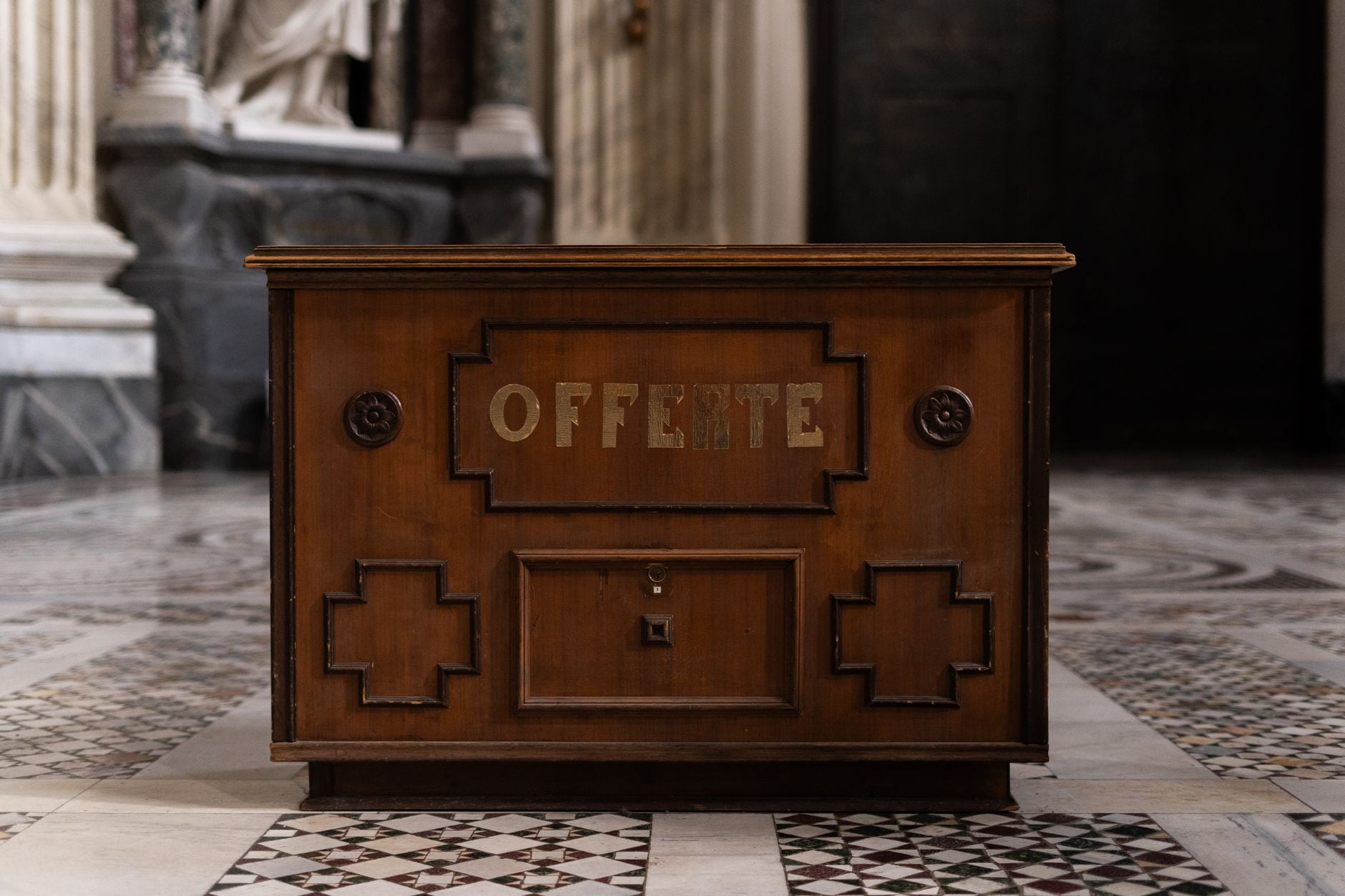
Thirty Christmas Eves in the Poor Box
“What something?”
Father Ted took his hand off the box and lifted the lid.
Inside were small folded slips of paper, held in bundles of ten with rubber bands gone brittle and yellow. Three bundles. Under them, in the bottom of the box, lay a flattened Christmas card with a barn on the front, and I had no idea why it was there.
“Thirty,” Father Ted said. “I counted them again this morning, in case I had been wrong all these years. I was not.”
“Thirty what?”
“Dale.” He reached into the pocket of his black cardigan, the one with the leather elbows. “Do you have something in your coat?”
I did. I had been carrying it for thirty-five days, and I had not told Karen, and I had not told my sister Thelma, who had driven up from Omaha for the funeral and gone home the next day.
When the funeral home gave back my father’s things, they gave them to me in a brown paper sack, the way they do. His watch, a Timex he had worn on the inside of his wrist since 1971 so the crystal would not catch on the fence wire. His billfold. His rosary, which I had not known he carried. His reading glasses with one earpiece mended in black electrical tape. And from the inside pocket of his good brown suit, which the funeral home had emptied before they dressed him, a plain white envelope, sealed, no stamp.
On the front, in his square carpenter’s-pencil hand, two words. Poor Box.
I took it out and laid it on the counter beside the cigar box. It looked small there. It looked like what it was, which was something a man had meant to do on a particular night and had run out of time.
“Thirty-one,” he said.
“Every year, Dale, the same night. Your father put an envelope in the poor box at the back of this church. Every Christmas Eve since 1994. I know because I empty that box myself, on Christmas morning, and have since I came back to this parish in 1987. The first year I found it I thought somebody was being careful about their name, putting it in an envelope. There was twenty dollars in it, and a little slip of paper folded once. I read the slip, and I knew whose it was before I got to the end of the line. I did not say a word.”
“But you knew.”
“I knew. The second year I made sure. I stood where the box is, in the back, after the late Mass, and watched who went by it. You and Ramona and your sister were downstairs in the hall getting coffee and a kolache from the Altar Society ladies. And your father said, ‘Going to start the truck.'”
I felt something go cold in my chest.
“Going to start the truck,” I said.
“Seven minutes,” said Father Ted. “I looked at my watch.”
“He said that every Christmas Eve of my life.”