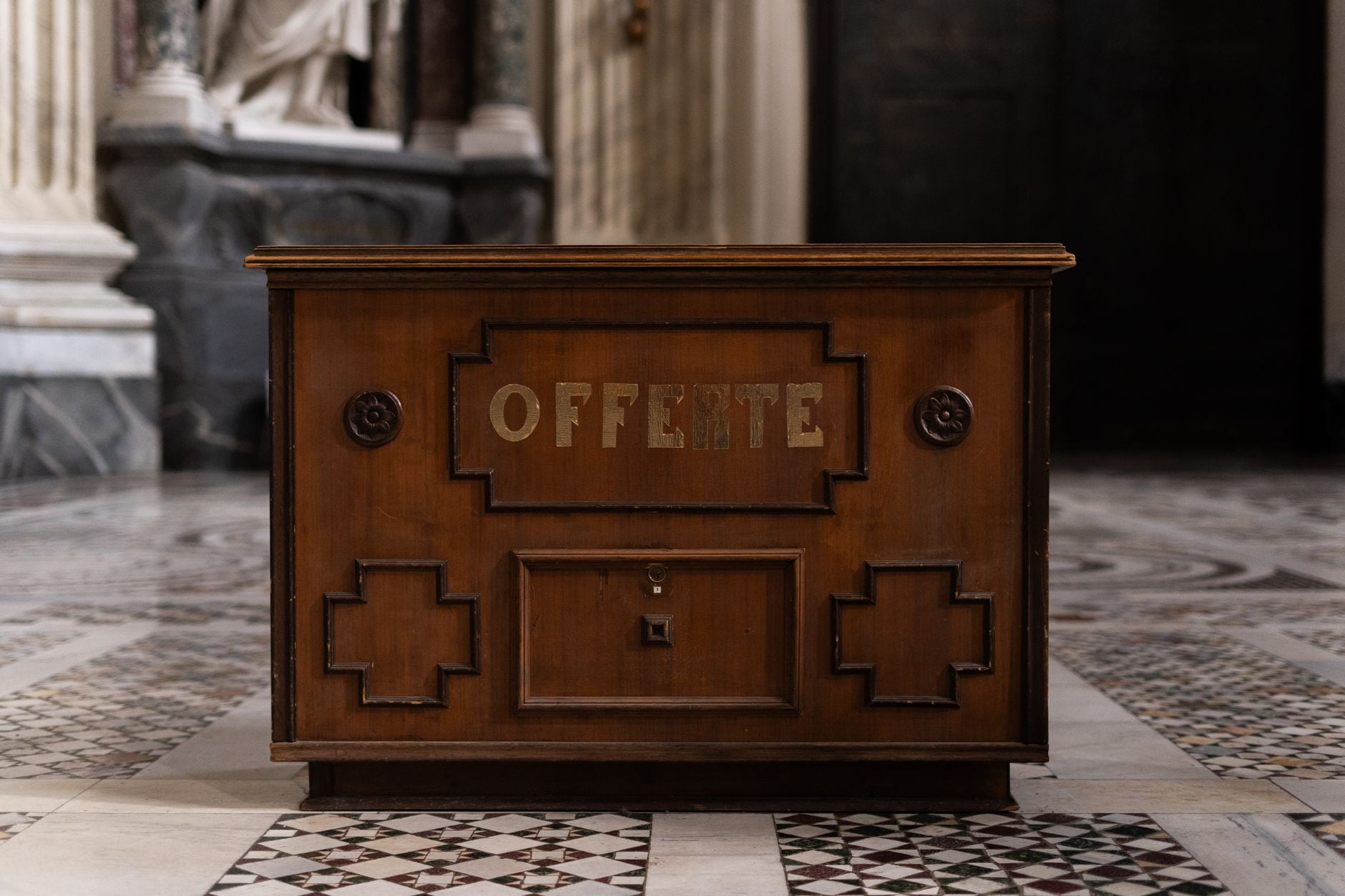
Thirty Christmas Eves in the Poor Box
I had never once thought about it. Every year, after the late Mass, my mother would take her good gloves off to hold her coffee, and my father would stand up from the folding table and tuck his scarf in and say, “Going to start the truck,” and be gone seven or eight minutes while we got our coats on. It was a joke in the family. Dad and his truck. The cab would be warm and waiting at the curb when we came out, windshield clear, heater roaring. I had thought of it, if I thought of it at all, as one of the small kindnesses a man does and does not announce.
It had been a cover story for thirty years, and the truck had been warm for every one of them.
“I never thought,” I said.
“He wanted that,” said Father Ted. “That was the whole design of it.”
He picked up one of the bundles and slid the brittle rubber band off with his thumbnail. It broke in half. He did not seem to notice. He chose one slip from the middle, pinched it by the corner, and held it between us.
“They are all the same,” he said. “Every year, the same words. Same pencil. I have read that line thirty times, Dale, and I have prayed over it thirty times, and I have never once come to the bottom of it. Your father told me to give it to you when it was time. I think it is time.”
“Go on,” Father Ted said, gently, the way you’d say it to a child at the edge of a pool.
I took it. The paper was soft as cloth from handling. It had been folded and unfolded so many times along the same creases that it had gone almost furry. I turned it toward the light over the sink.
In my father’s square pencil hand, one line.
I took $3.20 from this box on Christmas Eve 1952. The doctor put it back. I still owe the doctor.
I read it twice. Then I read it a third time, because the first two had gone into me without leaving any meaning behind.
“That can’t be right,” I said. “He wouldn’t. Father, you knew him. He walked me back to the Cenex over a pack of gum.”
“I know he did.”
“What doctor? He was ten years old in 1952.”
“He was.”
Father Ted smiled then, but it was not a happy smile. It was the smile of a man who has been alone with something for a very long time and is relieved to put it down in front of someone who has a right to it.
“Dale,” he said. “I was there.”
“I was ten too,” Father Ted said. “That’s the part nobody in this parish ever worked out. People think I came here from the seminary a stranger. I grew up two miles from your father’s place. We served Mass together. He was Bert, and I was Teddy, and neither of us was any good at the Latin.
“In 1952 your grandfather Warren had been gone fourteen months. You know how.”
I knew how. Everybody in Tabor Creek knew how. In October of 1951 my grandfather had been snapping corn with a pull-type picker, and the rollers had plugged, and he had done what every man was told never to do. He reached in. He lived four days. My father, who was nine, rode to the hospital in the back of Mr. Novak’s pickup holding a blanket over his own father’s legs. He never talked about it.