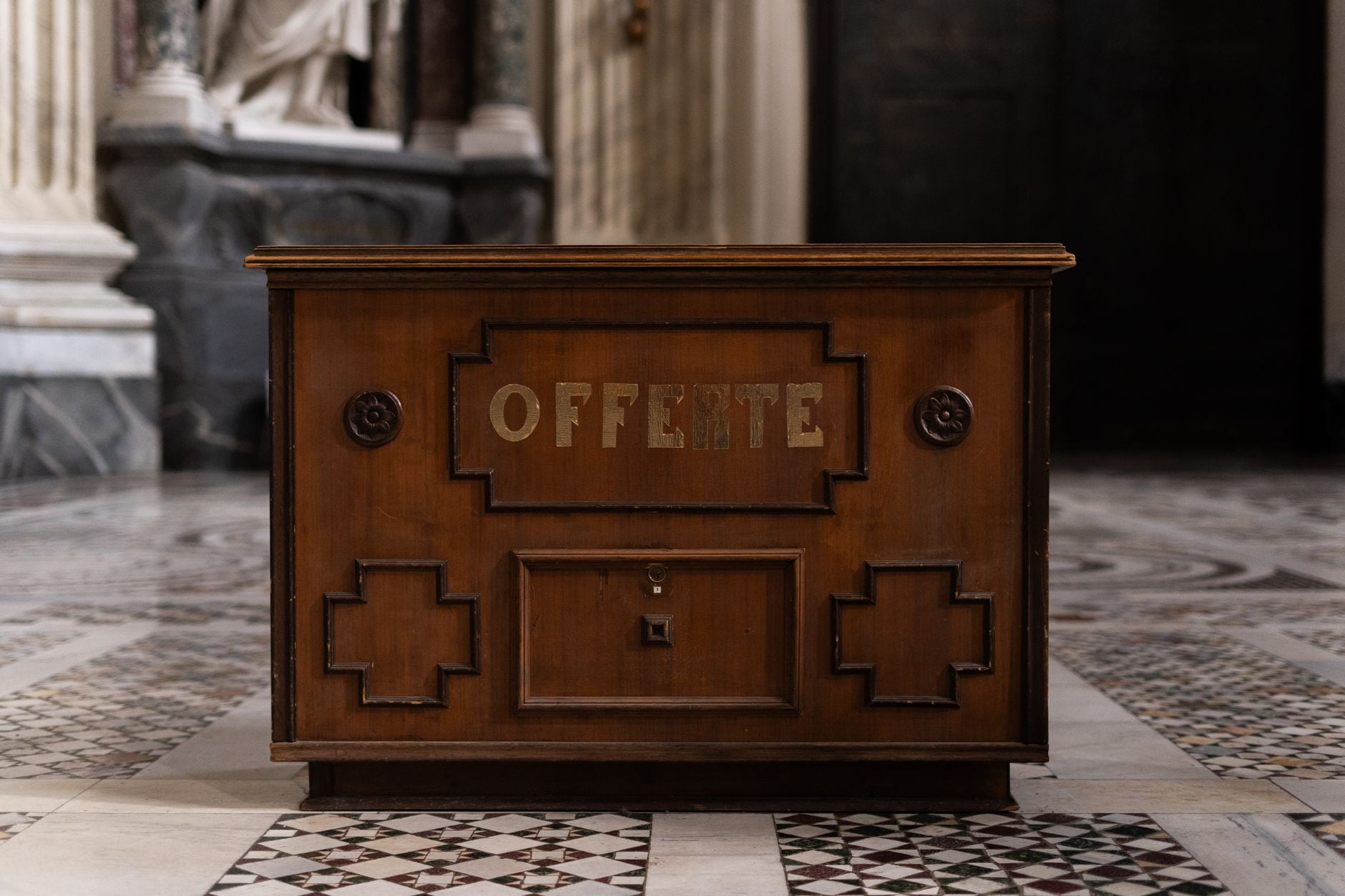
Thirty Christmas Eves in the Poor Box
Father Ted was practical about it. He came back from the sacristy with a stub of carpenter’s pencil and a plain envelope from the rectory office, and held them out to Herb without a word.
Herb took out his billfold. It was a worn brown leather one. He found a twenty, and he looked at it, and then he found another, and a third, and tucked all three in the envelope.
“Herb,” I said. “It’s twenty. Dad always made it twenty.”
“Your father was a farmer,” said my uncle. “I sell insurance.” But his hands were not steady, and he slid one of the three back into his billfold. Two twenties stayed in the envelope.
He leaned the envelope against the wall under Saint Anthony. He licked the pencil, a thing I had not seen anyone do since I was a boy, and wrote on the outside of the envelope, not on a slip, in big uneven letters that wandered downhill. He wrote for a long time. When he was done he showed it to me.
For the boy who gave me his sled. Not paid in full either. Herb.
“That’s not a line,” I said, because I had to say something. “That’s a sentence.”
“I was never any good at brief.” He sealed it, and then he put his hand on the brass slot, and for a moment I thought he might not be able to let go. He did. It dropped with a soft sound.
We stood there.
“Your turn,” Herb said.
I held my father’s last envelope. It was lighter than I’d expected. It had a little give in it where a twenty-dollar bill was folded in thirds, and a slip with the same words he’d written thirty times. I could have opened it. But it wasn’t mine to open. It was his, and it was for the box, and it had ridden in the inside pocket of his good suit until the day he died, and then in mine for thirty-five days.
I put it in the slot.
It made less noise than I expected. It dropped onto the others with the sound a leaf makes landing on a leaf.
Father Ted let out a breath that I think he had been holding since 1987.
“Will you be doing it?” he asked me. “Next year?”
I’d been dreading that question since the sacristy. I told him the truth.
“I don’t know what I’d put on the slip,” I said. “I didn’t take anything from that box. I don’t have a line.”
Father Ted smiled at me, the first real one I had seen on him in five weeks.
“Your father didn’t have the line when he started,” he said. “He had the twenty. The line came later.”
Outside it had started to snow, a fine, dry snow that wasn’t going to amount to anything, sparkling on the hoods of the trucks in the lights of the lot. Half the parish had gone home.
Karen was waiting on the steps in her good coat with my keys in her hand. She took one look at my face and at Herb’s and decided, with thirty-three years of marriage behind her, to say nothing at all. She looped her arm through Herb’s and said, “Come on, Uncle Herb, I made a ham.”