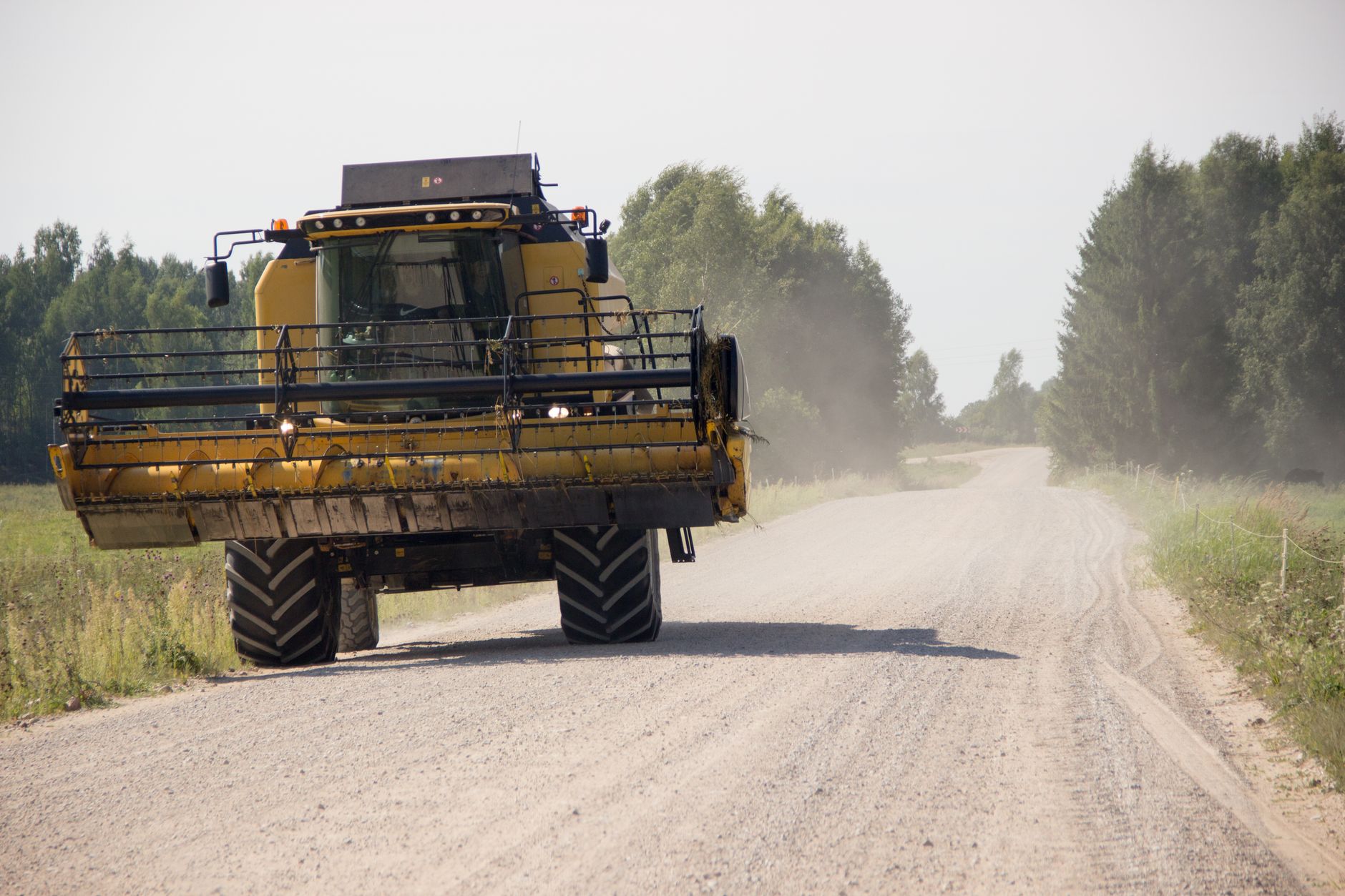
The Combine I Drove for Dad
Past Every Field He Farmed
Here is the thing Paulette could not have known to plan, the thing you only know if you farmed that ground.
The road from Zion Church to the Zion cemetery runs four and a half miles, and it runs past my father’s land almost the whole way.
We went by the home eighty first, where the house and the shed and the old bank barn sit, where I had washed the combine at four that morning, where my mother is buried up at the cemetery we were headed to. We went past the back forty where he died, the corn still half standing in it because nobody had the heart to finish it that week. We went past the Kuhlman ground he rented for thirty years and the forty acres along the ditch he tiled himself the summer I was ten, hauling clay tile on a stone boat behind the old 4020 that my brother Carl was driving in the line right then.
Every field. Four and a half miles of a man’s whole working life, and the combine he spent it in rolling past all of it at twelve miles an hour with him right behind in the hearse.
People were standing in their yards. Not even people I had called. Word had gone around the way it does, and folks had come out to the end of their lanes and stood there with their hands over their hearts. An old woman I did not know stood at her mailbox and waved a handkerchief slow back and forth the whole time we passed. A young dad had his little boy up on his shoulders and the boy was waving at the tractors.
At the Vincent place, Dan Vincent’s whole family was out at the road, and as the combine came even with them Dan took his cap off and held it against his chest and he did not put it back on until the last tractor had gone by. His boy had the gravity wagon in the line somewhere back there. Three generations of Vincents at that road, on account of a year of free seed a long time ago.
I had the window down. It was cold and I did not care. I wanted to hear it. The idle of the combine and behind it the long ragged chorus of thirty tractors, some of them older than me, some of them older than my brothers, all of them running slow and patient up that road behind my dad.
I did not feel like crying anymore by then. I felt something steadier than that. I felt like the county was answering a question that had been asked wrong in that funeral home hallway. The question was whether Harold Mentzer’s life had counted. And here was the answer, strung out a mile and a half long on a gray October road, and it was the only kind of answer that ever mattered to a man like my dad. It was the neighbors. It was the people.