The Combine She Drove Home
Saturday
I wore my red flannel shirt and the tan canvas vest Lowell bought me at the farm store three Christmases ago. Jeans. My good boots. I did not dress up, and I did not dress down. I dressed like a woman going to run a machine.
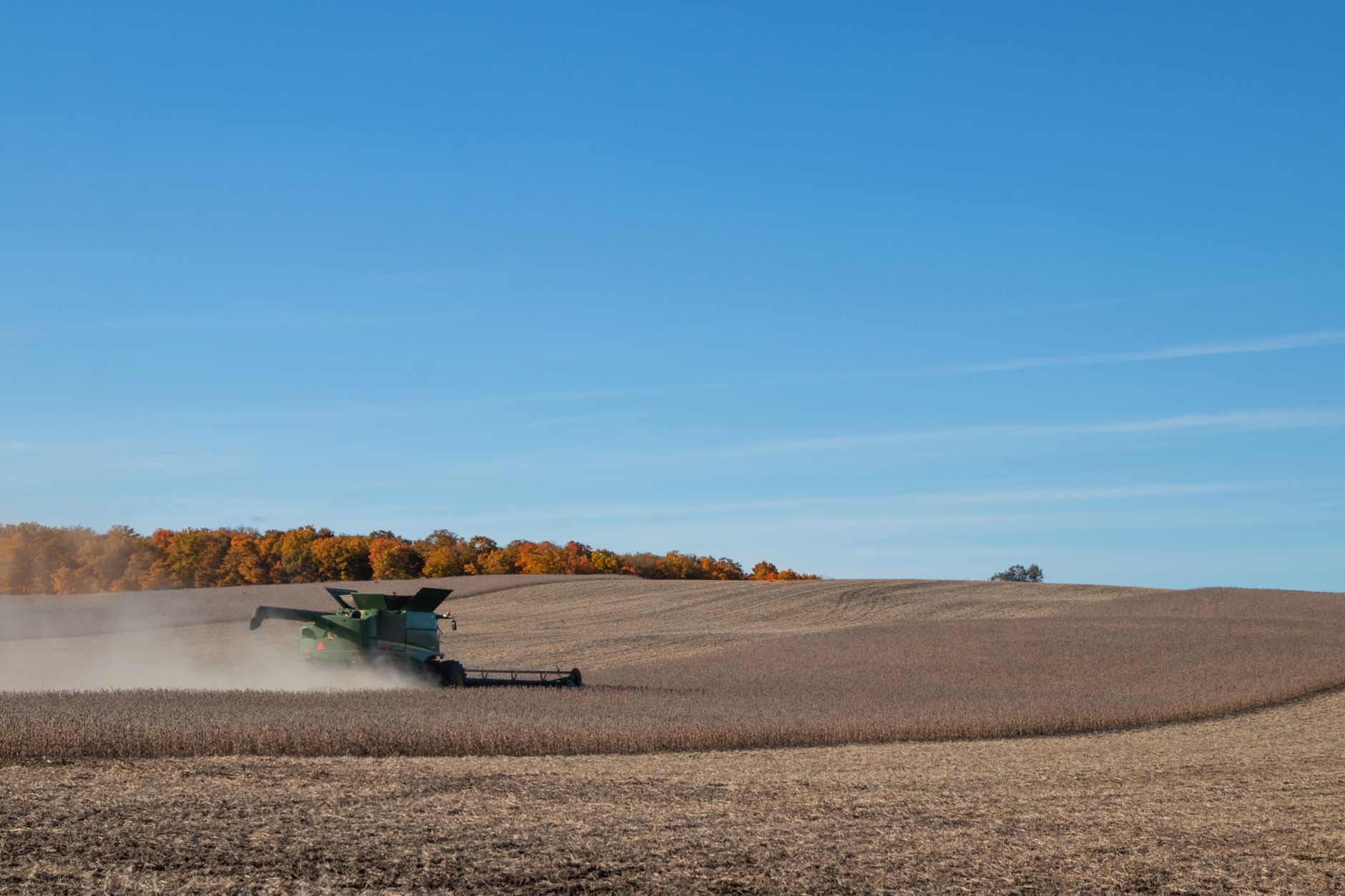
I drove out to the creek road at about five o’clock. The light was going long and gold across the stubble, the way it does in October, and the dust from the head hung in the air behind the combine like a curtain.
Merv’s quarter was about half done. I parked my car on the field approach and walked in along the end rows. The soybean stubble crackled under my boots. I could smell the beans, that dry, sweet, dusty smell that means harvest to anybody who grew up out here.
I stood at the end of the row and waited.
I watched my son bring his father’s combine down the field toward me. He ran it well. I will say that for him. The head was riding low and even, the reel turning steady, and he was taking a full cut without leaving beans on the ground. Lowell taught him that.
Merv was alongside him in the tractor with the red grain cart, matching his speed, and Colby swung the unloading auger out and dumped on the go without slowing down. Beans poured out of that auger in a gold stream. The two machines moved together like they had been doing it for years.
At the end of the row, Colby stopped. Merv swung the tractor and the red grain cart off to the side and parked to wait for the next round.
And then Colby did what I was hoping he’d do. He shut it down to idle, climbed down the ladder, and walked around front to pull a wad of bean stems out of the head. He did it every few rounds. Lowell always did too. Wet stems at the end of the day wrap the reel.
He did not see me until he straightened up.
“Mom?”
I didn’t answer him. I walked to the ladder.
The Ladder
There are seven steps on that ladder. I counted them in my head as I went up, the way I counted them the first time Lowell let me climb up there, when I was twenty-two.
“Mom. Mom, what are you doing?”
I heard him come around the side of the head. I didn’t look down. I put my hand on the rail and my boot on the next step.
“Mom, I’ve got Penner’s whole quarter to finish. I’ve got the Hofer place Monday.”
“No, honey,” I said. “You don’t.”
He was standing below me now. He had both hands up in the air, like a man watching his truck roll down a hill with nobody in it. He was wearing a gray hooded sweatshirt and his seed cap, and his face had gone blank under the dust.
“You can’t just take it,” he said.
I stopped on the top step and looked down at him. “It’s in my name, Colby. I can just take it home.”
“It’s Dad’s,” he said.
“It was your dad’s,” I said. “Now it’s mine. And there’s a thirty-one-thousand-dollar payment due on it the first of December that you have not once asked me about.”
He opened his mouth and nothing came out.
I opened the cab door and climbed in.
The Cab
It still smelled like him. Not Colby. Lowell. I don’t know how that’s possible eight months later, but it did. Coffee and grease and the wintergreen gum he chewed when he was trying to quit dipping.
The seat was set for Colby’s long legs. I pulled the lever and slid it forward. The screen was lit up, showing the field map in green and yellow, the half of Merv’s quarter that was done.
And there, on the dash, was Lowell’s seed cap. The faded one with the sweat line.
Colby had left it there. All those weeks, all those neighbors’ fields, all that money, and he had never moved his father’s cap.
I sat with my hand on it for a second. Just a second. I want to be honest that I almost climbed back down. I almost said, “Oh, honey, forget it, finish the field.”
Then I thought about December first, and the fuel tickets, and “Dad would have wanted it,” and I raised the head and put it in gear.
I have not driven a combine down a gravel road since 1998. It came back to me the way riding a bicycle comes back. You take it slow. You watch your mirrors. You remember the head is wider than anything coming the other way.
In the mirror I could see my son standing at the end of Merv’s field with his hands still half up, and the tractor with the red grain cart parked behind him, Merv climbing down out of the cab.