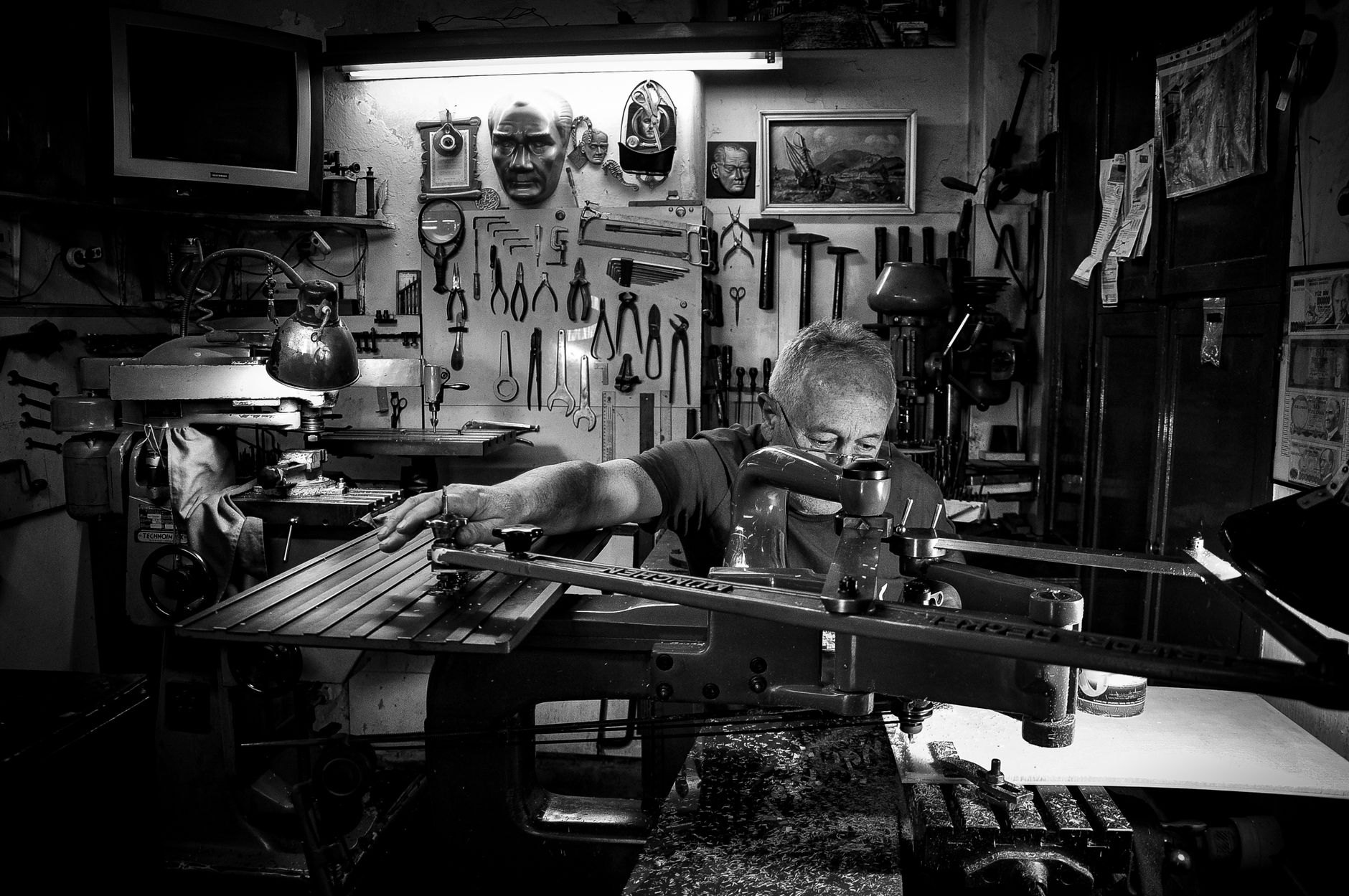
The Workbench Nobody Was Allowed to Touch
The thumbnail
I should explain something about my father and me, because the bench is only half of this.
I was never a shop kid, and it was not for lack of trying, his or mine.
When I was nine, he gave me a coping saw and a scrap of pine and let me stand at his elbow on Saturday mornings, and I loved it. I loved the smell of cut wood and cutting oil, and the radio with its dial taped to one station, and the way he would nod once, without looking up, when I got a line right.
When I was twelve, he let me drive a brass pin with a hammer. I hit my thumb instead. The nail went black before I got the word out of my mouth.
I remember my father looking at it. He did not look unkind. He looked like a man watching a part come off the press with a flaw in it.
“Go get your mother,” he said, and he turned back to the vise.
That was all. He did not say it to hurt me. I have turned it over for forty-eight years and I am nearly sure he said it the way you would say it to any boy who had just smashed his thumb.
But I walked out of that garage holding my hand in my fist, and the next Saturday I did not walk back in. He did not call me. I decided he did not want me there, and he decided, I suppose, that I did not want to be there, and each of us was right enough about the other to keep it going for the rest of his life.
I went to Mankato State for ag business. When I told him, he said, “Books don’t need hands, I guess.” That was the entire discussion.
We never had a fight, my father and I. That was the trouble. A fight at least opens something up.
My mother, Mavis, carried messages between us for thirty years. When she died in 2011, there was nobody left to carry them, and so we quit sending any.
I drove over on Sundays. We watched the Twins with the sound down low and ate whatever Pam had sent along in a foil pan.
“How’s the elevator?”
“Fine. How’s the knee?”
“Fine.”
I would stay through the seventh inning and say I had to get home. For eleven years that was the whole of it.
My son
Jonas was born when I was forty-four, which my wife says is why I was so tired for the first six years.
He is sixteen now, tall and narrow through the shoulders the way my father was, with the same habit of tilting his head when he listens. He runs cross-country for the Owatonna Huskies. He does his homework at the kitchen table with one earbud in.
He answers me in about six words a day, and I answer him in roughly the same number, and until this fall I would have told you we got along fine.
We got along the way two people do who were both raised by men like my father.
The summer he was thirteen, I came home early from the elevator and found him standing at the bench. He was holding my father’s wooden mallet, the one with the head worn smooth on one face, and he was not doing anything with it. He was just feeling the weight.
“Put that down.”
It came out sharper than I meant. It came out in my father’s voice, which I did not know I still had in me.
Jonas set the mallet down. I will say this for him: he set it down exactly where it belonged, inside its outline, handle toward the left, the way a person does who has watched closely how a thing is kept. Then he walked out past me, and I do not believe I saw him step into that garage again.
I told Pam that night that I had done the right thing. She was drying a pan. She said nothing, and Pam can say nothing so loudly that the windows hum.