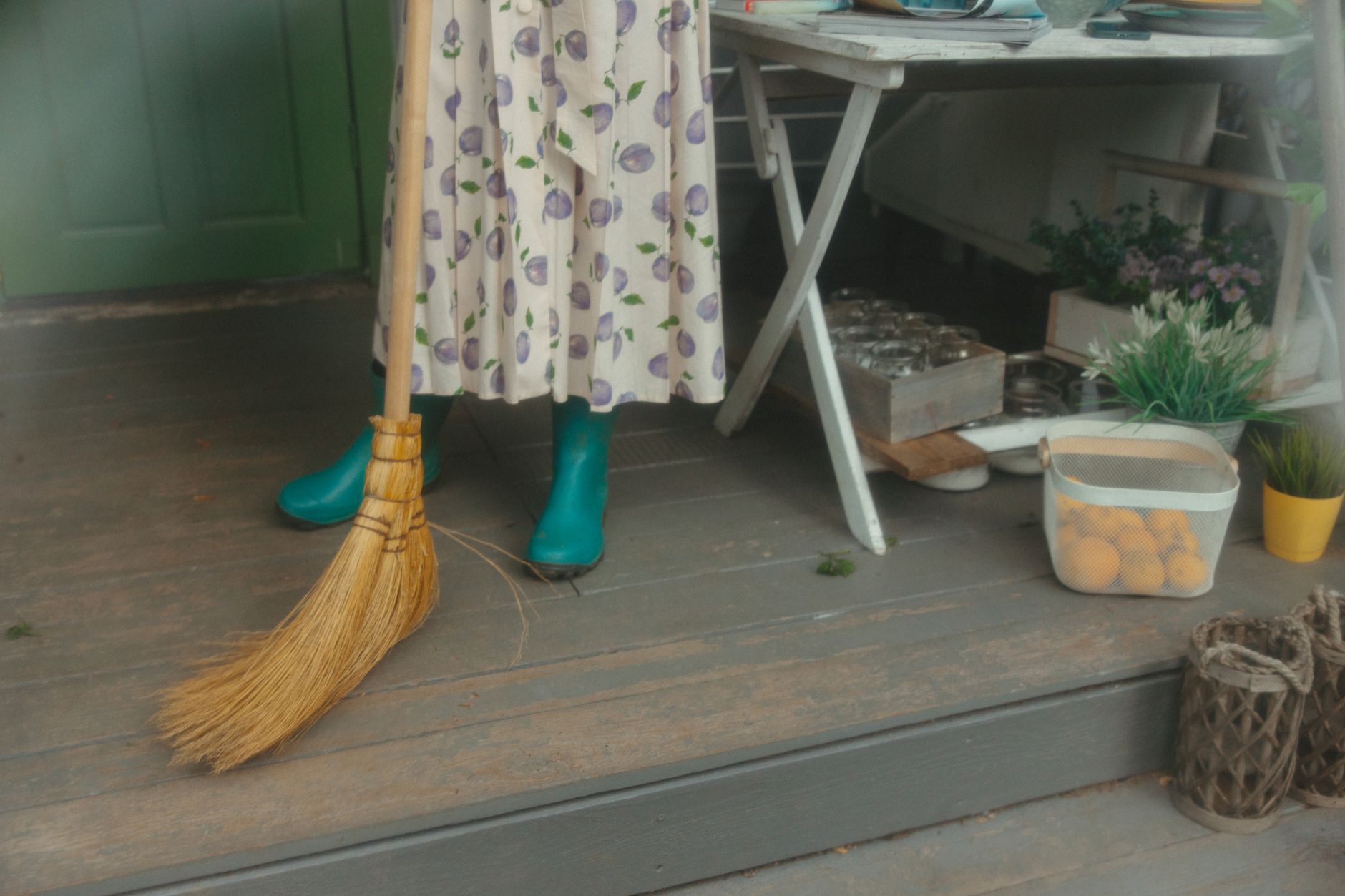
The Porch I Swept for My Neighbor
What Clifton said
I sat on the top step, where I had sat the day my knees quit. I held the soup in my lap, and the bowl warmed my hands through the towel. He set the mug on the rail, and for a minute neither of us said anything.
“I heard you the first morning,” he said.
“I thought you were asleep.”
“I was lying there. I haven’t slept past four since the funeral.” He looked out at the frost on the yard. “I heard the broom. And I’ll tell you, for about a second and a half, I thought it was her.”
I had no answer to that. I did not try.
“That sound. It was just that sound. Straw on boards, steady, six o’clock. I lay there, and my whole body went toward it. I got as far as sitting up. I had my feet on the floor.” He stopped. His jaw worked. “And then I remembered, and I sat there on the edge of the bed in the dark, and I thought, I can’t stand it. I can’t stand that sound. Make it stop.”
“Clifton,” I said.
“Let me finish.” He wiped his face with the heel of his hand. “And then it didn’t stop. It just kept going. It went back and forth, and back and forth, and by the end I understood that it wasn’t her, and it was something. Somebody was out there. Somebody had thought of that porch.”
He cleared his throat.
“I went to the window and I looked through the curtain. I saw you. In Vernon’s coat. With his gloves on. I knew those gloves. He wore them to rake leaves.”
“They were what I had.”
“And I thought, now there’s Lorraine Voelker, and she’s seventy, and she’s doing this at six o’clock in the morning, in the cold, and I’m in here in my socks.”
He looked at me then, directly, for the first time.
“I’ve never been so ashamed of anything in my life,” he said. “And I have never been so glad.”
I started to say something, and he held up one hand.
“I should have come out. I know. I stood at that door every morning for a week. I’d get my hand on the knob. I couldn’t do it. I thought, if I open it, she’ll know I’ve been watching. And if I thank her, she’ll know what a state I’m in. And if I don’t thank her, I’m a man with no manners.” His mouth twisted. “So I washed the plate.”
“You washed it every time.”
“It was all I could do. It was the one thing I could do with my hands, and I did it as well as I could.” He shook his head. “I dried them with Roz’s dish towels. I don’t know why. She’d have laughed.”
I laughed a little, though my eyes were wet. I had not known I could do both at once.
“And then the jar,” I said.
“Yes.”
“Clifton, that was the last of her August.”
“It was. That’s why.” He leaned forward in the rocker, his elbows on his knees. “I’d gone down to the cellar to look at the furnace. And there was the shelf with the whole row. Roz put up sixty pints of peaches every August of our marriage. We gave most of them away. I stood there looking at that shelf. And I thought, nobody should be the last person to have a thing they’ve been given. So I took one up.”
I could not speak. I held on to the soup.
“There’s more of them,” he said. “If you’d like. I can’t eat sixty pints of peaches.”
And then he said the thing I have turned over every day since.
“Roz swept your porch, you know.”
I looked at him.