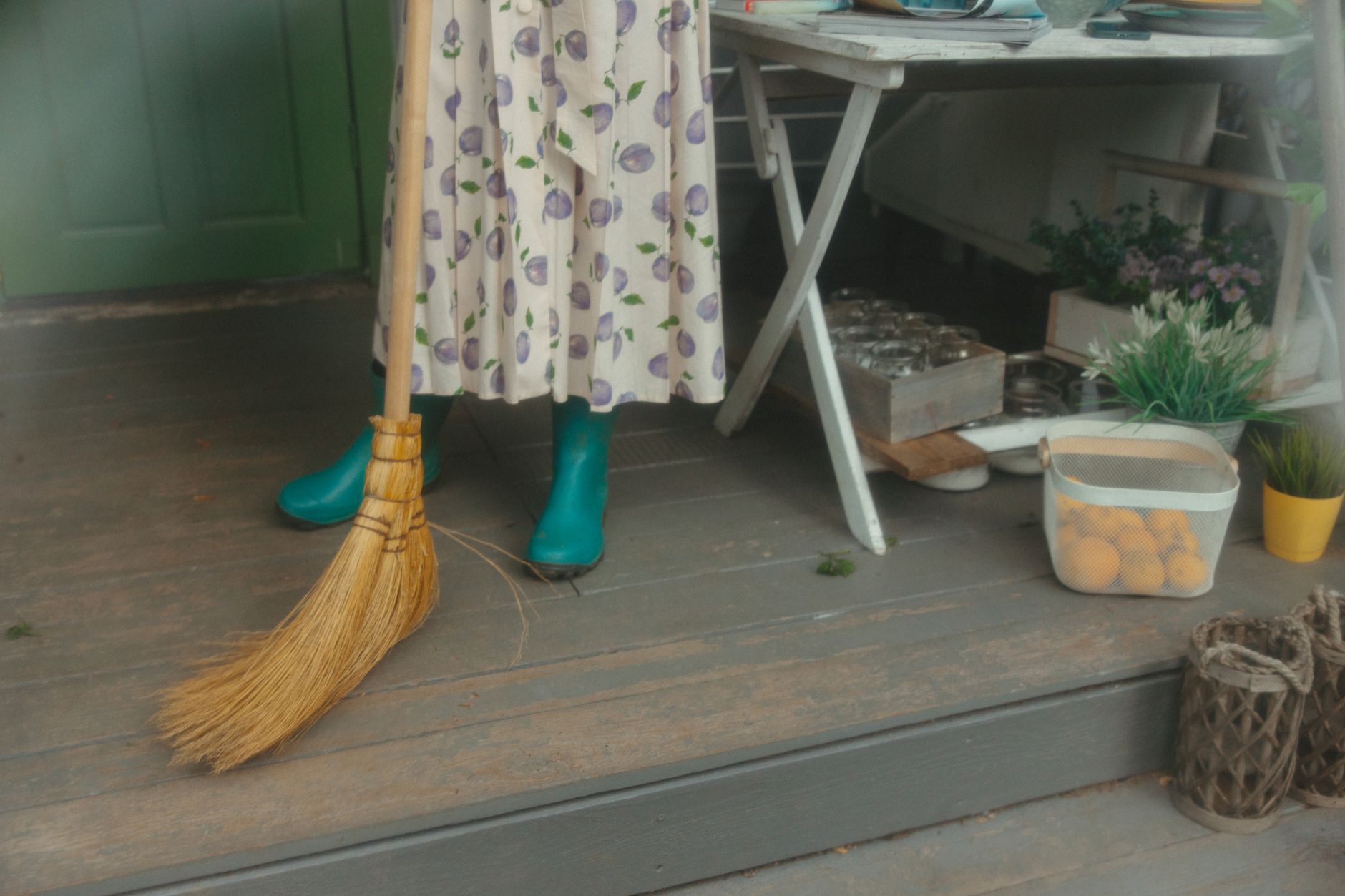
The Porch I Swept for My Neighbor
Pearl
Pearl Tuggle found out on the eleventh day.
Pearl has been my friend since we sat next to each other in the choir at Cobden United Methodist in 1989. She is eighty-one, sharp as a paring knife, and she drives a Buick the size of a boat. She pulled into my driveway one afternoon after the Wednesday Bible study, and she sat in the car with the engine running, and I knew from the way she was looking at me that someone had talked.
“Lorraine,” she said, when I leaned down to the window. “Margaret Dill says you’re over at Clifton’s every morning with a broom.”
“Every morning,” I said.
“And a plate?”
“And a plate.”
She turned off the engine. That was Pearl’s way of saying she had time.
“People are going to talk,” she said.
“They already are.”
“A widow and a widower, forty feet apart. You know how it sounds.”
I thought about that for a moment. I thought about it honestly, because Pearl has earned an honest answer from me.
“Pearl,” I said. “Roz Bartels has been gone three weeks. That man has not eaten a hot meal that wasn’t brought to his door by somebody else since the funeral. I’m seventy years old. I have a heating bill and a bad knee and a garden I can’t kneel in. What would anyone say about me that would be worse than a dirty porch?”
She looked at me a long time.
“Nothing,” she said finally. “I suppose nothing is.”
“Then let them talk. The porch will be swept.”
She started the Buick again. She sat there with her hands on the wheel, and then she said, not looking at me, “I took Maynard a hot supper every night for a month after he lost his Eleanor, you know. The year before you moved here. He never said a word about it to anyone. He just started waiting on the porch for me.”
“What happened?”
“I married him,” Pearl said. “Don’t get any ideas.”
And she backed out of my driveway with a wave, laughing so hard I could see her shoulders shake through the rear window.
Wendell
The last Saturday of October, a gray car pulled into Clifton’s drive at a quarter past five in the morning, and a man got out and stood looking at the porch.
I was on the steps with the broom. I had come early, because I had a funeral lunch to help with at the church later, and I had not thought anyone would be awake.
He was a tall man in a quilted jacket, forty-something, with his father’s long jaw. I knew him at once. It was Wendell, who had driven all night from Indianapolis, and he stopped at the foot of the steps with the car door still open behind him.
“Excuse me, ma’am,” he said. “Are you all right? Can I help you?”
“I’m Lorraine Voelker,” I said. “From next door.”
He looked at the broom. He looked at the swept boards, the clean pots on the rail, the mail stacked under its stone. He looked at the plate, the white one with the towel on it, that I had set down by the door while I worked.
“Is that,” he said.
“That’s his supper from last night. I’m just getting the empty one.”
“Mrs. Voelker,” he said. “How long?”
“Since the third of October.”
He counted. I watched him do it. He did not say a number.
“Every day?”
“Every day.”
“I call him every night,” he said. “He says he’s fine. He says he ate. I thought maybe it was the ladies from the church.”
“They did very well the first week.”
“And then?”
“And then they had their own suppers to make.”
Wendell nodded slowly. He looked at the plate again, and then he looked at the orchard for a while, the way a man does when he does not trust what his face will do.
“I was going to hire a service,” he said. “It costs two hundred dollars a week, and Dad would never let a stranger in the house. I’m five hours away. Mrs. Voelker, I’d like to pay you something.”
“No.”
“Wendell,” I said. “Your mother was a good neighbor to me for forty-one years. This is nothing.”
He looked at me oddly, as though something had moved behind his eyes, and I thought it was only tiredness. He opened his mouth, and he shut it again. Then he thanked me. He asked if I would mind not telling his father he had come early. He said he was going to knock at the front door and surprise him, and sit down to breakfast, and stay the weekend, and that he would not mention the porch unless Clifton did.
“He won’t,” I said.
“No,” Wendell said. “He won’t.”
He went up the steps and knocked. I heard the door open and a long silence and then Clifton’s voice, rough, saying, “Well, I’ll be.” Then the screen door closed, and I took my plate and went home.
The plate on the rail that evening was washed and empty, as always. Under it, folded very small, there was a corner of paper from a church bulletin with the word “Thank” written on it in pencil. That was all. The “you” had been rubbed out.
I put it in my apron pocket.