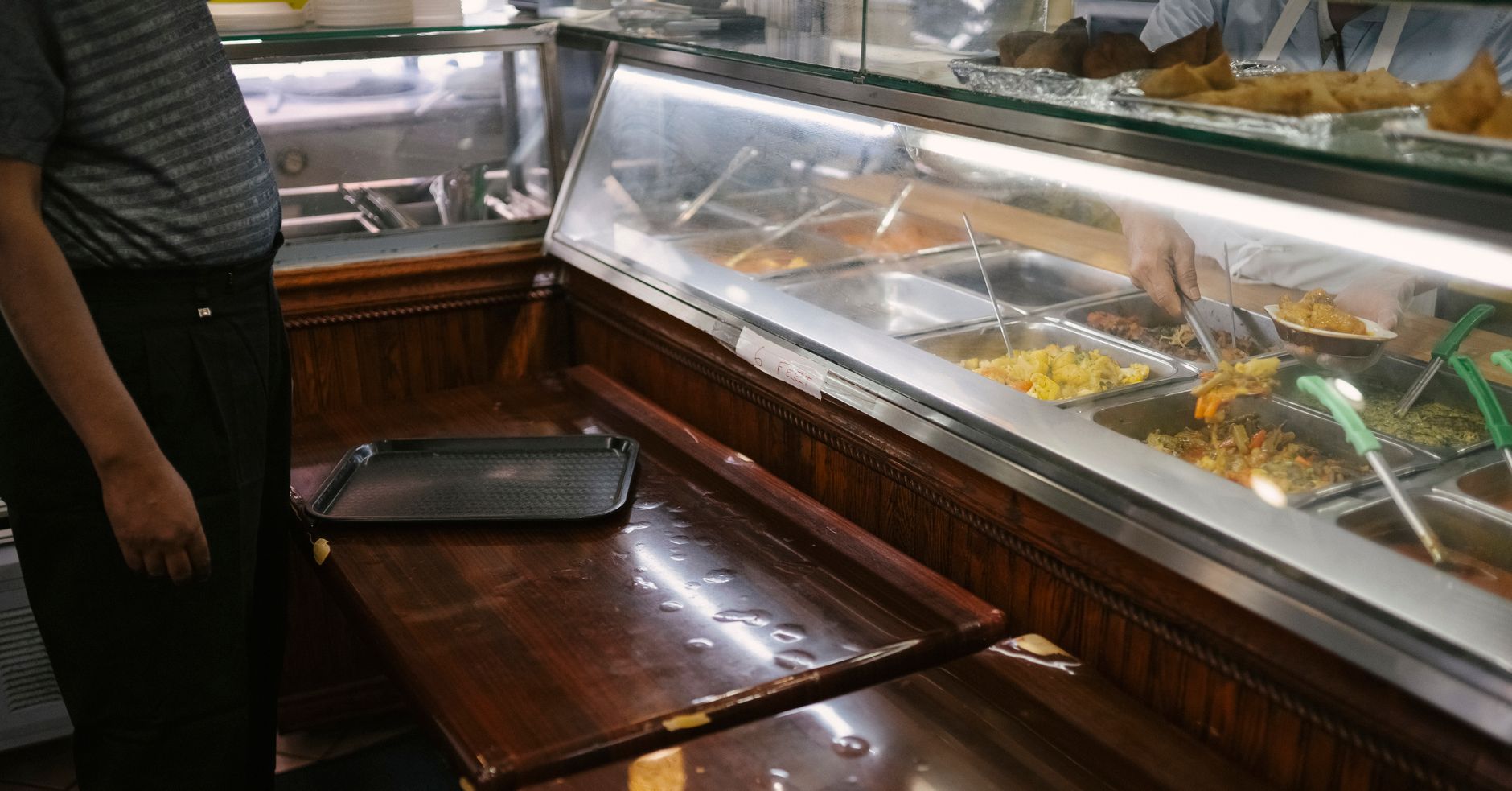
Forty Years Behind the Lunch Line
The table
Keith took my elbow and led me to the center of the floor. The crowd moved back, and I saw what they had done.
On the free-throw line, under the home basket, stood one lunch table. It was one of the old round ones with the benches attached, the kind that fold up into the wall. I had wiped down that table four thousand times. The color was faded to the blue-green of a duck egg.
It had a paper tablecloth on it. And on that tablecloth sat my box.
My green recipe box. The one that had gone missing from the shelf above the flour. It sat in the middle of the table with the lid open and a stack of cards in a neat row next to it, and I thought, for a second, they had ruined it.
“We didn’t read them,” Keith said quietly. “I want you to know that. Verna took the box last night. We all promised.”
“Then what…”
“Sit down, Miss Marlene.”
I looked at him.
“You never did,” he said. “Not once. Sit down.”
I sat.
It was a child’s bench, low and hard, and my knees complained about it. I put the tray on the table in front of me. The milk, the green beans, the chicken, the potatoes. And in my left hand, a roll, still hot enough that I had to shift it between my fingers.
The room was so quiet that I could hear the old gym clock tick over the scoreboard.
Brett had come around the steam table. He pulled off his hairnet and held it in his big hands, and he stood by the end of the bench.
“Miss Marlene,” he said. “Can I tell you one thing?”
“You may.”
“There’s a Friday sack program at this school. You know that.”
“I stopped it, Brett. In 2015. My knee. The district said they’d handle the weekend food, and they did, a little.”
“Sometimes,” Brett said. “A little.” He looked at his hands. “Verna never stopped. Neither did I. Twelve of us on this floor have put groceries in the back of that school every Thursday night since 2015. Thirty-one sacks a week. Peanut butter and crackers and a carton of milk. Same as you.”
I did not say anything.
“We didn’t tell you, because you’d have said no.” He finally looked up. “I was seven. I was the first one. I figure somebody’s supposed to take the second sack.”
“I didn’t ask for any of this,” I said. It came out thin.
“That’s why,” Brett said.
He reached past me, picked up the top card in the stack, and set it in front of my tray. It was an index card, soft with age, and I knew the handwriting before I read the card. It was mine, in blue ballpoint, and it was dated September 1996.
Brett R. March 9. No peas. Mom works nights. Hungry Mondays.
“Turn it over,” Brett said.
I did.
The back of the card had never had a mark on it in thirty years. Now it had writing. A grown man’s block printing, slow, in black marker, a little crooked, as if a heavy hand had pressed too hard.
Hog farmer. Two girls. Still no peas. Never ran out.
I held the card very still.
Around me, in the bleachers and along the walls, three hundred people were holding up index cards.
I had not seen them. They had been holding them down at their sides, and now each one lifted a card, and I understood the stack on the table was only the ones from the front. Verna had pulled the cards for everyone who could come. They had each been handed their own, a few weeks ago, by mail, with a pen. They had each turned it over.
Keith told me later it took the four of them, Keith and Verna and Brett and a woman at the post office, six weeks to find all of them. Two hundred and eighty-four cards came back. Some were mailed from Texas. One came from a base in Germany. One came on the back of a hospital menu.
They stood there holding up the backs of their own cards, so I could read them.
I could not read them all, of course. They were too far away. But I saw the one nearest me, held by a woman about forty in a nurse’s smock. In small neat handwriting, it said: Pediatric nurse. Left-handed. I still say careful, it’s hot.
And I saw the one next to hers.
I read them one at a time for the next three hours, and I keep them in the green box on my kitchen counter. I had spent forty years believing I was handing children their lunch. I had not known they carried something else out the door with them, and brought it back.