Forty Years Behind the Lunch Line
The gym
First I noticed the light, because the gym lights were on at full, the way they are for a game. Then I noticed the sound, which was no sound. Three hundred people breathing in at once.
They were standing. Every one of them. The bleachers had been pulled out on both sides, and they were filled to the top row, and there were more standing along the walls and across the baseline under the far basket.
I knew them. That was the thing that undid my balance.
I did not know every one. But I knew the shape of their faces the way you know a field you have walked as a child. A tall man in a feed cap who had my mother’s habit of tilting his head. A heavy woman in a nurse’s smock with a dimple I had last seen on a first-grader. Two men in matching Carhartt coats who had come through my line as twin boys in 1998, and who were still, God help me, finishing each other’s sentences.
Mothers I had known as girls. Men holding babies. An old couple in the front row I recognized as Mr. and Mrs. Alvey, who taught the third grade the year I started, and who were so old now they were being held up by their own grandchildren.
And there was a soldier.
He stood near the center line in his dress uniform, the Army Guard, with his cap tucked under one arm. He was young, and he stood at attention with his jaw set, looking straight at me.
Nobody clapped. That was what I will always remember. They did not clap, or cheer, or sing. A person clapping would have broken the moment, and they understood that.
They stood and looked at me.
In the middle of the gym floor, where the tip-off circle is painted, somebody had set up a serving line.
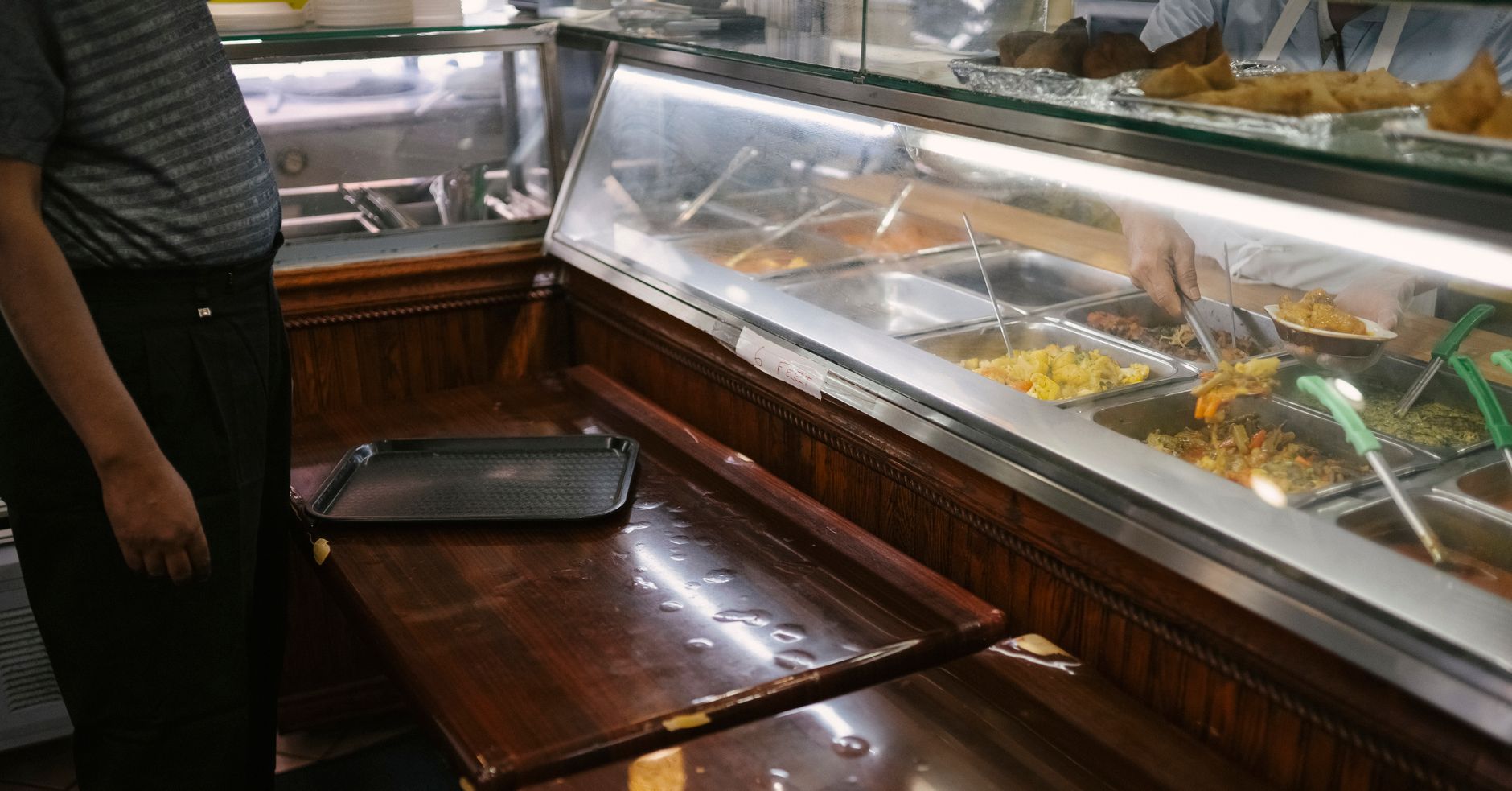
It was my serving line. I knew it before I understood it. Three stainless steel steam wells under a sneeze guard, and the dent in the left side, near the floor, where I had backed a rolling rack into it in 1994.
They had gone to the district warehouse, and they had borrowed back the old steam table, the one the district replaced in 2011. I thought it had been sold for scrap.
Behind it stood ten people in hairnets and aprons.
I want you to see this. Ten grown men and women, all of them in hairnets. A man in a seed company jacket. A woman in a deputy sheriff’s uniform. A man who looked like he could pick up a calf with one arm. Two women who were obviously sisters. And the soldier, who had come forward from the center line and put on a hairnet over his crew cut, with his dress uniform still on underneath.
The one in front was the biggest. Six-foot-three, with shoulders like a feed bin, with a plastic serving spoon in his hand that looked like a toy.
He was crying so hard that he could not speak.
I had not seen Brett Ruehl cry since the day he was ten years old and fell off the monkey bars on the playground. He stood there with his serving spoon and his hairnet and tears running into the stubble on his cheeks, and he did not wipe them.
“Miss Marlene,” he said. His voice broke in the middle. He started over. “Miss Marlene, we figured it was our turn.”