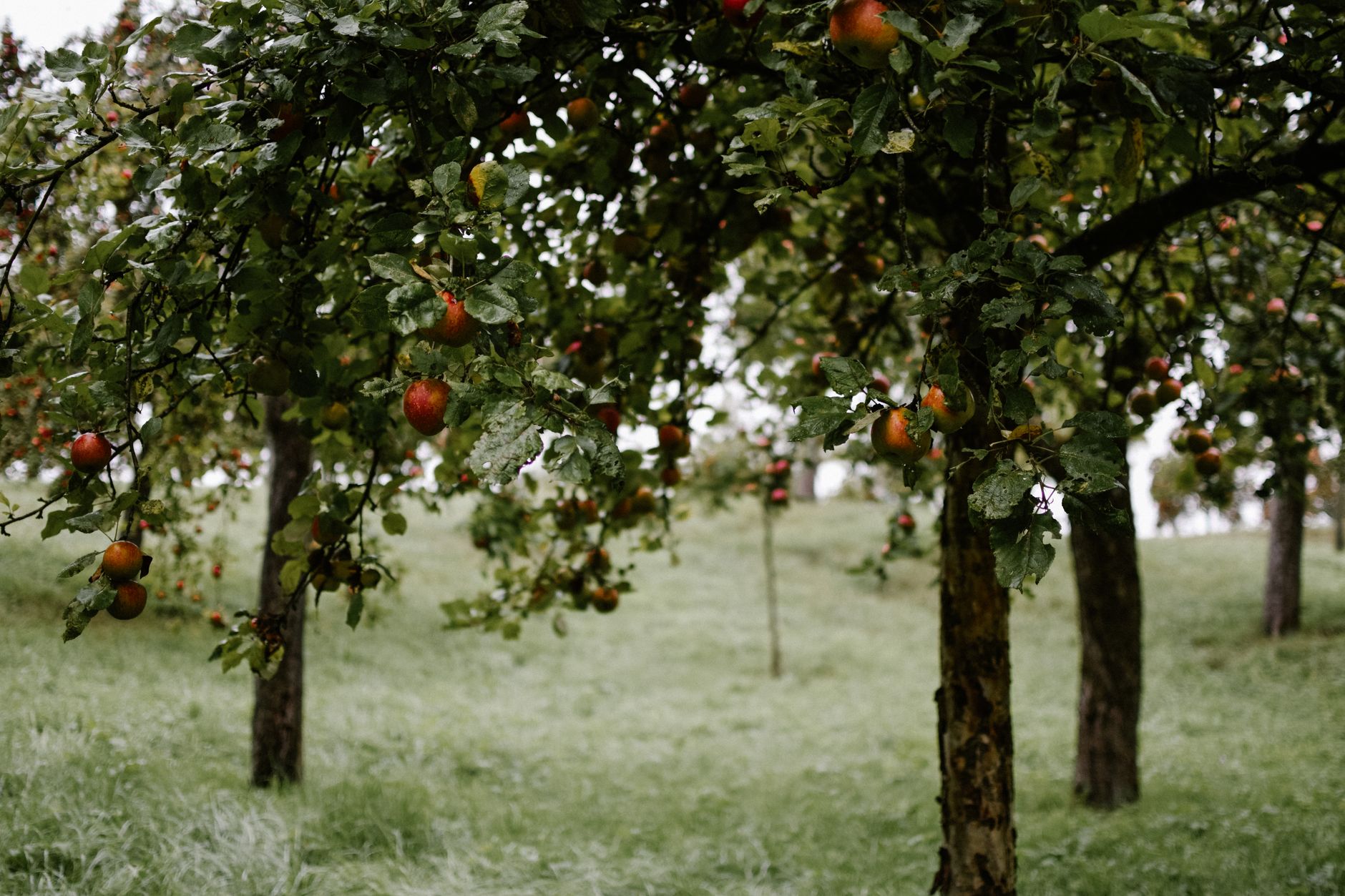
The Harvest My Neighbor Took
“Folks,” she said, “in honor of the late Boyd Sayer, who took this class thirty-one times, our head judge has requested the open judging, in the old way.”
Cecil came out from behind the curtain slowly, in his good brown suit, leaning on his cane, with a small silver knife in his breast pocket and half-moon glasses on a chain. There were five finalists. He cut the first four with unhurried courtesy, a Northern Spy, a Cortland, a Roxbury Russet, an old yellow Newtown Pippin, naming the variety and the grower each time, and the grandstand applauded politely.
Then he reached Corinne’s table.
She had her hands folded at her waist, and she was looking at him with a shining, expectant face, the face of a girl at a recital. Dean, in the second tier, had put his hand over his mouth.
Cecil picked up the top apple from her pyramid.
He turned it over once in his fingers. He held it close to his face, and he lowered his glasses on their chain and looked at the stem end. I watched his face change. It did not go hard or angry. It went still, as still as a pond, as if he had been listening for something a very long time and had just heard it.
He did not look at Corinne.
He lifted his eyes, slowly, over the rim of his glasses, and he looked straight up into the fourth row of the grandstand, at me.
Then he set the little silver knife against the apple’s pink skin and cut it cleanly through the middle.
What Cecil Said
The two halves fell open in his hands, and the whole grandstand leaned forward at once, so that I felt it in the boards under my feet.
The apple was pink to the core.
Cecil held it up to the light so the people in the back rows could see. He turned the halves slowly, the way you would show a jeweler a stone. At the center, in the heart of the fruit, five small chambers made the shape of a star, and in each chamber lay a pair of seeds, side by side. A double. Ten seeds, gleaming like wet pieces of mahogany.
“Folks,” Cecil said, “I have judged this barn for forty-four years, and I have cut open some thirty thousand apples in front of you. I do not remember the last time I was surprised. I was surprised just now.”
“This is a very rare apple,” Cecil went on. “I will tell you why, and then I will tell you what the card says, and then I will let you make up your own minds. You see this seed? The double? Two seeds to a chamber, in a five point star, with the flesh blushed to the core. In the whole of Pennsylvania there is one apple that does that, and it was not in any catalog until the spring of 1989, when a young man from this county and a fool of an old judge, who was not so old then, stood in an orchard on Hollis Road with a roll of grafting tape and a knife like this one, and spliced the first scion of it onto a rootstock in the dirt.”
He paused. I could feel Bev gripping my wrist.
“The young man’s grandfather had carried the original cutting from the old country in his coat. The young man grew it for decades and never sold a graft of it. He named it for his own family. It is called the Sayer Blush.” Cecil’s voice dropped. “There are seven trees of it in this county. I have walked every one of them. I have eaten under every one of them. And every one of them stands on Sayer land.”