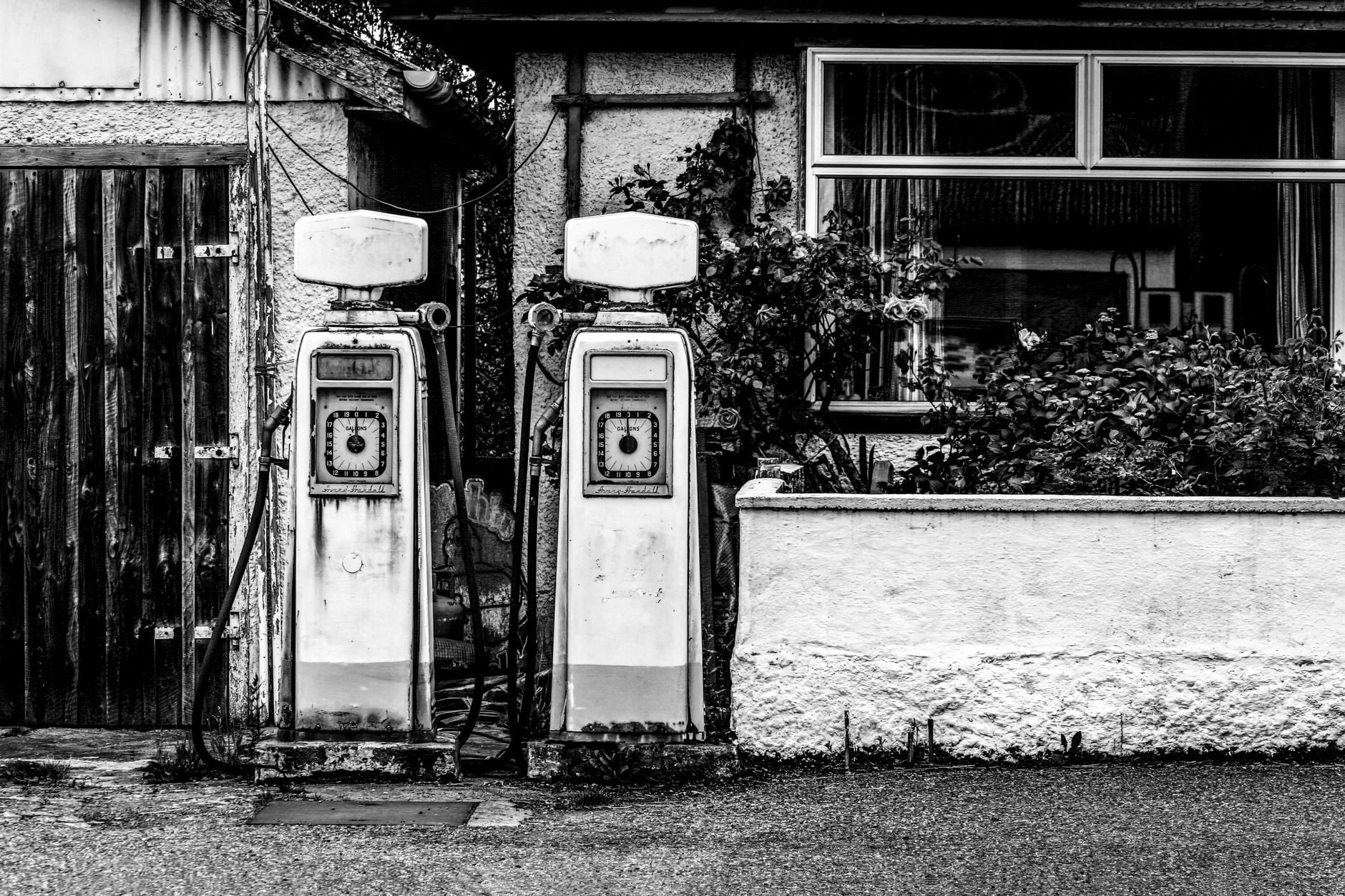
The Gas My Neighbor Kept Taking
The nozzle
“Fine,” he said. He raised his voice so everyone could hear. “Fine, Darrell, you got me. Real funny. Real cute. Let me just…” and he strode up the steps with his hard hat swinging and grabbed the nozzle off the side of the pump, lifting it out of the holster like a man in a commercial. “Fill her up!” he called. “Who wants to pay?”
A few people actually laughed. Not many.
The nozzle came out of its holster, and the switch Barry had built clicked.
A bell went off inside the pump body that I swear you could have heard in the next county. It was an old school fire bell, as big as a salad plate, and it rang and rang. At the same moment, the canvas banner I had painted unrolled down the glass front of the pump with a dry flapping sound, all five feet of it, landing in a clean white sheet against the red body of the pump.
THANK YOU FOR YOUR GAS, CLINT.
He froze with the nozzle in his hand. He was standing there on his own porch in his work clothes, with his boss twenty yards away, his wife at the foot of the steps, the pastor’s wife with her hand over her mouth, forty-five neighbors in lawn chairs, a row of nine-year-olds pointing and giggling, and a bell going off like the end of a prize fight. He looked at the banner. He looked at the nozzle. He looked, I think, like a man watching a coffin lid come down.
What Larry said
Larry wiped his hands on a towel and walked across the pavement. He is sixty-three, thick through the shoulders, with a gray mustache and the slow walk of a man who has spent his life around grain and heavy machinery. He stopped at the foot of the porch steps and read the sign from top to bottom without hurrying.
“Two hundred twelve gallons,” he said.
“Larry, it is a joke. It is a bit,” Clint said. “He and I, we…”
“Is it true?”
Clint looked at him. A small, bitter, pleading look.
“Is it true, son?”
“I took a little,” Clint said. “He is retired. He does not…”
“Darrell.” Larry turned. “Have you got proof?”
I stood up from the lawn chair. My knees creaked. I walked across the street with my phone in my pocket, not hurrying. I did not wave it around. I said, in the voice I have always used on a road crew, loud enough for the first six rows of lawn chairs and no louder:
“I have fourteen weeks of receipts in a coffee can. I have a mechanic who put my truck on a lift. And I have a camera, which I have no intention of showing anybody tonight, because I do not need to. I went to Clint’s door a week ago Sunday and asked him about it. Clint told me it was a little gas. He told me I was retired and sat at home and did not need it.”
Nobody said anything.
“I am not going to the sheriff,” I said. “I want that understood. I came to the man himself first, and I would have taken his apology and let the whole thing go. I did not get one.”
“Darrell, I…” Clint began.
“I would have given you that gas, Clint. If you had asked. That is the part I cannot get past. I would have filled the can for you myself.” I looked at the sign, then at him. “But you said I did not need it. And you said it with a smile.”
“That is not what this is about,” I said. I held up a hand. “I do not need a trial. I need what is mine back, and I need him to say so.”