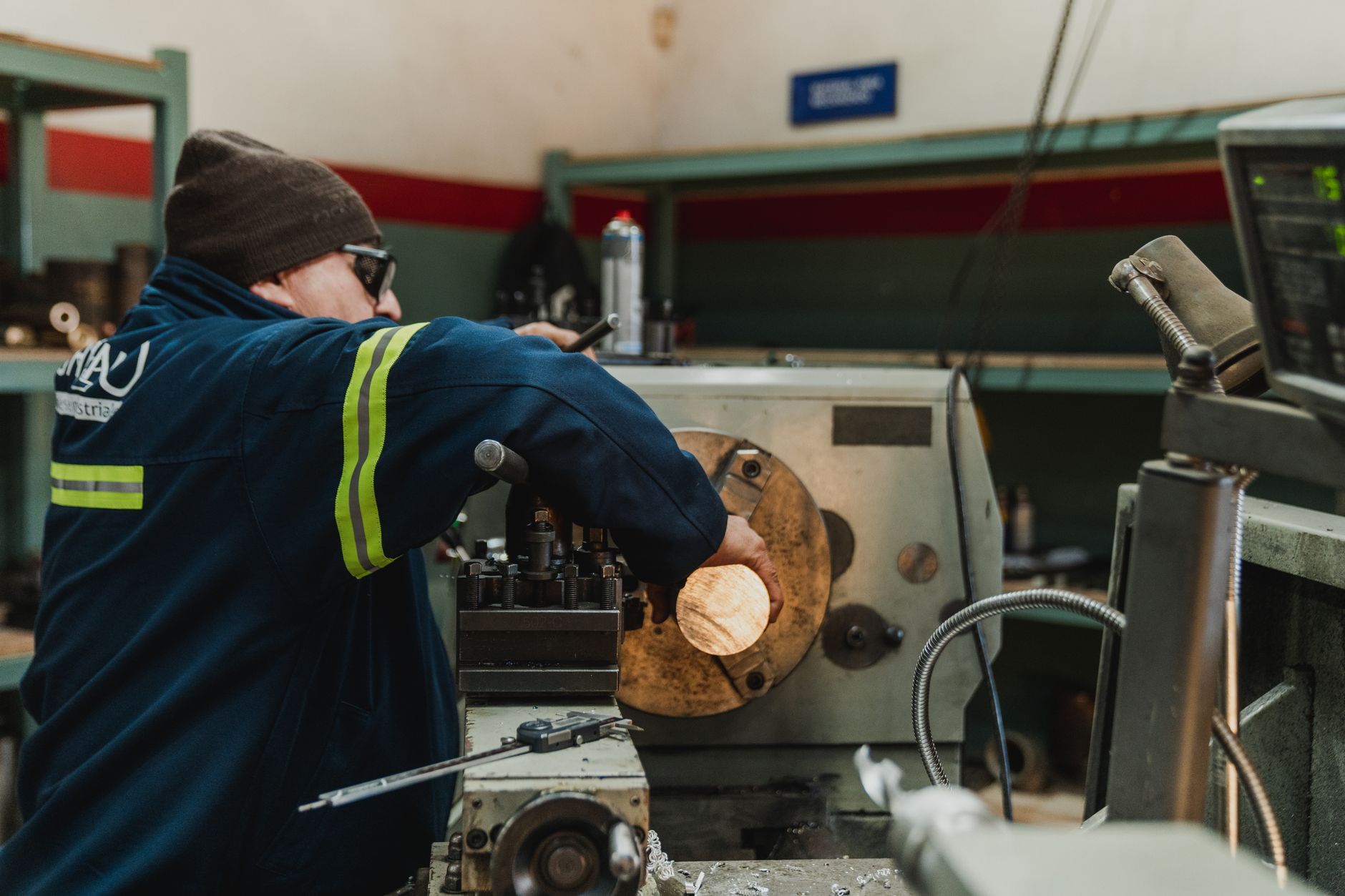
The Machinist Who Hid Behind A Mop
The alarm on the number two boring mill had been screaming for six minutes before anybody thought to ask the man with the mop what he thought was wrong.
I was not supposed to be paying attention. My job at Renke Machine and Tool, the precision shop that sits on the gravel frontage road outside Peoria, was to keep the break room clean, empty the coolant catch basins, and make the epoxy floor around the CNC bays safe enough to walk on without a man losing his footing in a puddle of cutting oil. Nobody paid me to look up when a machine started throwing a fault code. Nobody paid me to know what the fault code meant, either. That was supposed to be the whole point of the job I had chosen for myself three years ago. Invisible work. Work nobody expected anything extra out of.
But I had spent nineteen years of my life inside machines like that one, and old habits do not leave a man just because his uniform changed from a machinist’s coveralls to a set of navy blue custodial scrubs with my first name stitched over the pocket. Conrad. That was all the shop floor knew to call me. Most of the engineers had never once asked what I did before I started emptying their trash cans at six in the morning.
That Thursday, the whole plant had one job that mattered more than any other job running that week. A long time customer up in the Quad Cities had a contract worth two hundred and sixty thousand dollars sitting on the line, sixty finished hydraulic cylinder barrels for a compaction roller assembly, every one of them needing a bore held to four ten thousandths of an inch. If the last twenty two barrels did not ship by end of second shift, the customer’s own assembly line went down Monday morning, and Renke Machine lost the account it had carried for eleven years. Forty some people worked in that building. A lost account that size did not mean somebody’s bonus got smaller. It meant layoffs, the kind that hit a town like ours hardest right before the holidays.
I knew the number because everybody on the floor knew the number. It had been written on the whiteboard by the break room coffee pot in red marker since Monday, underlined twice.
The mill had been running clean all week until that Thursday morning, when the finishing pass started coming back point six thousandths out of tolerance, then a full thousandth, then worse, in a pattern that made no sense to the two engineers standing over the control panel with their laptops open. A random drift like that does not usually come from the program. It comes from something physical, something moving that is not supposed to move, and by the third bad part in a row the lead engineer had his hand pressed flat against his forehead the way a man does when he already suspects he is going to be the one explaining this to the owner.
“It’s not the offsets,” he said, more to himself than to anyone. “We’ve re-zeroed it twice.”
I was thirty feet away, wringing a mop into a yellow bucket, close enough to hear every word, and I already knew what I thought it was. I had known it inside forty seconds of watching the spindle housing on that machine, the particular way it hunted for a beat before it settled, like a diesel engine trying to find its idle. I had chased that exact ghost before, on a machine half this one’s age, in a shop of my own that closed its doors three years ago and that almost nobody at Renke knew I had ever owned.
I told myself it was none of my business. I went back to mopping.