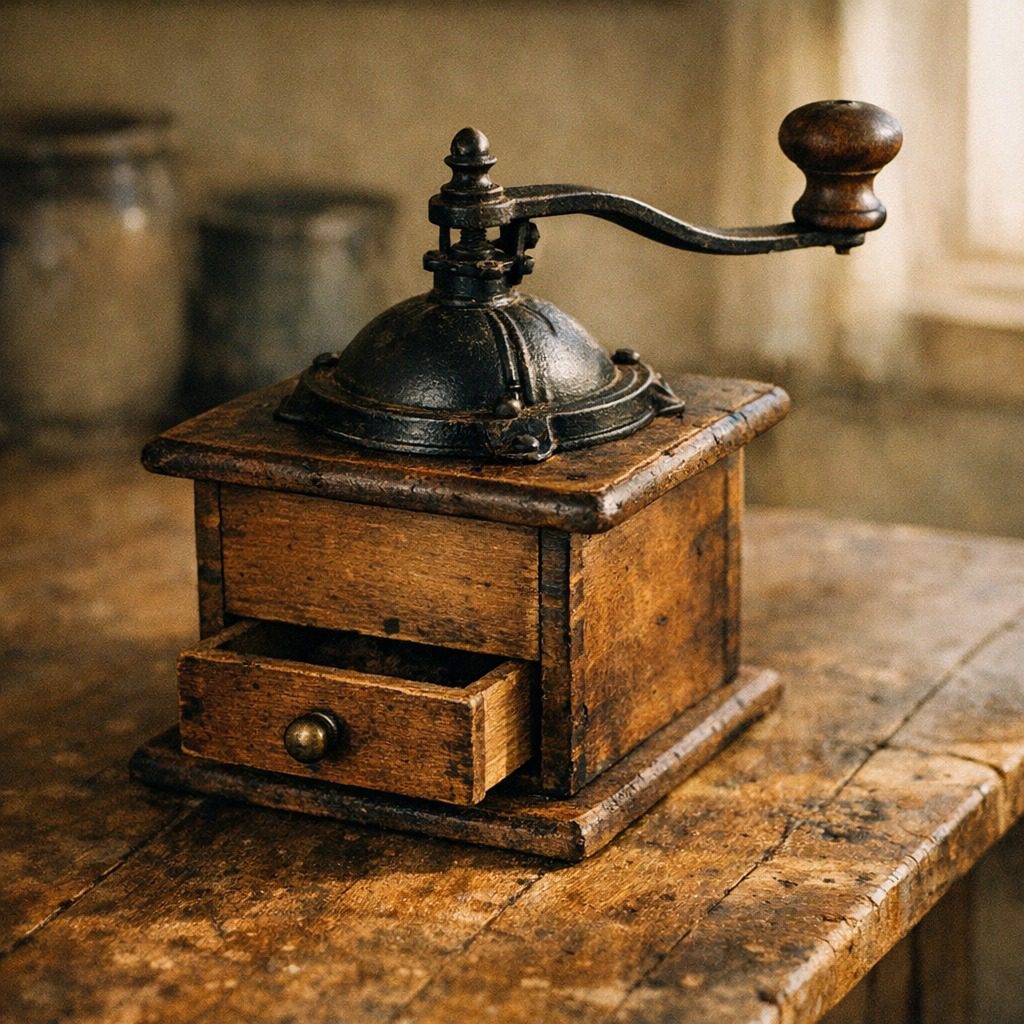
The Coffee Mill They Left Me
The cart
I started small because small was all I could afford, and because my grandfather never trusted anything that started big.
I bought a used concession cart off a man three towns over who had tried and failed to sell corn dogs at the farmers market. It cost me twenty-two hundred dollars, and I paid a welder two hundred more to build a shelf across the back where I could bolt down two hand mills. Not electric. Hand mills. That was the whole idea, the one everyone I told it to said would never work: I would grind every cup to order, by hand, the way my grandfather did at Hobart’s counter, in front of the customer, and I would sell the coffee and the watching of it both.
People said the line would back up. People said nobody would wait. People said in a world of drive-throughs no fifty-five-year-old woman is going to stand at a cart while some lady cranks a coffee grinder by hand. They were wrong, but I will get to that.
I roasted in my apartment kitchen until the smell got me a talking-to from the landlord, and then I rented, for almost nothing, the back room of a shuttered feed store from an old farmer named Gale who owned the building and did not need the money so much as he needed something to happen in a place where nothing had happened in a decade. Gale became, over that first year, something like a stand-in for a grandfather. He sat on a stool and watched me roast in my two skillets and then in the real drum roaster I bought used in month five, and when the second crack came he would say, in exactly my grandfather’s flat way, “There it is,” because I had told him that was what Walt said.
I named the cart Kessler’s. Just Kessler’s. Because it was the family name, and the family had made it clear the name was not for me, and I was taking it anyway.
The line that did not back up
I set up the cart the first Saturday of that summer at the farmers market, in a spot Gale got me for free, and I ground coffee by hand, and I will tell you exactly what happened, because it is the part that still makes me shake my head.
The line did back up. And nobody left.
Here is what I did not understand until I saw it with my own eyes. In a world where everything is fast, slow is not a defect. Slow is the product. People stood at my cart and watched me measure the beans into my hand and pour them into the hopper and count the turns, forty and adjust, and pinch the grounds and rub them along my thumb the way my grandfather taught me, and they slowed down with me. Older folks especially, the ones who remembered a grandparent doing exactly this, got quiet, and more than one of them teared up, and I did not even know why until a woman about seventy told me: “My mother had one of these. I forgot. I completely forgot until right now.”
That is what I was selling. The coffee was good, my grandfather’s blend done right. But what made people wait fifteen minutes and come back every Saturday and bring their sisters was the memory of a slower morning and a person who cared enough to grind it by hand. I was selling their own grandmother’s kitchen back to them.
I sold out both mills of ground beans by eleven that first Saturday. I sat in my truck afterward and counted the money, which came to two hundred and thirty-one dollars, and I laughed until I cried, which by then was a thing I did a lot.