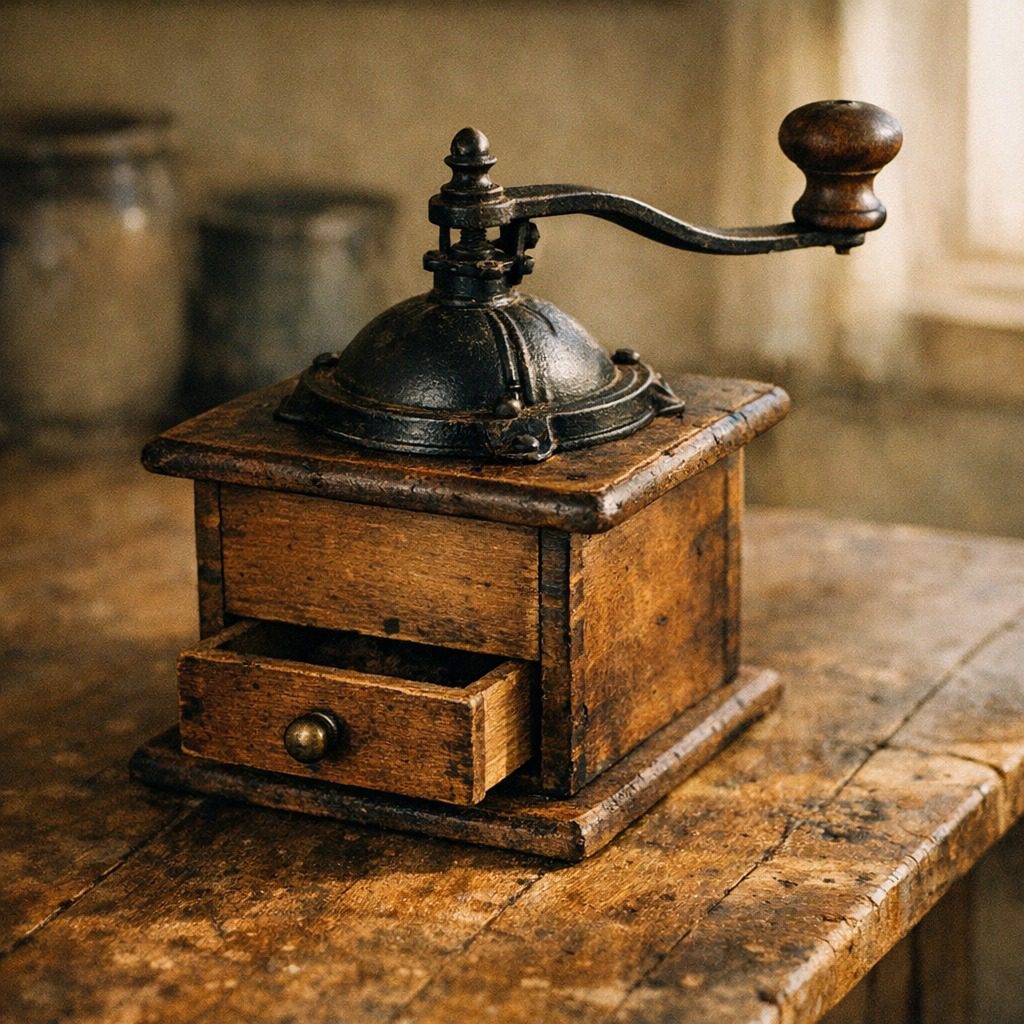
The Coffee Mill They Left Me
Carol at the counter
Carol came into Hobart’s about six months ago.
I did not know she was in town. She walked in on a Saturday while I was on my keg grinding, and I looked up and there she was, older, thinner, in a coat that had been expensive a few years ago, and she stood just inside the screen door and looked at the counter and the men on the stools and the little board that said Walt’s, and something moved across her face that I had never seen on Carol Kessler in my whole life. She looked lost.
She got in the line. She waited, the way everyone waits, and when she got to the counter I set my grandfather’s mill down and looked at her and neither of us said anything for a second.
“I heard you did this,” she said. “I didn’t believe it.”
I asked her what she wanted. I kept my voice even. I had practiced that moment in my head for two years, all the cruel true things I would say, and standing there I found I did not want to say any of them, not because I was better than her, but because those things were hers to carry now, and saying them out loud would only have made them mine.
“Cup of Walt’s,” she said, quiet.
So I made her one. Forty turns and adjust. I ground her coffee by hand at the counter of the store where her father used to grind it, and poured it and set it in front of her, and I did not charge her, because my grandfather never charged anyone at that counter either, and it seemed like the right way to honor him.
She drank it standing up. She got to about the middle of the cup and she stopped and looked at it, and then she looked at me, and her eyes were wet, and she said, “It tastes like his.”
“It is his,” I said.
She nodded. She put a twenty on the counter even though I had not charged her, and she left it there, and she said, in a voice I had never heard from her, “I’m glad somebody kept it.” Then she left, and I have not seen her since, and I keep that twenty in the drawer of my grandfather’s mill, folded small, because some debts get paid in ways that are not money, and I wanted to be able to see one of them.
What the mill was worth
People ask me sometimes, the ones who know the story, whether I am still angry. Whether it bothers me that they got the house and the land and the savings and I got a wooden box.
And the honest answer, the one I have earned the right to give, is that they did not get more than me. They got less. They got the things that could be counted and spent and lost, and they counted them and spent them and lost them. I got the thing that could not be split, and I have spent two years multiplying it, and it is worth more now than when he handed it to me, and it will be worth more still when I hand it to Marisol, or whoever comes after her with the hands to hold it.
My grandfather did not leave me the mill as a joke. Carol made it a joke, in that reception room, because a joke was the only way she could hold a thing she did not understand. But the man who scratched W.K. and an arrow and D.K. into the soft old wood underneath, where only the one who took it apart would ever look, that man was not joking. He was doing the last and most careful thing a maker does. He was choosing the next set of hands.
He chose mine, because I was the one who sat beside him at four-thirty in the morning and learned to count the turns. He chose mine because I was the maker and not the drinker, and he knew, the way he knew every kind of bean by its feel between his fingers, that the money would slip through the others and the work would not slip through me.
I grind coffee by hand every morning of my life, in my own kitchen before the sun, on the box mill they left me as a joke, and I count the turns, forty and adjust, and when the second crack comes off the roaster in the back of Hobart’s I still say it out loud, to the empty room, to him.
There it is.
There it is.