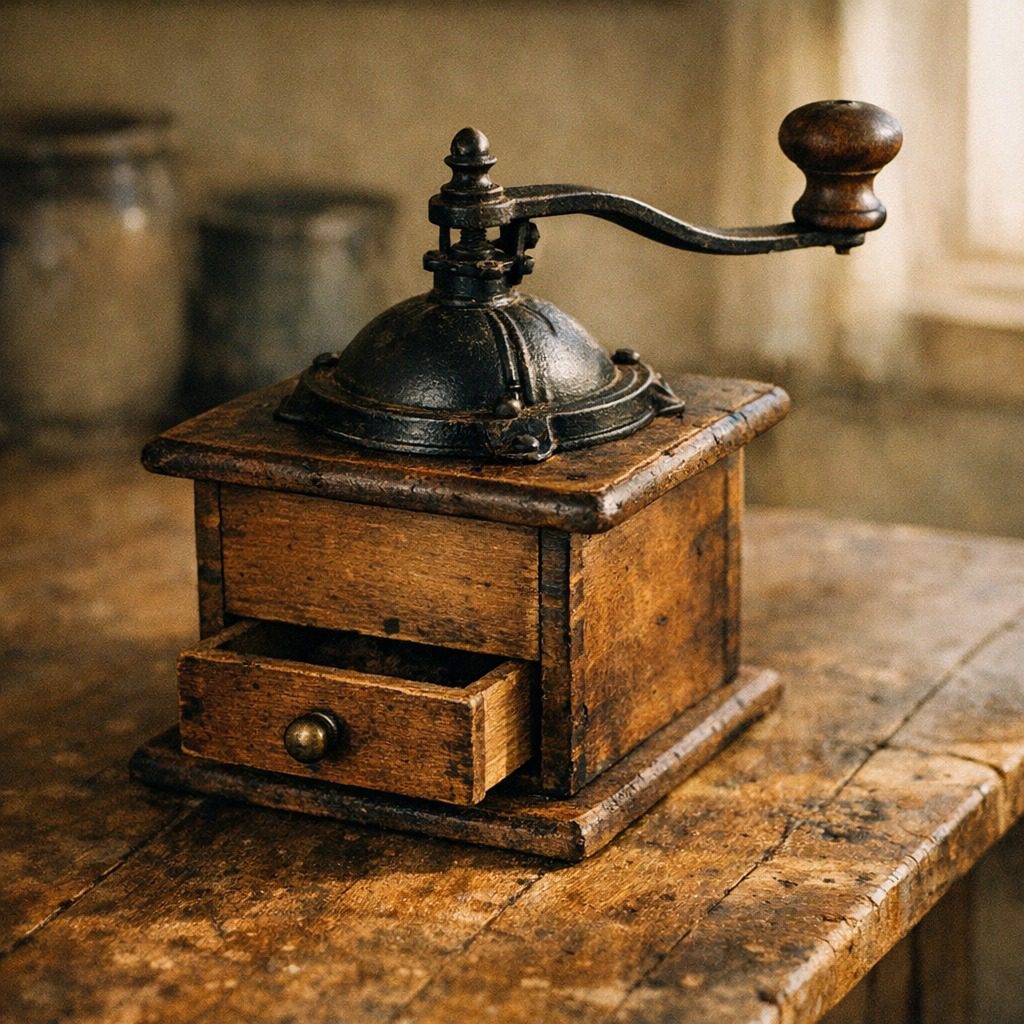
The Coffee Mill They Left Me
What I found
I want to be careful here, because this is not a story about hidden money in a false bottom, and I will not cheat you with a twist like that. There was no cash. There was no deed rolled up inside the crank. I checked, I will admit I checked, I took the whole thing apart on my kitchen table that first raw week because part of me needed there to be a reason, needed my grandfather to have hidden my real inheritance inside where the greedy ones would not think to look. There was nothing like that. It was a coffee mill and it was only a coffee mill.
But when I had it apart, down to the base, I turned the wooden bottom over in the light and I saw that someone had scratched into the underside of it, into the soft old wood, two sets of initials and a line between them. W.K. and then a little arrow, and then D.K.
Walt Kessler. Della Kessler.
The wood was pale in the grooves, which meant it was not old. It had not been ground into darkness by a hundred years of handling. He had done it recently, in the last year, with a nail or an awl, an old man’s shaky letters. He had marked it. Not in the will where the lawyer would read it and Carol would sniff and Pete would look at his phone. He marked it where only the person who took the mill apart to understand it would ever find it. He knew I would take it apart, because he knew me, and he knew Carol would have thrown it in a drawer and Pete would have sold it at auction for four dollars. I was the only one who would ever turn it over and look.
He did not leave me the money because the money was not the thing. He left me the only thing that could not be split, or spent, or understood by anyone who had not sat beside him at four-thirty in the morning and learned to count the turns. He left me the work.
I sat on my kitchen floor with the base of that mill in my two hands and I read those initials maybe two hundred times, and something in me that had been broken since I was seven years old finally, quietly, set itself back into place.
The idea, and the fear
I did not have a plan the next morning. Grief does not hand you a plan. What I had was a Saturday and a hand mill and a cast iron skillet and a bag of green beans I had ordered for my grandfather that arrived four days after he died, which is a cruelty the mail does not know it commits.
I roasted them anyway, and ground a batch by hand, forty turns and adjust, and made a pot of my grandfather’s blend for the first time since he had gone, and drank it standing at the window, and it was right. It was exactly right. And I thought, with a clarity that frightened me, this is the best thing I know how to do and nobody knows I can do it.
I was forty-one years old. I had nine thousand dollars in a savings account, a lease that was up in two months, and a job at a call center that was slowly killing me. Every reasonable voice I had ever internalized, most of them in Carol’s voice, told me that people like me do not start things, that we keep our heads down and take the deductible calls and are grateful for the paycheck. But I kept coming back to the initials on the underside of the base. A man who did not waste words or motions had spent his failing strength scratching an arrow into a piece of wood, and the arrow pointed at me, and I was going to stand there and take deductible calls?