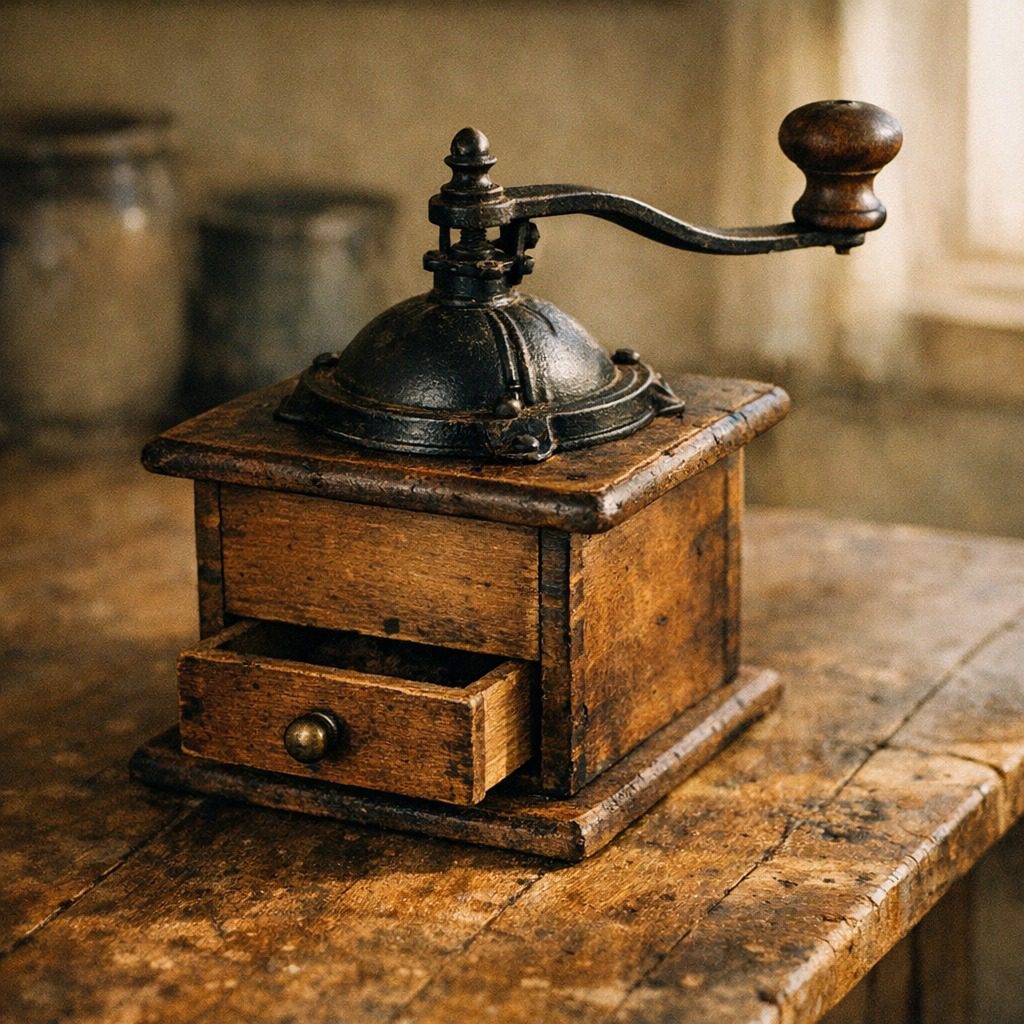
The Coffee Mill They Left Me
The farm and the man who ran it
Let me back up, because you cannot understand the mill without understanding the kitchen it lived in.
My grandfather was Walt Kessler. He ran a hundred and sixty acres of corn and soybeans outside a town in eastern Nebraska so small that the grain elevator was taller than the water tower and both were taller than anything else for eleven miles. The house was white clapboard with a wraparound porch that sagged on the west end where a maple root had heaved the footing. There was a red barn, a machine shed, a chicken run my grandmother kept until she died, and a windbreak of cedars he had planted the year my mother was born, that stood forty feet tall by the time he was buried under them.
I grew up two counties over, but my mother was a single parent working doubles at a hospital laundry, and so from the time I was seven I spent every summer and most weekends at the farm. My cousins came too, Carol’s kids and Pete’s kids, but they came the way you visit a place. They came for the pond and the four-wheeler and Grandma’s pie, and they left the second there was somewhere better to be. I stayed. Not to make myself the saint of this story. I stayed because the farm was the only place where the noise in my chest went quiet, and because my grandfather was the only adult in my life who looked at me like I was a person and not a problem to be managed.
He was up at four-thirty every morning, and for years I was up with him, first because a kid sleeping in a strange house wakes with the light, and later because I did not want to miss it.
The morning went like this. He came down in his sock feet so as not to wake my grandmother. He filled the kettle and set it on the burner. He took a coffee tin down from the shelf above the stove, a real tin with a lid that fit tight, and shook a measure of beans into his hand, and then he sat down at the kitchen table with the box mill between his knees and ground the coffee by hand.
He could have used an electric grinder. Carol bought him one for Christmas when I was maybe twelve, a whirring plastic thing, and he thanked her and set it in the cabinet and I do not believe it was ever plugged in. He ground by hand because his father had ground by hand, and because the hand mill did not heat the bean the way the fast blades did, and heat was the enemy of the thing. “You cook it twice,” he said, “once in the roast and once in the grind, and the second time you cook it you kill it.” I have since learned that is more or less true, that friction heat does scorch coffee, but at the time I only knew that he believed it, and that his coffee was better than any coffee anywhere, and those two facts felt connected.
The counting
Here is the part I have never told anyone, because it sounds like a made-up detail from a movie, and it is the truest thing in this whole story.
He counted the turns of the crank.
Not out loud. I did not even know he was doing it for the first few years. But one morning when I was maybe ten I asked him how he knew when it was done, because the drawer never looked full to me, and he said, “You do not look. You count.” And he showed me. For his morning pot he cranked forty times, then opened the drawer and pinched the grounds and rubbed them along his thumb, and if they felt right he was done, and if they felt too coarse he closed the drawer and gave it eight or ten more. Forty and then adjust. Different beans, different count. A hard dark bean took fewer turns because it shattered, a softer light-roast bean took more, and he kept the whole map of it in his head, even when the co-op changed suppliers and the beans came in oilier or drier.
He taught me the count the way you teach a language, by doing it in front of someone ten thousand times until the grammar of it lives in their hands. By the time I was fifteen I could grind his morning pot and he would taste it and nod, and a nod from Walt Kessler was worth more than a trophy. My cousins never learned. Ryan tried it once, cranked it like he was starting a lawnmower, jammed the mechanism, and handed it back and said this is why they invented Mr. Coffee. Everyone laughed. My grandfather did not. He cleared the jam and set the mill right and said nothing, and later, when we were alone, he said, “Some people drink coffee. Some people make it. Do not ever let anybody tell you which one is worth more, because the makers built every good thing there ever was.”
I have held onto that sentence for two years like a railing.