
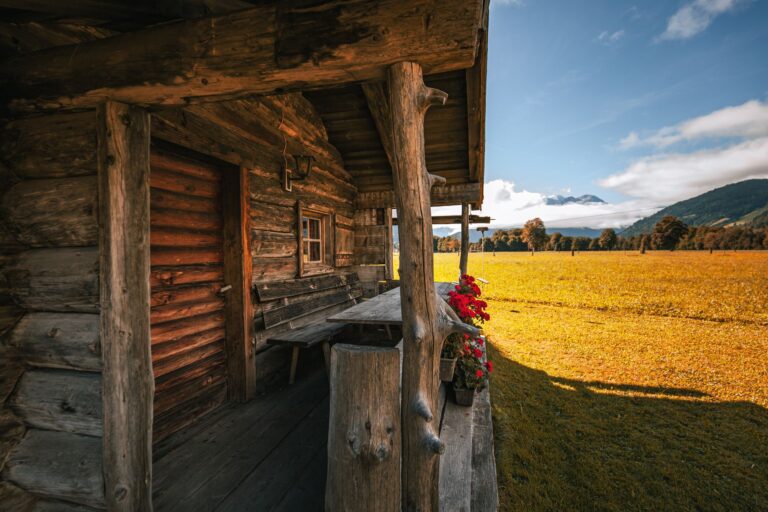
Woodsmoke and wet pine hung so thick over my porch that evening I almost didn’t hear the phone ringing inside. Behind me, Sawtooth Ridge was going purple with the last of the light, and down in the hollow somebody’s dog was barking at a shadow that wasn’t there. Up on that mountain there was rarely a reason to hurry for a phone. Then I saw the name on the screen. Zebedee. My son.
I could hear the party behind his voice before I heard him. A woman laughing too hard at something, the bright clink of glasses, somebody’s playlist thumping low under it all. He must have stepped out onto his own porch to make the call, because I could hear a screen door bang and the noise drop to a murmur.
“Hey, Dad.” Easy. Relaxed. Like he was telling me the score of a ballgame. “So, quick thing. Kelbourne and Wynelle are gonna move up to your place next month. Get settled before the holidays.”
I stood there with my hand on the porch rail and didn’t say anything, because for a second I honestly thought I had misheard him.
“Larissa’s folks,” he said, like I might not remember who Kelbourne and Wynelle were, like they hadn’t sat across from me at Thanksgiving every year since he married her. “They lost the restaurant, Dad, you know that. They’ve been on our couch for four months and Larissa’s about to lose it. You’ve got that whole upstairs sitting empty. Doesn’t make sense for you to have all that space and them crammed in our guest room.”
“Zebedee.” I got that much out before he kept going.
“It’s already basically settled. I told them it’s fine. You’ve got the room, you’re up there by yourself anyway, it’s not like you’re doing anything with it.” A pause, and behind him the woman laughed again, sharp and bright, and ice rattled in a glass. Then he said the part I will hear for the rest of my life. “If you don’t like it, Dad, go back to the city. Get a condo or something. This isn’t that complicated.”
He said it the way you’d tell somebody the trash truck comes on Tuesdays now instead of Monday. Not cruel, exactly. Worse than cruel. Bored. Like the whole conversation was a formality he was getting through so he could get back to his party.
I did not argue with him. I want that understood, because everything that came after only makes sense if you understand that. I did not raise my voice. I did not tell him about the twenty summers his mother and I spent hauling lumber up that mountain road in the bed of a pickup that overheated on every switchback. I did not tell him that “go back to the city” meant leaving the only place on this earth that still smelled like her. I said, “All right, Zebedee. I hear you.” And I hung up, and I stood on my porch in the dark with the phone still warm in my hand, and somewhere down in the valley that dog kept on barking at nothing.
I am sixty-eight years old. I built this house with my own two hands and my wife’s steady ones, and that phone call is the moment I finally understood, all the way down, that my son had stopped seeing either of those facts as something that mattered.
My name is Holt Ashwell. For forty-one years I ran Ashwell Diesel and Machine, a cinderblock shop at the bottom of the valley road that my own father started and that I grew from two bays into six. We fixed the log trucks and the county graders and the farm equipment for half the families in that valley. I was not a rich man, but I was a steady one, and steady, in a diesel shop, is its own kind of wealth. Marielle used to say I could diagnose an engine by the sound it made walking past it, the way other men could tell you the weather by their knees.
We bought this land the year I turned thirty, forty acres of scrub oak and granite outcrop up on Sawtooth Ridge that nobody else wanted because the road up was too rough and the water table was too deep to drill cheap. We could only afford it because nobody else was bidding. Marielle walked the property line with me the day we closed on it, in her church shoes because we hadn’t planned on hiking, and she stood at the spot where the ridge opens up over the whole valley and she said, “This is where the porch goes.” Not a question. She’d decided already.
It took us twenty years to build what she saw that day. We didn’t have a contractor’s budget, so we had a contractor’s patience instead. Every summer weekend, every evening after the shop closed, we hauled lumber up that switchback road a truckload at a time. I poured the foundation myself over three exhausting weeks the summer Zebedee turned nine, and Marielle mixed concrete in a wheelbarrow while he napped in the truck cab with the windows cracked. We framed it ourselves, the two of us and my old foreman Dell on weekends, and when we finally got the roof on, the three of us stood under it in a rainstorm just to hear what it sounded like, and Marielle cried, and I did too, though I’ve never admitted that to anyone until now.
We didn’t move up here full time until I retired, six years ago, and sold the shop to a mechanic I’d trained myself, a young man named Quinlan who came back from two deployments with a bad knee and a resume nobody in the valley would touch. I’ll come back to Quinlan. He matters to how this ends.
Marielle and I had four good years up here together before a stroke took her in her sleep on a Tuesday in March, four years ago now, in the bed she’d chosen the spot for with her church shoes on. I buried her on the ridge under the rhododendrons she’d planted the first spring we owned the land, and I have lived up here alone since, at peace in a way I did not expect grief to allow. The mountain does not ask anything of you that you cannot give. It only asks that you show up for it, the way it showed up for us.
Get a new story in your inbox every morning.
Facebook doesn’t show you every story we post. Our free newsletter does. Join 2,500+ readers.
That peace is the thing my son offered to a stranger over the phone, on his way back to a party, without once asking me a question.
I need to tell you what it cost me to raise that boy, not because I want credit for it, but because you cannot understand how deep that phone call cut without understanding what came before it. Zebedee was born the year the shop finally turned a real profit, and I worked every hour the shop would give me for the next eighteen years to make sure he never once felt what I’d felt growing up poor in that same valley. I worked Saturdays so he could play travel ball. I cosigned his first truck loan at twenty-two when no bank would touch him on his own credit, and I paid the difference twice, quietly, when he fell behind and was too proud to tell me. I covered what his scholarships didn’t at the state college, four years, without complaint, because his mother and I had agreed a long time before that our son would never carry the kind of debt that keeps a man small his whole life.
When Zebedee married Larissa six years ago, I gave them the down payment on their first house outright. Not a loan. A gift. Marielle and I sat at our own kitchen table and wrote that check together, and she told me afterward it was the best money we ever spent, because it meant our son would start his marriage without the weight we’d started ours under. I believed that too, once.
Larissa’s parents, Kelbourne and Wynelle Duvane, ran a restaurant two towns over for almost thirty years, a decent little steakhouse that did a brisk business until the state rerouted the highway around the town and the traffic that used to stop for supper started driving straight through instead. They held on two years longer than they should have, mortgaging the building twice trying to keep it alive, and when it finally folded they had nothing left but debt and each other. That part isn’t their fault, and I’ve never held it against them. People lose things. I understand that better than most.
What I hold against them, and against my son, is what happened after. Kelbourne and Wynelle moved in with Zebedee and Larissa a little over a year ago, meant to be temporary, and temporary calcified into permanent the way it does when nobody wants to be the one who says the word out loud. I noticed the shift before Zebedee ever called me. At Thanksgiving last year, Kelbourne stood at my porch rail with a plate of turkey he hadn’t touched and looked out over the whole valley and said, half to himself, “Must be, what, forty acres up here? Prime land like this.” He wasn’t asking. He was appraising. I let it go, because I’d built a whole life on letting small ugly things go for the sake of peace at the table.
A few weeks before the call, Larissa made a joke at a family dinner, the kind of joke people make when they’re testing whether you’ll object. She said something about how, once the mountain place was “ours,” she’d want to redo the kitchen. Ours. Not “yours someday” or “Zebedee’s inheritance.” Ours, present tense, already decided, already spent in her head. I laughed it off at the table because that is what you do, and I drove home that night with my hands too tight on the wheel, and I told myself I was imagining the weight in it.
I was not imagining it. I understand that now.
The call came on a Friday. I sat on my porch a long time after I hung up, until the cold came up off the ridge and the stars came out hard and close the way they do at that elevation, and I thought about the whole shape of my life. Forty-one years in that shop. Twenty years building this house one truckload of lumber at a time. Eighteen years making sure my son never wanted for anything. Four years alone on this mountain with my wife’s grave under the rhododendrons at the tree line. And at the end of all of it, my own son had looked at everything Marielle and I built and seen an empty guest room he was entitled to fill with someone else’s parents, because I was, in his words, not doing anything with it.
I did not cry that night, though I came close more than once. Mostly I sat very still and let something in me go quiet and cold and clear, the way a shop goes quiet after the last customer’s truck pulls out and you can finally hear exactly what’s wrong with the engine you’ve been putting off. I had spent my whole life being the man who absorbed things without complaint, for Marielle’s sake, for Zebedee’s sake, for the sake of a peace that turned out, in the end, to only run one direction. I decided that night that I was done absorbing.
The next morning, before the coffee had even finished dripping, I drove the switchback road down into the valley to see Elderidge Cranmer.
Elderidge and I went to the same one-room grade school forty years before either of us had gray in our hair, and he’d handled every piece of paper Marielle and I ever signed, the deed to this land, our wills, the sale of the shop to Quinlan. Two years ago, not long after Kelbourne made his little comment about prime acreage at another gathering I’d since half forgotten, Elderidge had said something to me over coffee at the diner that I hadn’t taken seriously at the time. “Holt,” he’d said, “you’re sitting on forty acres, paid off, no mortgage, no partner, and you’re the kind of man who’d hand somebody the keys before you’d make them ask twice. You ought to protect that place. Not from Zebedee. From the day somebody talks him into thinking it’s already his.” I’d laughed it off then. I told him Zebedee was a good boy and I didn’t need a trust to know that.
I did not laugh it off that Saturday morning. I sat across the desk from Elderidge in his little office above the hardware store and I told him what my son had said on the phone, word for word, and Elderidge listened without interrupting, and when I finished he took his glasses off and rubbed the bridge of his nose the way he does when something makes him tired in his soul rather than his eyes.
“You want to punish him,” he said, “or you want to protect the place.”
“I want it to never again be something somebody else gets to decide the future of over a phone call at a party,” I said.
That was the whole answer, and Elderidge understood it, and by noon we had drawn up the frame of an irrevocable trust. The land and the house would no longer be mine to give away, sell, or hand off on a whim, mine or anyone else’s. I would keep the right to live in it for as long as I wanted, alone, on my own terms, with the explicit condition, written into the document itself, that no other resident could move onto the property without my written consent. Zebedee would not inherit it. I named a different beneficiary, the eventual owner once I chose to leave the mountain for good, and I want to tell you exactly who, because it matters.
Quinlan, the young man I’d sold the shop to, had come home from his second deployment six years ago with a knee that would never again let him run and a discharge packet that half the shops in the valley treated like a warning label instead of a résumé. I hired him when nobody else would, because I remembered what it was to be a young man nobody trusted with anything real, and within two years he was running half the shop floor better than I ever had. He married a sweet, sharp-tongued young woman named Aveline, a hospice nurse who used to stop by the shop on her lunch break just to needle him, and the two of them have been raising their first baby in a rented single-wide on the edge of town because the valley’s housing has gone the way housing goes everywhere now, out of reach for people who actually do the work that keeps a place running.
I named Quinlan and Aveline as the trust’s eventual owners. Not as charity. As the truth of who had actually earned a claim on that mountain, the way my father would have understood the word earned. Elderidge had the paperwork ready to sign by Monday. I signed it in his office with two witnesses from the hardware store downstairs, and by Monday afternoon, the house Marielle and I built with our own hands was legally, permanently, no longer mine to hand to anyone Zebedee decided deserved it.
Kelbourne and Wynelle were set to arrive in three weeks. I had that long to decide what they would find when they got there, and I did not want it to be cruelty. I wanted it to be the truth, laid out plain, the way a good mechanic lays out exactly what’s wrong with an engine and lets the owner decide what to do about it.
I spent those three weeks quietly, the way I do most things. I did not call Zebedee to argue, and he did not call me to check, which told me everything about how settled the matter already was in his mind. I walked the property line the way Marielle had walked it in her church shoes thirty-eight years before, and I sat on the porch she’d chosen the spot for and watched the light change over the valley, morning and evening, trying to memorize it the way you memorize a face you’re not sure you’ll see again. I went out to the rhododendrons at the tree line and told her what I’d decided, out loud, the way I still talk to her sometimes when nobody’s around to think it strange. I told her I hoped she’d understand it wasn’t about Zebedee stopping being our son. It was about making sure nobody could ever again treat what we built like it was theirs to redistribute.
I called Birdie Loach, my nearest neighbor and the closest thing I have left to an old friend in this world, and I told her the whole of it over coffee at her kitchen table. Birdie’s husband died the same year Marielle did, and the two of us had gotten into a habit of looking out for each other since, nothing more than that, just two old people who understood the particular silence of a house built for two. Birdie listened to the whole story without interrupting, the way Elderidge had, and when I finished she reached over and put her hand flat on the table, not on my hand, just on the table between us, and said, “Holt, that boy needed somebody to finally tell him no. You’re not being cruel. You’re being the first honest thing that’s happened to him in years.”
I decided, in that last week, that I would not stay to watch it happen. I did not want to see the look on Kelbourne and Wynelle’s faces when they found the door locked, and I did not particularly want Zebedee’s first sight of me, after that phone call, to be me standing on the porch like a man defending a fort. I wanted the paperwork to do the talking, the way it should have from the start, since paperwork was the only language that call had actually been spoken in.
I hired a locksmith from two towns over, a man with no connection to Zebedee or anyone in our family, and had every lock on the house changed the Thursday before the Duvanes were set to arrive. I packed two suitcases, the same number Marielle and I had once used to move into a small apartment the year before we bought this land, which felt right somehow, a small closing of a circle. I moved myself into the guest cottage I’d built behind the old shop years before, back when Marielle and I would come down for the weekend farmers market and want a bed closer than the mountain. Quinlan had been keeping it in good repair without ever being asked to. It has one bedroom, a woodstove, and a view of the valley instead of the ridge, and I want you to know, before I tell you what happened next, that I was not miserable in it. I felt, for the first time since that phone call, like a man standing on solid ground again.
I left one thing behind at the house. A single envelope, taped to the front door at eye level, where nobody arriving could miss it.
Inside was a short letter in my own hand, and a business card. The letter said this:
Zebedee, Kelbourne, Wynelle. This house is no longer mine to offer anyone. It belongs to a trust now, one that protects it from ever again being treated as available for the taking, by anyone, including me. I love you, Zebedee, and that has not changed. But I built this place with your mother’s hands and mine, and I will not spend what’s left of my life being told to leave it or share it by a phone call from a party. Mr. Cranmer can answer any questions you have. I am not hiding from you. I am simply done being assumed. Dad.
I asked Elderidge to be there the morning they arrived, not to gloat, and not to hide behind either. I asked him to stand in for me because I did not trust myself yet to say what needed saying without my voice shaking, and because some things land harder coming from a man in a collared shirt with a folder of paperwork than from a father who might, in the moment, soften.
Elderidge told me about it afterward, in enough detail that I could see it as clearly as if I’d stood on the porch myself.
They came up the switchback road on a Saturday morning in a U-Haul trailer hitched behind Zebedee’s truck, Kelbourne and Wynelle following in their own sedan packed to the windows with the last of what the restaurant failure had left them. Zebedee had told them, apparently, that the key would be under the mat, that I always kept it there, which had been true for thirty years and was true no longer.
Elderidge said Wynelle got out of the car first and stood on the porch a long moment before she noticed the envelope, running her hand along the doorframe the way you do when you’re already deciding where the furniture goes. Kelbourne tried the door, found it locked, and knelt to check under the mat with the particular irritation of a man who assumes a problem is small until it proves otherwise. It was Zebedee who finally saw the envelope with his name on it.
Elderidge said he watched my son’s face change three separate times reading that letter. The first was confusion, plain and simple, the look of a man who cannot make the words in front of him line up with the world he expected to wake up into. The second was anger, and it came fast, his jaw working, the letter crumpling a little in his fist before he caught himself and smoothed it back out to read it again. The third took longer to arrive, and it was the one Elderidge said he’d remember. Something that looked almost like recognition. Like a man realizing, for the first time in longer than he’d admit, that his father had never once said no to him before, not really, not all the way, and that the no, when it finally came, had been earned by every yes that came before it.
Wynelle demanded to know what was going on. Kelbourne wanted to see the deed himself, as if reading it would change what it said. Elderidge walked them through it plainly, the way he’d walk any client through a piece of paper: the house and the land belonged to an irrevocable trust now, I retained the right to live there myself for as long as I chose, no other resident could be added without my written consent, and the ultimate beneficiary, upon my eventual departure, was not Zebedee, and was not the Duvanes. It was a family Elderidge did not name, out of respect for Quinlan and Aveline’s privacy, though I’ve named them to you here because I think they’ve earned the telling.
Zebedee, Elderidge said, went quiet after that. Really quiet, not the sullen kind. He asked Elderidge one question, and it’s the one detail from that morning I’ve turned over in my mind more than any other. He asked, “Did he do this because of what I said, or because of everything before it?”
Elderidge told him the truth, because that’s the only thing Elderidge has ever known how to tell anybody. “Both,” he said. “But mostly the second one. Your father’s been absorbing things for a long time, son. This is just the first time he decided not to.”
Kelbourne and Wynelle did not take it well, not at first. Wynelle said something about lawyers, about elder manipulation, about how a man my age couldn’t possibly have understood what he was signing, which is a particular kind of insult when you consider she’d never once asked whether I wanted them there in the first place. Elderidge, calm as ever, told her that the trust had been drawn up with two independent witnesses, that I’d driven myself down the mountain of my own accord to sign it, and that any lawyer she hired was welcome to review the paperwork, at her own expense, and would find exactly what he was telling her. She did not hire a lawyer. I think, in the end, some part of her knew there was nothing crooked in it to find, only something final.
They turned the U-Haul around that same afternoon. Kelbourne and Wynelle spent six weeks in a cramped extended-stay motel off the highway before they found a small rental apartment in town, the first place either of them had lived that wasn’t tied to family or business in almost thirty years. I heard, secondhand, that it humbled them in ways nothing else had, having to explain to old customers and church friends why the mountain retirement they’d been telling everyone about had fallen through. I take no pleasure in that. I take a quiet, private satisfaction in the fact that it was never mine to give them in the first place, and that the truth of that finally had to be said out loud by somebody.
Zebedee did not call me for eleven days. When he finally did, I let it ring twice before I answered, not out of spite, but because I needed the extra two seconds to make sure my voice would hold. He did not open with an apology. He opened with anger, the way people often do when shame is coming up behind them faster than they can outrun it. He said I’d humiliated him in front of his in-laws. He said I’d made a decision that affected his family without ever once talking to him about it first.
“You made a decision that affected my family without ever once talking to me about it first,” I told him. “You just made yours over the phone at a party. I made mine with a lawyer and two witnesses, sober, in daylight. I’ll let you decide which one of us actually thought it through.”
He hung up on me that day. I let him. Some doors have to slam before anybody’s ready to walk back through them honestly.
I spent the next few months settling into the guest cottage the way you settle into any smaller life after a large one, slowly, and with more contentment than I expected. Quinlan had me back in the shop two or three afternoons a week, not to work, exactly, my hands aren’t what they were, but to sit on the stool by the parts counter and tell him what I was seeing when a customer described a sound their engine made, the same trick Marielle used to tease me about. Aveline had the baby that winter, a girl, and she brought her by the cottage some evenings so I could hold her while Aveline caught a breath she hadn’t had in weeks. Birdie came around most Sundays with a pie or a casserole, and we sat on my little porch that looked out over the valley instead of the ridge, and I found, to my own surprise, that I did not miss the mountain house nearly as much as I’d expected to. I think some part of me had built that house for a version of my life that had already ended the day Marielle did, and coming back down into the valley, closer to people who actually needed me, felt less like retreat and more like arriving somewhere true.
It was Larissa, in the end, who cracked the thing open. She called me herself, four months after the U-Haul turned around, and she did not make excuses for her parents or for her husband. She told me she’d watched her own mother and father lean on Zebedee for a year, watched Zebedee start to resent them for it in ways he never said out loud, and watched all of that resentment come out sideways, aimed at me, because I was the safest target he had, the one person who’d never once told him no. “I should have said something before that call happened,” she told me. “I didn’t. I’m not calling to ask you to undo anything. I just wanted you to know I finally see it.”
Zebedee came to see me on his own, three weeks after that, on a Sunday afternoon, without Larissa, without calling ahead. I was on the cottage porch when his truck came up the gravel, and I watched him sit in the cab a full minute before he got out, the way a man sits gathering himself before he walks into a room he’s not sure will let him back in.
He did not launch into an apology right away. He sat down on the porch step, not the chair beside me, the step, like he wanted to be lower than me for once, and for a while neither of us said anything, and the valley did what it always does in late afternoon, went gold and quiet and unhurried, no matter what the people sitting in it were carrying.
“I’ve been trying to figure out how I got to be a man who’d say that to his own father,” he finally said. “Go back to the city. I keep hearing myself say it and I don’t even recognize the voice.”
I told him the truth, because I’d promised myself, sitting with that letter three weeks before I ever taped it to a door, that I would not spend what time I had left saying anything to my son that wasn’t true. I told him I understood how a man gets there. I told him about years of watching him get handed things without having to ask twice for them, the truck loan, the tuition, the down payment, all of it given freely and gladly, because Marielle and I never wanted him carrying what we’d carried. I told him I thought, somewhere along the way, all that giving had quietly taught him that things simply arrived, that space simply existed to be filled, that a father simply existed to be leaned on and never asked. “I don’t say that to blame you entirely,” I told him. “I built some of that lesson myself, one gift at a time, without ever meaning to.”
He cried on that porch step, not the performance kind, the kind that comes up out of a man against his will and embarrasses him even as it’s happening. He told me he wasn’t asking for the house back. He told me he understood, now, why I’d done what I’d done, and that some nights since he’d lain awake picturing his mother standing at that tree line the day we closed on the land, picturing the two of us hauling lumber up a switchback road for twenty years, and feeling something close to disgust at the version of himself who’d looked at all of that and seen an empty guest room.
We did not fix it all in one afternoon. Anybody who tells you a single conversation repairs years of taking somebody for granted is selling you something. But he started coming by the cottage every other Sunday after that, sometimes with Larissa, sometimes alone. He started helping Quinlan out at the shop on Saturdays, learning, at thirty-four, some of the same trade his grandfather taught me, hands in an engine instead of a phone. It has been slow, honest work between us, the way real repair always is, and I have let it be slow, because I would rather have a true thing built carefully than a fast one built to make me feel better in the moment.
Kelbourne and Wynelle, I’ll tell you plainly, have never apologized to me, and I no longer expect them to. They settled into their little rental in town, and Kelbourne found work managing the parts counter at a farm supply store two counties over, and I hear from Larissa that the humbling of it, small as it was, did something good for both of them that a comfortable guest room upstairs never would have. I do not need their apology. I have the deed, or rather, I have the trust that says the deed no longer belongs to anyone’s assumptions at all, mine included, and some nights that is enough peace to fall asleep on by itself.
Last spring, I made the decision I’d known was probably coming since the day I signed the trust. I moved out of the cottage for good, deeded my remaining occupancy rights to Quinlan and Aveline early, and let them and the baby move up into the mountain house Marielle and I built board by board, twenty summers of our life folded into every wall of it. I go up on Sundays now, when they’ll have me, and I sit on the porch Marielle chose the spot for, and I watch their little girl chase the barn cats across the same grass Zebedee once played in as a boy, and I think there is something right in it, something that closes a circle instead of just breaking one. The house went, in the end, to people who understood exactly what it cost to build a life from nothing, because they were living that lesson themselves when nobody else would give them a chance to.
Zebedee has never asked to inherit anything from me since, and I think that absence of asking is, strange as it sounds, the truest gift he’s given me back. He visits the mountain house now same as I do, on Sundays, and he sits on that porch beside his own father in a chair his mother picked out the spot for, and neither of us needs to say out loud what it means that he’s finally there because he was invited, not because he assumed he was owed it.
I am sixty-nine years old now. I live simply, in a small cottage with a woodstove and a good view, closer to the people who show up than I ever was up on that ridge alone. I did not do any of this to punish my son. I did it because a man who spends his whole life being generous eventually has to decide whether generosity and being taken for granted are the same thing, and I had finally, at sixty-eight, learned the difference.
Marielle used to say a house isn’t the wood and the nails, it’s who you build it for and who you let live in it after. I think about that every Sunday I climb that switchback road and see smoke coming steady from the chimney she picked the spot for, and I know, without a single doubt left in me, that I finally got that part right.
This story is a dramatization. Names, characters, and details are invented, and any resemblance to real people or events is coincidental.