
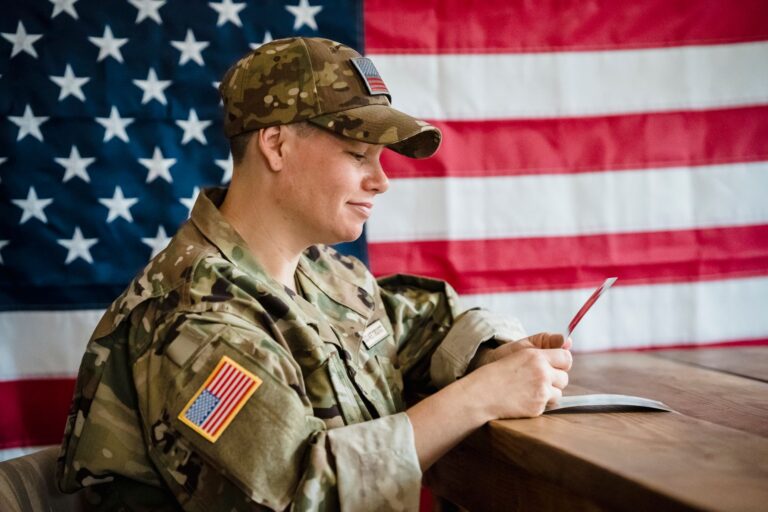
Hollis Deemer waited until the whole room was quiet, then pointed his beer at me and said, “Renata here was never really in it. You know how it was. The women just drove trucks in the rear.”
I was sixty-one years old, standing under a paper banner that read WELCOME HOME 1990-1991 in a rented hall behind a Baptist church in Sallow Creek, Missouri, and for one long second I could not feel my own hands.
There were maybe forty of us in that room. Men mostly, in ball caps that said things like DESERT STORM VET and PROUD TO HAVE SERVED, some of them heavier now, some of them thin and gray in a way that made me do the math on how long it had been. Thirty-five years. Thirty-five years since a stretch of highway north of the Saudi border, since a night I have spent most of my adult life trying not to describe to anyone, and here was Hollis Deemer, who I had known for exactly none of it, deciding in front of everyone that I had not been there.
I want to tell you the whole thing. I want to tell you about the reunion, and about Hollis, and about the man who stood up at the end and said the one thing that put the room back in order. But I have to start with the road, because everything Hollis tried to take from me lives on that road, and if you do not know what happened there, you cannot know what he did.
So let me take you back.
In 1990 I was twenty-six. I had a two-year-old daughter named Simone and a mother who watched her, and I had enlisted three years before that because the plant in our town had closed and the Army was the only place I could find that would pay me a real wage and teach me a trade. I was a truck driver. Motor transport operator, the paperwork said. Specialist Colvin. I drove the big fuel and cargo trucks, the ones that kept everything else moving, and the thing people like Hollis never understood, or pretended not to, is that in that war there was no rear. Not really. The supply lines were the war. You cannot fight without fuel and water and ammunition, and somebody has to drive it up the road to the people who need it, and that somebody, a lot of the time, was me.
I remember the heat first. Everyone who was there remembers the heat, a dry oven heat that came up off the sand and cooked you from below. I remember the sky at night, so full of stars it looked fake, and I remember the sound of the trucks, that low grinding diesel note that I can still hear if the room gets quiet enough. I remember being scared in a way I did not have words for, a low steady hum of scared that never fully switched off, not for months.
I want you to understand what the driving actually was, because people hear “truck driver” and they picture a man in a cab with the window down and the radio on, an easy job, a safe job, a job you do while the real war happens somewhere else. It was not that. We ran at night with our lights blacked down to nothing because lights are what a person on a ridge aims at. We ran roads that had not been roads a week before, graded flat by engineers and mined by whoever had been there first. We carried fuel, which is the thing everyone forgets, because fuel is not cargo, fuel is a bomb you are sitting on top of, and every driver in that convoy knew that one round in the wrong tank turned your truck into a torch with you inside it. You learned to drive with that knowledge sitting on your chest the whole time. You learned to keep your spacing so that if the truck ahead of you went up, you did not go up with it. You learned that the rear was a word people used who had never driven the road that fed the front.
I wrote my mother letters. I have some of them still, because she kept every one and gave them back to me when she got sick, years later, a rubber-banded stack in a shoebox. In one of them I told her the food was fine and the tent was hot and I missed Simone, and I did not tell her about the roads at all, because what would that have done except sit her up in the dark. She read those letters and thought her daughter was somewhere safe, driving trucks in the rear, and that is the version she died believing, and I let her, and I do not regret it. But I knew the truth of it every single mile.
And I remember the night on the highway.
We were running a convoy north. Fuel and water, mostly, up to a unit that had pushed ahead. It was dark. We ran with our lights low. There were maybe fifteen trucks in the line and I was somewhere in the middle, and the man in the truck two ahead of mine was a kid from Ohio named Dwayne Pruitt, twenty years old, who talked about his girlfriend so much that the rest of us could have picked her out of a lineup.
The ambush came fast. That is the thing nobody tells you. In the movies there is a build. In real life there is nothing and then there is everything at once, a bright wrong flash off to the left and a sound that goes through your chest, and then the lead trucks are stopping and the whole line is bunching up and there is fire, actual fire, orange and climbing, from one of the fuel trucks up ahead.
I did not think. I want to be honest about that because people want you to have been brave, to have made a decision, and the truth is there was no decision. There was just the fire, and the knowledge that Dwayne’s truck was near it, and my body doing things while my mind ran along behind trying to catch up.
I stopped my truck. I got out. There was small arms fire, I know that now, I did not fully register it then. I ran up the line toward the burning trucks, and the heat off that fuel fire was a wall, a physical wall you had to push through, and the air smelled like diesel and something else, something I still cannot name, and I found Dwayne’s truck stopped at an angle with the cab crumpled where something had hit it.
And there was a man half out of the passenger side, hung up, not moving right, with the fire coming.
That man was Hollis Deemer’s convoy, but it was not Hollis. It was a soldier named Ferris. Marcus Ferris. He had been riding with Dwayne. Dwayne himself was out and running, dazed, bleeding from his scalp but on his feet. But Ferris was caught, and the fire was maybe forty feet away and moving, and there was nobody else there yet.
Get a new story in your inbox every morning.
Facebook doesn’t show you every story we post. Our free newsletter does. Join 2,500+ readers.
I have replayed the next ninety seconds ten thousand times. I got up on the truck. His leg was pinned under a piece of the cab that had folded in. He was conscious, barely, and he kept saying a woman’s name, over and over, and I braced my back against the frame and I pulled, and it did not move, and I pulled again, and I remember screaming at him to help me, to push, and something in his leg gave and he came free and we both went off the side of that truck into the sand.
I dragged him. By the collar, by the arm, whatever I could hold, backward across that sand away from the fire, and my whole body was one long note of effort, and I got him maybe sixty, seventy feet before the medics reached us. Somewhere in there the fuel truck went up all the way, a sound like the sky tearing, and I felt the heat of it on my back like a hand pressing down.
Marcus Ferris lived. He lost part of his left foot. He went home. And I did not see him again for thirty-five years.
I got a burn on my forearm that night, up near the elbow, a shiny patch of skin I still have. I got three stitches in my hand from something I never identified. And I got a commendation, on paper, weeks later, in a ceremony that lasted about ninety seconds because there was another convoy to run.
I want to tell you about the nights after, because that is the part that does not fit on a commendation. For weeks I could not sleep with my back to a door. The smell of anything burning, a barbecue, a candle blown out, a truck with a bad clutch, would put me right back on that road, and my heart would go and I would have to stand very still until it passed. When I got home to the States and Simone ran to me across the airport in a dress my mother had pressed, I picked her up and I held her and I was so grateful and so far away at the same time, and I did not have any words for that, and there was nobody to ask. You did not talk about it then. Especially not a woman. A woman who said the war had followed her home got a look that suggested maybe she was not built for it in the first place, that maybe she should have stayed in the rear where she belonged, and so you learned to fold it up and put it away and smile at the airport. I folded it up so many times over so many years that I half forgot there was anything inside the fold at all.
My mother knew, a little. Not the details, she never got the details, but she knew her daughter had come home carrying something. She never pushed. She would just sit with me some evenings, the two of us on her porch with Simone asleep inside, not talking, and she would reach over and hold my hand, and that was the closest I came for decades to anyone knowing. When she got sick, near the end, she gave me back the shoebox of letters and she said, “I always knew it was worse than you wrote.” I said it was. She said, “I’m proud of you anyway. Maybe more, for how you carried it quiet.” I have thought about that a lot since the reunion, because she was right about the carrying, and she was wrong about the quiet being the thing to be proud of. The quiet was not strength. The quiet was just the only door anybody had left me.
That is what I was. That is what I did. And thirty-five years later Hollis Deemer stood in a rented hall and told a room full of people that I drove trucks in the rear.
Now let me tell you about the reunion, and about how I almost did not go.
Simone found it. My daughter, grown now, with children of her own, saw a post online, a Desert Storm unit reunion in Sallow Creek, which was close to where a lot of us had trained and mustered out. She printed it and put it on my refrigerator with a magnet shaped like a sunflower and said, “Mama, you should go.”
I did not want to go. I want to be honest about that too. For most of my life I had kept that war folded up small and put away. I did not go to the meetings. I did not wear the cap. When people asked if I was a veteran I usually just said yes and changed the subject, because the follow-up questions always went the same way, always circled around to a version of what Hollis said out loud, the assumption that a Black woman my age could not really have been where I said I was, could not really have done what I did. It was easier to fold it up and put it away.
But Simone kept at it. And there was a part of me, a part I did not fully admit to, that wanted to stand in a room with people who had been there. Who knew the heat. Who knew the sound of the trucks. Who would not need me to explain.
So I drove down. Four hours, alone, with the radio off for most of it. I checked into a motel by the highway and I pressed my good blouse against the wall with my palm because I had forgotten to pack the iron, and the next evening I walked into that rented hall behind the Baptist church with my heart going hard, feeling sixty-one and twenty-six at the same time.
For the first hour it was fine. Better than fine. There was a table of old photographs and I found myself in one, young and squinting, standing by a truck, and a man I did not recognize came up beside me and said, “That’s you, isn’t it,” and I said it was, and he said, “You drove the fuel runs,” and I said I did, and he nodded like that meant something, because it did.
I ate a plate of ham and scalloped potatoes off a paper plate. I talked to a woman named Deb who had been a medic. I started, just barely, to unfold that thing I had kept folded so long.
And then Hollis Deemer got the room’s attention.
I had noticed him earlier, loud at the drinks table, a big man gone soft, with a voice that carried. He had been holding court for a while, telling stories, and the stories all had him at the center of them. I had kept my distance. But somewhere in the evening the talk had turned to who did what, the way it does, and someone must have mentioned my name, or the fuel runs, or the convoy, because Hollis turned and looked at me across the room and got that look men like him get, and he said it loud enough for everyone.
“Renata here was never really in it. You know how it was. The women just drove trucks in the rear.”
I have thought a lot about why it landed the way it did. It was not that I had never heard it. I had heard a version of it my whole life. It was that he said it here, in the one room where I had let myself believe I would not have to hear it. He said it to the exact people I had driven the fuel to. He reached into the one place I had kept safe and he put his hand right on the thing I had risked my life for and he called it nothing.
The room went quiet the way rooms do. Some people looked at their plates. A couple of the men near Hollis laughed, that low uncomfortable laugh that is not really about anything funny.
I did not say anything. That is the part I am least proud of and most honest about. Thirty-five years of folding it up small had taught my mouth to stay shut. I felt my face get hot and I felt the old burn scar on my forearm like it was new again, and I thought, I should just leave. I should get my coat and go back to the motel and drive home in the morning and put this whole thing away for good.
I actually turned. I actually reached for my coat on the back of the chair.
And that is when a man in the corner stood up.
He stood up slow, the way a man stands up when one of his legs does not fully cooperate, and he put a hand on the table to steady himself, and the room turned to look at him because he was clearly about to speak, and he was not a loud man, you could tell that just from how he stood.
I did not recognize him at first. Thirty-five years. He was gray and lined and thinner up top, and he had a cane hooked over the edge of the table. But then he spoke, and something in the voice reached all the way back.
“Hollis,” he said. “You need to sit down and shut your mouth.”
The room went very still.
“You want to talk about who was really in it,” the man said. “All right. Let’s talk about it. My name is Marcus Ferris. Second platoon. And I would not be standing in this room, I would not have a wife and two grown kids and a granddaughter who calls me Pop, if that woman you just insulted had not climbed up on a burning truck north of the border in 1991 and pulled me out of it with her bare hands.”
I could not breathe. I want you to understand that. I stood there with my hand still on my coat and I could not draw a breath.
“I was pinned,” Marcus said, and now he was not talking to Hollis anymore, he was talking to the whole room, his voice steady and getting stronger. “My leg was caught under the cab. The fuel truck ahead of us was already burning. There was fire coming down the line and everybody who was there knows what fuel fire does, it does not wait. And I was hung up in that cab saying my wife’s name and waiting to burn.”
He looked at me then. Straight across the room.
“And she came,” he said. “Specialist Colvin came up the line into the fire when a lot of people were going the other way, which was the smart way to go, and she got up on that truck and she pulled on that frame until something in my leg broke and I came loose, and then she dragged me. Sixty, seventy feet. Through the sand. With the fire behind us. I know exactly how far because I have measured it in my head every single day for thirty-five years.”
You could have heard a pin drop on carpet.
“I lost half my foot that night,” Marcus said. “I could have lost all of me. The only reason I did not is standing right there with her hand on her coat like she is about to leave, and if she leaves this room tonight because of what you said, Hollis, then every single one of us should be ashamed of ourselves.”
Nobody laughed now. Not the men near Hollis. Not anybody.
Marcus reached down and picked up his cane and he pointed it, not at Hollis, but down at his own leg. “You want to know who was really in it,” he said. “I have got a foot that ends where it should not, and she has got a burn scar on her arm, and you have got a beer and a big mouth. So you tell me, Hollis. Which one of us was really in it.”
Hollis Deemer did not say anything. His face had gone a bad color. He set his beer down on the table like it had gotten heavy, and he looked around the room for someone to laugh with him, and there was nobody, and he sat down.
I am going to tell you what happened next, and then I am going to tell you the part that mattered more, the part that came later, quiet, away from the room.
What happened next was that Marcus Ferris walked across that room, slow, with his cane, and he did not shake my hand. He put his arms around me. And this man I had not seen in thirty-five years, this man whose collar I had dragged across the sand, held on to me in the middle of that rented hall, and I felt him shaking, and I realized I was shaking too, and the whole thing that I had folded up so small for so long came unfolded all at once, right there, in front of everyone.
People were on their feet. I do not fully remember it. Somebody was clapping and then everybody was, and the woman named Deb who had been a medic was crying, and someone put a hand on my back, and it was too much, it was thirty-five years arriving all at the same time, and I let Marcus hold on to me because my legs did not entirely want to hold me up on their own.
Hollis left not long after. He got his coat and went out a side door and nobody stopped him and nobody said goodbye, and I have not thought about him much since, which I understand is its own kind of justice, the forgetting.
But here is the part I actually want you to have. Because the reunion, the standing up, the applause, that is the part that would make a good scene in a movie. The part that changed me came after.
Marcus and I sat at a folding table in the corner while the party wound down around us, two coffees going cold between us, and we talked for the first time in our lives. We had never actually spoken. On the road that night there had been no words, only the pulling and the dragging and the fire. And now here we were, an old man and an old woman, filling in thirty-five years.
He told me about the woman’s name he had been saying while he was pinned. It was Yvonne. He married her. He told me he had spent decades wanting to find me and not knowing my name, because in the chaos of that night nobody had told him, and by the time he thought to ask, the unit had scattered. He said he had told his children the story so many times that his granddaughter, who was seven, sometimes asked him to tell the one about “the lady in the fire,” and he would tell it, and every time he got to the part where he did not know her name, his granddaughter would say, “But who was she, Pop,” and he never had an answer.
“I have an answer now,” he said. He wrote my name down on a napkin. Renata Colvin. He folded it and put it in his shirt pocket and patted it. “She’s going to be glad to finally know.”
And I told him something I had never told anyone. I told him that I had spent most of my life half believing the Hollis Deemers of the world. That some quiet part of me had wondered if it counted, what I did, if driving trucks and pulling one man out of one fire was really the same as being in a war. That I had folded it up small partly to protect it and partly because I was not sure it was big enough to leave out.
Marcus Ferris looked at me across those cold coffees and he said, “Renata. I am the size of what you did. Me, and Yvonne, and my kids, and that little girl who asks about the lady in the fire. That is the size of it. You could not fold that up small if you tried. You just did not have anybody to show you how big it was.”
I have carried that sentence with me every day since. You just did not have anybody to show you how big it was.
I drove home the next morning with the radio on. I called Simone from a gas station halfway home and I could not even get the story out right, I kept losing it, and she just said, “Mama, it’s okay, tell me when you get here,” and when I got there I told her the whole thing, the road and the fire and Marcus standing up, and she cried, and her kids sat on the floor and made me tell it twice.
I wear the cap now. The one that says DESERT STORM VET. I did not for thirty-five years and now I do, and when someone asks me if I really served I do not change the subject anymore. I tell them yes. Specialist Colvin. Motor transport. I drove the fuel runs, and there was no rear, and one night I went up the line into a fire and I came back out with a man named Marcus Ferris, and he has got a granddaughter who calls him Pop because of it.
Marcus and I talk now. Every couple of weeks. His granddaughter has met me over the phone. She calls me the lady in the fire, which I have decided I do not mind at all. Yvonne sends me a card every year around the end of February, near the date, and it always says the same simple thing, thank you for my husband, and I keep them all in a drawer.
I think about Hollis Deemer sometimes, not with anger anymore, just with a kind of tired understanding. He needed the war to have been a certain way, needed the rear to be a real place where the real work did not happen, because if it was not, then his own idea of himself got smaller. I understand that now. I spent thirty-five years making myself small so men like him could stay big. I am done doing that.
The thing about being told you were never really in it is that it only works if you are alone. If there is nobody in the room who was there. Hollis counted on that. He counted on thirty-five years and a scattered unit and a woman who had learned to keep her mouth shut. What he did not count on was that the one man who knew the exact truth, who had measured it in his own body every day for thirty-five years, was sitting in the corner with a cane, and that when it mattered, he would stand up.
I did not save myself in that rented hall. I want to be clear about that. I stood there with my hand on my coat, ready to fold it up small one more time and carry it home. Marcus Ferris saved me that night, the same way I saved him on that road, by standing up when it would have been easier to stay down, and reaching into the fire, and pulling.
We are even now, he likes to say. I tell him we are not even, we are just both still here, and that is better than even.
I was really in it. I know that now, all the way down, in a way no Hollis Deemer can touch. And if you ever find yourself in a room where somebody stands up and tries to tell you that the hardest thing you ever did was nothing, I hope there is a Marcus Ferris in the corner for you.
But if there is not, let me be him for a second. I do not know what you carried. But I know they do not get to tell you it was nothing. I know it was the size of everything it touched, everyone it saved, every day you have spent measuring it in your own body. You just may not have had anybody to show you how big it was.
You were really in it.
I promise you that you were.
This story is a dramatization. Names, characters, and details are invented, and any resemblance to real people or events is coincidental.