
Tomas stood up in the middle of my husband’s funeral, straightened his jacket, and said loud enough for the whole church to hear, “She was only married to him a few years. The family comes first. That flag is ours.”
I was sitting in the front pew of Sacred Heart, the little brick church on Alamo Street where Hector and I had knelt every Sunday for eleven years, and I did not move. I could not move. The honor guard was still standing at the head of the aisle in their dress uniforms, white gloves folded across the flag that had covered my husband’s casket, and my husband’s nephew had just stood up in front of two hundred people and told them all that I was a stranger who had wandered in off the road and married a dying man for his benefits.
Eleven years. Not “a few.” Eleven years of marriage, and four before that, when Hector Vargas came into the diner where I waited tables on Route 87 and ordered the same cup of black coffee and the same slice of pecan pie every Tuesday for a month before he found the nerve to ask me my name.
But Tomas did not know that. Tomas did not know anything about us, because Tomas had not spoken to his uncle in nine years, not since the Thanksgiving he asked Hector to co-sign a loan and Hector, gently, the way Hector did everything, said no. Tomas walked out that night and did not come back. He did not come to the hospital when Hector had his first heart attack. He did not come when Hector was diagnosed. He did not call once in the last long year when my husband got smaller and quieter and more tired, when I learned to give injections and change dressings and sleep sitting up in the recliner so I could hear him breathing.
And now here he was, in a suit I did not recognize, telling the town of Fredericksburg, Texas, that the flag was his.
I want to tell you the whole of it. Not just that moment, though I will come back to that moment, because it is the hinge everything turned on. I want to tell you who Hector was, and who I was before him, and what it means when a man like that chooses you, quietly, completely, and then someone tries to erase the choosing after he is gone. Because that is the real theft. The flag is cloth. The benefits are money. What Tomas tried to take from me in that church was the truth of my marriage, and I was not going to let him.
My name is Consuelo Vargas. I am sixty-three years old. I was born in Del Rio, closer to the river than to anything else, the fourth of six children in a family that did not have much and did not pretend to. My mother cleaned rooms at a motel off the highway. My father drove a truck. I learned young that love in my family was not a thing you said, it was a thing you did, and you did it whether you felt like it or not, and you did not expect a thank you.
I married young, the first time, and badly. I will not spend your time on that man except to say that he taught me exactly what I did not want, which is a kind of education too. He left when I was thirty-one. I did not chase him. I got a job at the diner on 87 and I kept it for the better part of twenty years, and I made my peace with the idea that some women are meant to build their lives alone, and I was one of them, and there was no shame in it.
Then Hector Vargas ordered a cup of coffee.
He was a big man, broad through the shoulders even in his fifties, with a way of holding himself very straight that I did not understand until later. He wore plaid shirts and clean work boots and he took his hat off when he came inside, every time, and set it on the seat beside him. He was polite in a way that was not performance. He said thank you like he meant it. And he was shy, which surprised me, because everything else about him said he was a man used to being in charge of hard things.
For a month he came in every Tuesday and ordered coffee and pecan pie and read a paperback western and left a tip that was too big and said almost nothing. On the fifth Tuesday, when I set his pie down, he looked up and said, “I don’t know your name, and I’ve been coming here a while, and it’s starting to feel rude.”
“Consuelo,” I said.
“Hector,” he said, and put out his hand like we were closing a deal, and I shook it, and that was the whole of the beginning.
I did not know then that he was a retired Master Sergeant. I did not know he had served twenty-two years in the United States Army, that he had done three tours overseas, that the very straight way he stood was twenty-two years of standing that way. He did not lead with it. In all our years together I never once heard him bring it up first. He was not ashamed of it and he was not proud of it in the loud way, he simply held it the way you hold something heavy that you have carried so long you have stopped noticing the weight.
I found out about the Army the slow way, in pieces, the way you find out everything real about a quiet man. There was the way he made the bed, corners so tight you could bounce a coin. The way he could not sit with his back to a door. The way, some nights, he would go very still and far away for a minute and then come back and squeeze my hand like an apology. The photograph on his dresser, a young man in dress uniform, unsmiling, standing at attention, that he never talked about and I learned not to ask about, not until much later, when he was ready.
We married when I was forty-eight and he was fifty-six. We stood in front of a judge in the Gillespie County courthouse with two witnesses off the street, and then we drove to the same diner and I made him a cup of coffee and a slice of pecan pie on the house, and he laughed, which he did not do often, a big surprised laugh, and I thought, this is the man. Whatever years I get, they get to be his.
Get a new story in your inbox every morning.
Facebook doesn’t show you every story we post. Our free newsletter does. Join 2,500+ readers.
We got eleven. It was not enough and it was everything.
I want you to understand what those eleven years actually were, because Tomas made them sound like a footnote. “A few years.” As if a marriage is a lease you can prorate.
Hector had a small place outside town, twelve acres and a barn and a house he built onto himself over the decades. He kept goats, not for money, just because he liked them, and a garden that fed half the street, and he could fix anything with an engine. He was the man neighbors called when the well pump quit at ten at night, and he went, every time, in the dark, and would not take money for it. He coached nothing and joined nothing and gave no speeches, but if you were a young man in that town and you were drifting, somehow you ended up spending Saturdays in Hector’s barn learning to rebuild a carburetor, and somehow you came out the other side of that with a job and a spine.
He did this for boys who were not his blood, because we were not given children of our own, and I watched him pour into those kids everything Tomas had thrown away. I watched him become, without ever saying the word, a father to half the young men on that county road. And every single one of them was in that church the day we buried him. Every one.
He got sick slow and then fast, the way it goes. The heart first, then the rest of it giving way behind the heart. The last year was the hardest and the closest year of my life. I do not tell you this for pity. I tell you because Tomas stood up in that church and priced my marriage in years, and I want it on the record what those years held.
I learned to give him his injections when his hands shook too much to do it himself. I learned the exact angle to prop him at three in the morning so he could breathe. I learned which foods he could still keep down and I cooked them at whatever hour he could eat, and I threw out more than he ate and never let him see me do it. I read to him when his eyes got too tired to read his westerns, and I did the cowboy voices, badly, and he told me I was terrible at it, and made me keep going.
Near the end he could not always keep straight what year it was, or where he was, but he never once forgot who I was. Never once. Even the last week, when so much of him had gone somewhere I could not follow, he would open his eyes and find my face and something in him would settle. “There you are,” he would say. “There you are.”
That is a marriage. Not the number of years. The being found, over and over, until the last day.
Three days before he died, on a good afternoon when he was clear and sitting up, Hector asked me to bring him the box from the top of his closet. It was an old ammunition box, olive drab, dented, that had sat up there our whole marriage and that I had never opened because he had never opened it in front of me. I brought it down and set it on the bed and he ran his thumb over the latch for a long moment before he opened it.
Inside were his medals, laid flat in a rag. His Army records in a folded envelope gone soft at the creases. His retirement papers with the raised seal. And a photograph, the same young unsmiling man from the dresser, but this one I had not seen, and on the back, in a woman’s handwriting that was not mine, it said, To Hector, come home. All my love, Elena, 1974.
“My first wife,” he said. He had told me about her, once, early. She had died young, before I ever knew him, a car on a wet highway. He did not talk about her, not out of secrecy, out of a grief he had folded up and carried so long it had gone smooth. “She sent me that when I was overseas the first time. I carried it every day of every tour. Two tours after she was gone, I still carried it.”
I sat with that. It did not hurt me. I think a smaller woman would have been hurt, but I understood that a man who could love that faithfully, that quietly, for that long, past death, was the whole reason I had trusted him with what was left of my heart.
Then he took out a second photograph, and this one I knew, because I had taken it. It was the two of us at the diner on the day we married, me in a blue dress holding a coffee pot, him laughing that surprised laugh, and on the back, in his own careful block printing, he had written, To Consuelo. You found me. All my love, Hector.
He put both photographs in my hands. “I carried Elena’s when I had nothing else,” he said. “I want you to have both. So you know I don’t do this halfway. I loved her all the way, and I love you all the way, and there was room for both because that’s how I’m built.”
I could not speak.
“The papers underneath,” he said, and his voice was getting tired now, “you keep those where you can find them. There’s people who come around after. There’s always people who come around after. You show them who I chose.”
I did not understand, then, that he was warning me. I thought he was rambling, the way he sometimes did by that hour. I put the box under our bed and I did not think about the papers again until I needed them.
He died on a Tuesday. Of course it was a Tuesday.
The funeral was the following Saturday at Sacred Heart. Because Hector was a retired Master Sergeant with an honorable discharge and twenty-two years of service, he was entitled to full military funeral honors, and the funeral home arranged it, and I signed the paperwork as his wife, his next of kin, without a second thought, because I was his wife and his next of kin and no one had ever suggested otherwise.
The church was full. I have told you about the young men, and they came, grown now, some with wives and babies of their own, and they filled the back of that church and stood along the walls when the pews ran out. The neighbors came. The man whose well pump Hector fixed at ten at night came and wept openly in the third row. The whole county road came.
And Tomas came.
I almost did not recognize him. I had met him exactly twice in eleven years, both times briefly, both times before the falling out. He had gotten heavy and prosperous-looking, and he came in late, after everyone was seated, and he sat not with the family, because he did not know anyone, but toward the front, alone, in a suit that was too new.
The Mass was beautiful. Father Reyes had known Hector for years and he did not give a generic homily, he told stories, real ones, the goats and the well pumps and the boys in the barn, and the church laughed and cried in the right places. And then it was time for the honors.
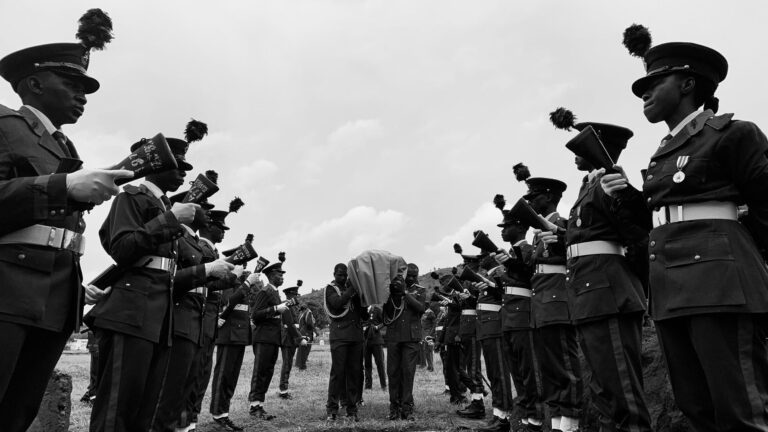
The honor guard was six soldiers, young, immaculate, and they moved the way Hector used to move, that same economy, no wasted motion. They lifted the flag from the casket and they folded it, and if you have never watched a flag folded by a real honor guard I cannot fully describe it to you, the slowness of it, the precision, thirteen folds, each one crisp as a page turning, until what was a wide bright field became a tight triangle of blue with the white stars showing, and the soldier holding it turned, and took the first step toward me.
That is when Tomas stood up.
“Excuse me,” he said, and stepped into the aisle, into the path of the honor guard, and put out his hands for the flag. “I’ll take that. I’m his nephew. I’m his family.”
The soldier stopped. The whole church went silent in a way a full church can go silent, a held breath of two hundred people at once.
I stood up. My legs did not feel like mine but I stood.
Tomas turned to me, and his voice was not even cruel, that is the part I keep coming back to, it was reasonable, it was patient, like he was explaining something to a child. “Consuelo,” he said. “I know this is hard. But she was only married to him a few years. The family comes first. This is our flag. These are our benefits. You understand.”
Our benefits. He said it in a church, over the casket, with the flag folded and waiting. He had come for the money and he had built himself a story on the drive over, that I was the recent wife, the outsider, the woman who married an old sick man, and the real family, the blood, had the true claim. And he said it out loud in front of everyone because he was so sure of it that it did not occur to him he could be wrong.
The soldier holding the flag looked at Tomas, and looked at me, and did not move. He had a job with exactly one correct recipient, and he was not going to guess.
I have thought a great deal about what happened in me in that moment. I did not feel rage, exactly. I felt something colder and clearer than rage. I felt Hector’s hand in mine, three days before, saying, there’s people who come around after. You show them who I chose.
So I did.
“Wait here,” I said. My voice came out steadier than I was. “I have something in the car.”
I walked down that aisle past Tomas, past two hundred people, out the doors of Sacred Heart into the Texas afternoon, and I opened my car and I took out the ammunition box, because I had brought it, I do not fully know why I had brought it, except that it was the last thing Hector had put in my hands and I could not leave it at the empty house on the day we buried him. I carried it back up the aisle and I set it on the step in front of the altar and I opened it.
I took out the photograph first. The one of us at the diner. I turned it over and I read what he had written, out loud, into the silence.
“To Consuelo. You found me. All my love, Hector.”
Then I took out the other photograph, Elena’s, and I did not read that one out loud, that was not for the crowd, but I held them both up, one in each hand, and I said, “He carried this woman’s picture through two wars after she was dead because he did not know how to love halfway. And then he chose me. And he wrote it on the back so no one could tell me different.” My voice broke on that and I let it. “You want to stand in a church and tell these people I was married to him a few years. I was married to him eleven. I gave him his last cup of coffee and his last injection and I held him the night he died, and he opened his eyes and he found my face, and he said, there you are.”
I set the photographs down and I took out the papers. The retirement documents with the raised seal. The records. And I held up the one that mattered, the DD-214, his discharge, and the marriage certificate folded with it, and I said, “It is all here. His name and my name. His wife. Next of kin. He knew somebody would come. He told me three days ago, somebody always comes after. So he made sure I could show them who he chose.”
Father Reyes had come down from the altar by then and he was standing beside me, and he is a gentle man but he was not gentle now. He looked at Tomas and he said, quietly, in a voice that still carried, “Sir. You did not visit this man once in nine years. I know, because I visited him every week of the last one, and you were never there. Consuelo was there every hour. Sit down, or leave, but you will not do this over his casket.”
The honor guard soldier, the one holding the flag, had been standing at attention through all of it, and now, in the silence, he made his decision the only way a soldier can. He turned, deliberately, so that his back was fully to Tomas, and he took the three steps to me, and he knelt on one knee, and he held out the folded flag, and he said the words. On behalf of the President of the United States, the United States Army, and a grateful nation. He said them to me. And I took the flag, and it was heavier than I expected, a tight dense triangle, still warm somehow, and I held it against my chest the way you hold something that is the last of a person.
Tomas stood in the aisle a moment longer. I will give him this, he did not fight it. Whatever story he had told himself on the drive over had come apart in front of him, in front of everyone, and there is no rebuilding a thing like that in a full church. He looked at the flag in my arms and he looked at the box on the altar step and he understood, finally, that he had walked into a place he had no claim to and announced it to the whole town. He turned and he walked out, and the doors closed behind him, and no one went after him, and no one has heard from him since.
I did not gloat. I want you to know that. There was no triumph in it. A man was dead and I loved him and his family, what little of it he had left, had just shown me exactly why he had built his real family out of goats and neighbor boys and a woman who poured his coffee. I felt sorrow more than anything. Tomas had a living uncle for nine years and chose a grudge over him, and now the uncle was in the box at the front of the church and the flag was in my arms and it was too late, forever, for Tomas to fix it. That is not a victory. That is just the truth arriving too late for the one person it was about.
The rest of the honors went as they should. The bugler played Taps from the back of the church, and if you have heard Taps in a stone church with the light coming sideways through the windows you know there is no sound on this earth lonelier or more beautiful. The young men Hector raised carried his casket out. And I walked behind it with the flag against my chest and the ammunition box under my other arm, and I did not look at the empty pew where Tomas had been.
I want to tell you the part that came after, because the story is not only the church.
There were benefits, real ones. A military widow of a retired Master Sergeant is entitled to survivor benefits, and the flag Tomas grabbed for was the smallest part of what he was actually reaching for. In the weeks after, I learned that he had already, before the funeral, called the county and made inquiries, tried to position himself as a beneficiary, filed something. He had done his homework. He had come to that church believing that if he claimed it publicly and confidently enough, in front of the town, with the blood-family argument, I might fold. Might feel like the outsider he had decided I was.
He did not know that Hector had spent his last clear afternoon handing me the exact papers that made every claim of Tomas’s collapse on contact. My name is on the marriage certificate. My name is on the beneficiary designation, in Hector’s own hand, filled out years ago, because a Master Sergeant does not leave his affairs to chance. There was never a real question. Tomas’s whole play depended on me not having the papers, and I had the papers, because a dying man three days out reached up to the top of his closet and made sure of it.
The benefits came to me. Not quickly, nothing with the government is quick, but they came, and they are mine, and they let me keep the twelve acres and the barn and the goats, which I still keep, badly, because I do not have Hector’s hands for it but I cannot bear to let them go. The neighbor boys, grown men now, come by and help. They will not take money either. They learned that from him.
The photographs sit on my dresser now, both of them, Elena’s and ours, side by side, because that is where they belong. I did not put Elena’s away out of some small jealousy. She was part of who Hector was, part of what made him able to love the whole way, and a man who loves like that is not diminished by having loved before. He was enlarged by it. I got to marry the man his first grief made him into. I will not resent her for that. I light a candle for her sometimes, at Sacred Heart, next to the one for him.
The flag is folded in a wood and glass case on the mantel, the case one of the neighbor boys made in his shop, unasked, and brought over one evening without a word. It sits above the fireplace where Hector used to sit and read his westerns, and some nights I sit in his chair and I look at it, the tight triangle of blue and stars, and I do not feel the theft of that day in the church anymore. I feel the weight of it in my arms when the soldier knelt and handed it over. Heavier than I expected. Still warm.
People ask me sometimes, the ones who were there, whether I was afraid, standing up in that church with the whole town watching and my husband’s own blood telling everyone I was a stranger. And the honest answer is no. I was not afraid, because I was not the one who had something to hide. I had eleven years and two photographs and a box of papers and the plain fact of every hour I had spent at that man’s side. Tomas had a suit and a story and nine years of silence. When you have the truth, you do not have to shout it. You just have to be willing to open the box.
I am sixty-three. I will likely have a good many years yet, alone, on the twelve acres, with the goats and the neighbor boys and Hector’s chair. That does not frighten me either. I built a life alone once before, and it was a good life, and then a man ordered a cup of coffee and made it a better one for eleven years, and now I am building the third life, the after one, and I am not doing it alone even though I am doing it without him. There are the young men. There is Father Reyes. There is the whole county road that Hector poured himself into, and that pours a little of it back into me now.
And there is what he said, which I carry the way he carried Elena’s photograph, every day, past the ending of it.
There you are.
He found me in a diner on Route 87, and he chose me, all the way, the way he did everything, and he made sure that when the time came and someone tried to take that choosing away from me in front of the whole town, I would have the proof in my hands. I did. I opened the box. And the flag came to me, because it was always going to come to me, because he made certain of it, three days before, with his tired hands, at the top of a closet, in an olive-drab box that held the whole truth of a quiet man’s heart.
That is the flag a relative tried to claim. And that is why he could not.
This story is a dramatization. Names, characters, and details are invented, and any resemblance to real people or events is coincidental.