
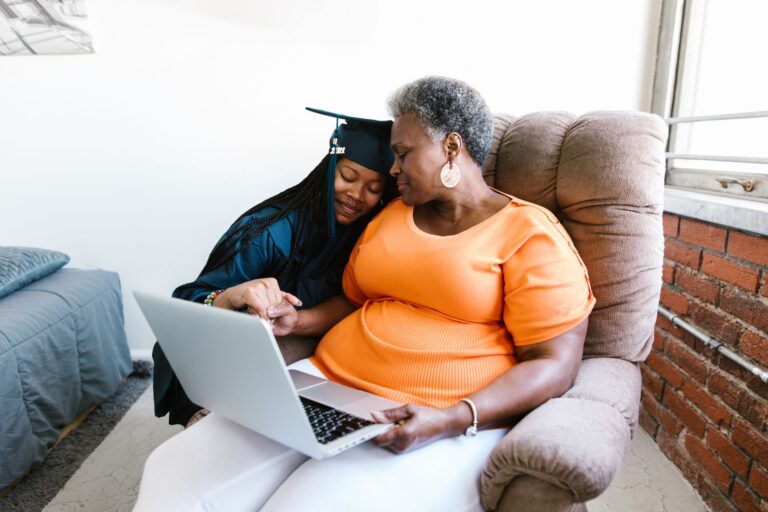
The man in the good gray suit stood up in the third row and said, loud enough for the whole gymnasium to hear, “That’s my son. I made all this possible.” His name is Peter Han, and he is my son. He had not paid for a single school lunch, a single winter coat, a single doctor’s visit, or a single one of the fourteen birthdays I sat through alone with a small boy who used to ask me why his daddy never called. And now here he was, in a suit that cost more than I made in a month, standing to claim a life he had walked out of when Daniel was four years old.
I want to tell you how we got there, because the standing up was only the last thing Peter did. It was not the first, and it was not the worst.
My name is Grace Han. I am sixty-seven years old, and I have been a widow for nineteen of those years. My husband, Sam, died of a heart attack in the parking lot of the hardware store where he had worked for thirty-one years, in a town in central Illinois small enough that the woman at the register knew to call me at home instead of the ambulance company, because she knew I would want to hear it from a person. We had come to that town from Chicago in 1985, when Sam took the hardware job, and we never left. I taught myself the names of every family on our road. I brought hotdish to funerals. I learned that in a small town, you are never anonymous, and I decided a long time ago that I would rather be known than hidden.
Sam and I had one child. Peter.
I have thought a great deal, over the years, about where a boy goes wrong. I have turned it over on long nights the way you turn a stone looking for what lives under it. Sam and I were not cruel people. We were not rich, but Peter never went without. He had his own bicycle, his own bedroom, a father who took him fishing at the reservoir on Saturday mornings and a mother who checked his homework at the kitchen table. And still, somewhere in his teenage years, Peter learned a lesson I never taught him: that other people were things you used, and then set down when they got heavy.
He was charming. I want to be honest about that, because it matters to the story. Peter could walk into a room and make everyone in it feel chosen. He had Sam’s easy laugh and my mother’s dark, quick eyes, and when he turned that charm on you, you felt for a moment like the most important person alive. The trouble was that it never lasted. The charm was a door he opened when he wanted something and closed when he had it.
He met a girl named Anna when he was twenty-three. She was gentle and a little lost, the kind of young woman who mistakes intensity for love because no one has ever shown her the difference. They were not married when Daniel came, and they were barely together. Anna struggled. She had troubles that were bigger than a young mother should have to carry, and I do not say this to shame her, because I loved Anna, and I still light a candle for her. But between the two of them, Peter and Anna, there was not enough steadiness to raise a goldfish, let alone a boy.
So Daniel came to me.
He was four years old the winter he came to stay. It was supposed to be temporary. “Just until we get on our feet, Ma,” Peter said, standing in my doorway with a diaper bag and a boy who was holding a stuffed rabbit by one ear. “A few weeks. Maybe a month.” I looked at my grandson, at his round serious face and the way he pressed himself against his father’s leg, and I said what any grandmother would say. I said of course. I said bring him in out of the cold.
The few weeks became a few months. The few months became a year. Somewhere in that year, Peter stopped coming by. He would call, at first, always with a reason he could not make it, always with a promise about next month. Then the calls came further apart. Then they stopped being about Daniel at all and became about money, small amounts he needed and swore he would pay back, until finally they simply stopped.
Anna was gone by then too, in a way I will not spell out on a page, because Daniel may read this someday, and there are some things a boy does not need in print. I will only say that by the time Daniel was six, it was the two of us. An old woman and a small boy in a little house on a county road, with a widow’s Social Security and whatever I could bring in cleaning offices in the evenings.
I want to tell you about the money, because everyone always wants to skip past the money, and the money is where love actually lives.
A widow’s income in a small town does not stretch. I know this the way you know your own name. I know it in the specific arithmetic of a person who has stood in a grocery aisle and done math with her thumbnail on the edge of a cereal box. When you are raising a child on almost nothing, love is not a feeling. Love is a spreadsheet. Love is deciding that the boy gets milk and you get the powdered creamer in your coffee because it is cheaper and no one has to know. Love is patching the knees of his jeans a fourth time because a new pair is eleven dollars and eleven dollars is the electric bill. Love is standing in the back of the church clothing drive, hoping no one you know sees you, and finding a winter coat in his size, and being so grateful you have to step outside so the ladies do not see you cry over a coat.
I cleaned offices. I took in sewing. For six years I did the books, badly but honestly, for the Nelsons who ran the feed store, and Mr. Nelson used to send me home on Fridays with a sack of “damaged” cans that were not damaged at all, because he was a kind man and he knew, and he let me keep my pride by pretending. That is what a small town does, at its best. It keeps your pride for you and never mentions it.
And through all of it, I kept the photographs.
This is the part I most want you to understand. I am not a woman with much to leave behind. I have a paid-off house worth less than a nice car, a set of my mother’s dishes, and a Bible with Sam’s handwriting in the margins. But I have a box of photographs, and that box is the most valuable thing I own, because it is the only complete record that exists of a boy being loved.
I photographed everything. I could not afford much, but I could afford film, and later I could afford the little disposable cameras from the drugstore, and I took pictures of Daniel the way a person takes an inventory of a treasure she is afraid of losing. Daniel at five, gap-toothed, holding up a fish half the size of his arm at the reservoir where Sam used to take Peter. Daniel at seven, in the church Christmas pageant, a shepherd in a striped bathrobe I made from one of Sam’s old ones. Daniel at nine, asleep on the couch with a library book open on his chest. Daniel at eleven, at the county fair, his whole face orange from the light of the Ferris wheel. Daniel at thirteen, taller than me for the first time, pretending to be embarrassed as I made him stand for a first-day-of-school picture on the porch.
Get a new story in your inbox every morning.
Facebook doesn’t show you every story we post. Our free newsletter does. Join 2,500+ readers.
Fourteen years of a boy, and in not one of those photographs is there a father.
I did not do it out of spite. I want to be clear about that. I did it because I understood something in my bones: that a child who is not photographed can come to believe he was not wanted, and I was not going to let Daniel grow up thinking no one had cared enough to point a camera at him. Every picture was a small argument against the lie his father’s absence told. See, the pictures said. You were here. You were loved. Someone was watching all along.
Daniel was not an easy child, and I will not pretend he was, because easy children are a thing that exists mostly in the memories of people whose children are grown. He was a boy with a hole in him where a mother and a father should have been, and holes like that do not stay quiet. There were years, the middle school years especially, when he was angry at everything and could not have told you why. He slammed doors. He said a cruel thing once, at twelve, about how I was not his real family, and then he saw my face and burst into tears and we sat on the kitchen floor together until midnight, both of us crying, and he never said it again.
I did not have the money for counselors. What I had was time and a kitchen table and the stubbornness of an old woman who had already buried a husband and was not about to lose a grandson too. So we talked. We talked over dishes and homework and the long drives to his ballgames in the next county. I told him about Sam. I told him about Korea, about my mother, about the boat my grandfather fished from in a country Daniel will probably never see. I gave him a family made of stories, because stories were free, and because a boy needs to know where he comes from even when where he comes from has walked out the door.
There is one night I go back to more than the others. Daniel was eight, and he ran a fever in the deep part of winter, the kind of fever that makes a small body burn and shake at the same time. It came on a Sunday, and by Monday afternoon it was a hundred and four and would not come down, and I did not have a car that I trusted on the ice and I did not have the money for the emergency room, which in those days would have been a bill I paid off in pieces for a year. So I did what my mother did, and what her mother did before her on a boat in a country far from here. I sat up with him. I put cool cloths on his forehead and warm blankets on his feet and I read to him in the dark from whatever library book was on his nightstand, and when he cried for his mother, and he did cry for his mother that night, in the delirium of the fever, I held his hot little hand and I did not correct him. I did not say she is not coming. I let him call for her, and I answered to the name, because a sick child does not need the truth at two in the morning, he needs a hand. By dawn the fever broke, and he slept, and I sat in the chair beside his bed and watched the color come back into his face, and I made God a promise I have kept every day since. I promised that as long as I was breathing, that boy would never wake up alone in the dark. I have kept a lot of promises in my life. That is the one I am proudest of.
I want to tell you about a smaller thing too, because the small things are the real ones. Every school morning for fourteen years, I made Daniel a hot breakfast. Not cereal, a hot breakfast, eggs and toast, because I had read somewhere that a child does better in school on a hot breakfast, and I decided that whatever it cost me in eggs and in getting up an extra half hour early on my old knees, my grandson was going to walk into that school with something warm in him. It seems like nothing. It was not nothing. On the morning of his graduation, a grown man now, he came into the kitchen in his good shirt and he stopped in the doorway and he looked at the eggs on the stove and something moved across his face that I did not understand until later that afternoon, in the gymnasium, when I found out he had been counting the mornings all along.
I gave him a family made of stories, because stories were free, and because a boy needs to know where he comes from even when where he comes from has walked out the door.
And slowly, the way a field comes back green after a hard winter, Daniel came back to himself.
He was smart. Lord, that boy was smart, in a way that frightened me a little, because I did not always know how to feed a mind like that on what we had. But the library was free, and the internet at the library was free, and his teachers, God bless small-town teachers who are paid in nothing and give everything, his teachers saw it too. Mrs. Delgado, who taught him sophomore English, stayed after school with him twice a week for two years to help him with essays for scholarships. Coach Pearson let him keep his cleats over the summer instead of turning them back in. The whole town, in its quiet way, raised that boy alongside me. That is the part the man in the gray suit will never understand. He thinks a child is made by a bloodline. A child is made by a thousand small hands.
By his senior year, Daniel had done what I could not have imagined the winter he arrived with his rabbit. He had a full scholarship to the state university. Full. Tuition, room, board, all of it. He wanted to study engineering. He was going to be the first person in our family, on either side, in either country, to finish a four-year degree. I used to lie awake at night just holding that fact against my chest like a hot water bottle.
Which brings me to the graduation.
I had not seen Peter in eleven years. Not since Daniel was seven, when he showed up one Thanksgiving smelling of somewhere he should not have been, made a scene, and left with the forty dollars from my purse and a good deal of my hope. I did not know how he learned about the graduation. I have thought about it since, and I believe someone must have posted it, one of the cousins, on the internet where everything lives forever now. However he found out, he came.
The graduation was in the high school gymnasium, because our town is too small for anything else, and I got there an hour early to make sure I had a seat where Daniel could find my face. I wore my good dress, the navy one, the one I bought for Sam’s funeral and have worn to every important thing since, weddings and funerals both, because a widow on a budget owns one good dress and it does double duty. I brought the box.
I had brought the box of photographs because I had a plan for it, a small private plan. After the ceremony, at the little reception in the cafeteria, I was going to give it to Daniel. All of it, every picture, fourteen years, the complete record. My gift. The one thing I had that was worth anything. I had it on my lap in a shopping bag, and I sat there in my navy dress with a boy’s whole childhood in my hands, and I watched them call the names.
They were nearly to the H’s when I saw him.
Peter came in late, the way he always did, but he came in like he owned the place. Gray suit. Nice shoes. A haircut that cost money. He slid into a seat three rows ahead of me and to the left, and he did not see me, or he pretended not to. And I felt the old dread come up in me like water in a basement, because I knew, I knew the way you know a storm from the color of the sky, that Peter had not come to watch. Peter had come to be seen.
They called Daniel’s name. “Daniel Sam Han.” I had given him Sam’s name for a middle name, so that a piece of his grandfather would walk across every stage he ever crossed. He stood, in his blue gown, and he was so tall and so handsome and so much a man that my breath caught, and the whole gym clapped the way a small town claps for one of its own, warm and loud and long.
And Peter stood up.
He stood up in the middle of the applause, and he turned halfway around so the people near him could see his face, and he said it. “That’s my son. I made all this possible.”
I have replayed it a thousand times. The awful smoothness of it. The way he spread his hands a little, modest, like a man accepting an award he was too gracious to have expected. “I made all this possible.” Fourteen years I made possible, in powdered creamer and patched jeans and church-drive coats and a thousand small hands, and this man in a good suit stood up in a room full of people who knew better and took it, took all of it, the way he had taken the forty dollars from my purse.
I did not stand. I did not say a word. I have wondered since whether I should have, whether I owed it to Daniel to stand up and tell the truth, but I could not. I sat in my navy dress with a box of photographs on my lap and I felt myself getting small, the way I used to feel small in the grocery aisle, the way a person feels small when someone louder and shinier decides the story is theirs.
But here is the thing about my grandson. Here is the thing fourteen years of a thousand small hands had made.
Daniel had crossed the stage. He had his diploma in his hand. And the principal, who liked him, had leaned into the microphone and said what she said for the top student every year, that Daniel would say a few words on behalf of his class. It was a small honor in a small gym. Daniel walked to the podium in his blue gown, and he unfolded a piece of paper, and he looked out at all of us.
And then he stopped. He folded the paper back up.
He said, “I had something written down. But I want to say something else.”
And what he did next, in front of the whole town, with his father standing there in his gray suit still half-turned to be admired, is the reason I am telling you this story at all. It is the reason I can sit here at sixty-seven and tell you that the boy came out right, that the thousand small hands did their work, that a life poured out is not a life wasted.
I am going to tell you exactly what my grandson did.
Daniel looked out over that gymnasium, past the folding chairs and the proud tired parents and the little brothers and sisters kicking their heels against the metal, and he found my face in the crowd. He found me the way he had found me at a hundred ballgames, first thing, before anything else, the way a boy checks that the one steady thing is still there.
Then he said, into the microphone, in a voice that did not shake:
“Before I say anything about the future, I need to say something true about the past. A lot of people helped me get to this stage. Teachers. Coaches. This whole town. But there’s one person who did more than help. There’s one person who did all of it.”
The gym had gone quiet. That particular quiet a room gets when everyone can feel that something real is about to happen.
“When I was four years old, my grandmother took me in. She was already a widow. She was already tired. She didn’t have money, and she took in a little boy anyway, and she never once made me feel like a burden. I know now what that cost her. I know about the second jobs. I know about the coats from the church. I found the receipts, actually, in a shoebox, years later, and I sat on the floor of her closet and I cried, because I finally understood what fourteen years of somebody choosing you looks like on paper.”
I put my hand over my mouth. I did not know he had found the receipts. I did not know he knew.
“She kept every photograph of my whole life,” Daniel said. “There’s a box. I’ve seen it. And you know what’s not in a single one of those pictures? A dad. Because he wasn’t there. He wasn’t there for the fish or the pageants or the ballgames or the sick nights or the birthdays. He wasn’t there for any of it.”
He was not looking at Peter. That was the thing that undid me. He was not looking at his father at all. He was looking at me.
“So if anybody in this room stood up today and told you they made this possible,” Daniel said, and his voice caught just once, just barely, and then steadied, “they were telling you about a woman named Grace Han. She made this possible. Everything I am, she paid for. And the only thing she ever asked in return was that I turn out to be a good man.”
He held up his diploma.
“Grandma,” he said, “this is yours. It always was.”
I do not remember standing up. The women around me told me later that I stood, that half the gymnasium stood, that there was a sound in that room like a wave coming in. I remember Daniel coming down off the stage in his blue gown, walking straight up the aisle past the rows and past his father, who had sat back down by then, who had gone the color of the powdered creamer in my morning coffee. I remember Daniel not looking at Peter as he passed. Not a glance. He walked past his father the way you walk past a stranger who has said something you have decided not to hear.
And he came to me, and he took the shopping bag out of my hands and set it on the floor, and he put his arms around me, this boy who was a head taller than me now, and he held on, and into my ear, under all that noise, he said the thing I will keep until the day I go to Sam.
He said, “I saw you the whole time, Grandma. I always saw you.”
I want to tell you what happened with Peter, because you are wondering, and because the ending matters.
Peter did not stay for the reception. He did not come up to us. He did not have the nerve, or perhaps, and I would like to believe this, he had just enough shame left in him to know he did not belong at that table. He left the way he came, quiet this time instead of loud, out a side door of the gymnasium and into his nice car and gone. I have not seen him since. I do not know where he is. I pray for him, because he is my son, and because a mother does not get to stop being a mother just because her son forgot how to be one. But I do not chase him anymore. I stopped chasing him a long time ago, on a kitchen floor, with a crying boy in my arms.
Daniel and I did have the reception. We stood by the sheet cake in the cafeteria and half the town came through to shake his hand and to hug my neck, and Mrs. Delgado cried, and Coach Pearson cried, and Mr. Nelson from the feed store, who is old now, older than me, held my hand in both of his and said, “Grace, we always knew.” And I understood that the town had known all along, the way a small town knows everything, and that they had let me keep my pride for fourteen years and were only now, on the far side, telling me they had seen it too.
The box of photographs. I did give it to Daniel, that night, at the kitchen table, the same table where we had cried on the floor and done homework and talked about Korea. We went through them one at a time, the whole record, fourteen years of a boy being loved, and this time I got to watch him see it. He is taking the box to college. He asked to. He said he wanted the whole thing on his shelf where he could see it, so that on the hard nights, and there will be hard nights, he could remember exactly how many hands it took to make him, and exactly whose face was behind the camera the whole time.
He is at the university now. He calls me on Sundays. He is going to be an engineer, which means he is going to build things that hold weight and do not fall down, and I have told him that this is the family business, because it is exactly what I spent fourteen years doing.
I am sixty-seven years old. I have a paid-off house worth less than a nice car, my mother’s dishes, and a Bible with Sam’s handwriting in the margins. I no longer have the box of photographs, because I gave it away, and it was the best gift I have ever given, because a thing is only worth what it is worth to the person who receives it, and to that boy it was worth everything.
The man in the gray suit was wrong. He did not make it possible. But I will tell you who did, because my grandson told a whole gymnasium and now I am telling you.
A tired widow made it possible. A thousand small hands made it possible. Powdered creamer and patched jeans and a church-drive coat made it possible. And a boy, a good man now, who folded up the speech he had written and told the truth instead, made it possible for an old woman to know, before she goes, that not one hour of it was wasted.
That is the whole story. I do not have a lesson to give you, except maybe this one, which I learned on a kitchen floor a long time ago and had confirmed in a gymnasium on a spring afternoon.
You are never raising a child for the credit. You are raising a child for the child. And if you do it right, if you do it long enough and steady enough and with enough of yourself poured out, then one day the child stands up on his own, in front of everyone, and gives the credit back.
I have Sam’s Bible, my mother’s dishes, and a paid-off house. And I have a grandson who saw me the whole time.
That is enough. That is more than enough. That is everything.
This story is a dramatization. Names, characters, and details are invented, and any resemblance to real people or events is coincidental.