
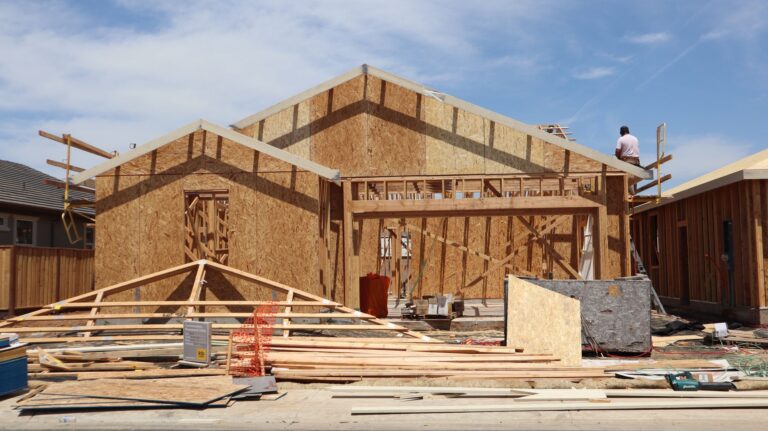
Chad Rensler stood in my half-poured driveway, folded my deposit check into his shirt pocket, and told me that if I did not like how it turned out I could take it up with the contract I signed, that a deal was a deal and the rest was on me.
He said it the way a man says something he has said a hundred times before. Flat. Comfortable. A little amused, like I was the slow one for not understanding how the world worked. Behind him was a single concrete slab, gray and already curing, sitting in my backyard like a headstone for a room that would never exist. That slab was supposed to be the floor of a wheelchair-accessible addition for my wife, Marlene. A wide door, a roll-in shower, a ramp gentle enough that she could get herself out to the garden she loved without asking me to lift her.
I had handed Chad Rensler eighteen thousand two hundred dollars. Nearly everything we had left after the medical bills. And he had turned one slab of concrete into all of it, and he was standing in my yard telling me it was my own fault for trusting a handshake and a signature.
I am sixty years old. I have poured my own concrete before. I have framed a shed, wired an outbuilding, fixed a well pump at two in the morning in January. I am not a man who gets taken. That is what I kept telling myself, standing there. That is the story I had told myself my whole life, that a careful man does not get robbed in his own backyard in broad daylight.
But I want to start at the end, because the end is the part that matters. Chad Rensler was right that I signed the contract. He was wrong about the other thing. He did not know I had been recording him.
Let me back up.
We live in Delphi Springs, a town of maybe four thousand people two hours from anything you would call a city. It is the kind of place where the same six families have run everything since before I was born, where the feed store still lets you run a tab, where the Methodist church and the Baptist church take turns hosting the fall dinner so nobody feels slighted. I grew up here. Marlene grew up two towns over, and I married her in 1989 in a church that has since burned down and been rebuilt, and we have lived in the same house on Coldwater Road for thirty-one years.
The multiple sclerosis came on slow. For a long time it was just a bad leg, a cane on the worse days, a joke she made about her balance. Then it was a walker. Then, this past winter, it was a wheelchair more days than not. Marlene never complained. That is the thing about her that I could never match. She got quieter, but she never got bitter. The bitterness in this house has always been mine to carry.
I want you to understand what the nights were like, because that is where the eighteen thousand dollars actually came from, and why it was not just money. On the bad nights her legs would seize up, a hard spasm that would grip and not let go, and there was nothing to do but sit with her and rub the muscle and wait it out. I would get up at two or three in the morning when she needed the bathroom, and getting her there was the whole problem. Three steps up from the kitchen. A hallway too narrow for the chair. So I would lift her. I am sixty and my back is not what it was, and I would get my arms under her and stand her up and pivot us both across a house that was built in 1911 for people who never got old in it. Some nights I got it wrong. Once, in February, I lost my footing on the top step and we both went down against the door frame, and she hit her shoulder and I hit my hip, and we lay there on the cold floor in the dark and she started to laugh, that quiet laugh, and said, “Well, Doyle, at least we match now.” I did not laugh. I lay there thinking that the next fall might not be a bruise. That is what the ramp money was. It was not a home improvement. It was the difference between me being her husband and me being the man who drops her.
Our house is an old farmhouse, which means it is beautiful and it is a trap. The bathroom is up three steps from the kitchen. The back door has a lip you have to step over. The hallway to the bedroom is too narrow for the chair to turn. By February I was carrying her more than she was walking, and I am strong for my age but I am not young, and we both knew that one bad slip on the ice by the back steps would put us both in the hospital.
So we decided to build. A single-story addition off the back of the kitchen, all on one level. A bedroom she could reach, a bathroom she could use alone, a wide door out to the yard so she could sit among her tomatoes in the evening like she used to. I drew it out myself on graph paper at the kitchen table. It was not fancy. It was going to be the last good thing I built for her, and I wanted it to be right.
I did not do the work myself because I could not. Not a job that size, not at my age, not while also being the one who got her up and dressed and fed every morning. I needed a real contractor. And that is how Chad Rensler walked into my life.
He came recommended, which is the part that still burns. My cousin Ray had used him for a garage two counties over and said he was smooth and quick. Chad showed up in a clean truck with a magnetic sign on the door, Rensler Custom Builds, and a laptop with three-dimensional drawings he made right there at my table while Marlene watched, delighted, as the little rooms spun around on the screen. He was maybe forty-five, good-looking in a salesman way, easy with his hands and easier with his words. He called Marlene “young lady.” He admired my graph paper drawing and said I had the bones of it exactly right, that he would just clean it up. He shook my hand like he meant it.
He quoted the whole job at thirty-six thousand four hundred. He wanted half up front, he said, because a job this size he had to order the specialty materials, the wide door, the roll-in shower pan, the grab bars, the ADA-rated ramp components, and those he had to pay for on delivery. That is standard, he said. Any honest builder needs materials money up front. He was not wrong about that either. Half up front for a job with custom-order parts is normal. That is the trap of a good con. Every piece of it sounds like the truth.
Get a new story in your inbox every morning.
Facebook doesn’t show you every story we post. Our free newsletter does. Join 2,500+ readers.
I wrote him a check for eighteen thousand two hundred dollars on the fourteenth of March. He signed a contract, one page, that he printed off his laptop on my kitchen printer. Marlene signed it as a witness. I remember she used the good pen, the one from her father. I remember thinking, this is happening, we are actually doing this, and I felt something come loose in my chest that had been clenched for months.
That was the last easy day.
He poured the slab three weeks later. That part he did, and he did it fast, one afternoon with two young men I did not recognize, and it looked fine. A clean rectangle of concrete right where the addition was going to go. He told me the framing lumber was on order and the specialty parts were “in the queue at the supplier,” and that he would be back in ten days to start standing walls.
Ten days came and went. I called. Voicemail. I called again. Voicemail. On the fourth call he picked up and was all warmth, so sorry, the supplier had a delay on the shower pan, these ADA parts are backordered everywhere since the pandemic, he was on it, he would have news by Friday. Friday came. Nothing.
This went on for six weeks. Every call was the same. A delay, an apology, a promise, and always some detail that made it sound real. The lumber yard had a truck break down. The specialty distributor was in Ohio and their warehouse flooded. His crew lead had a family emergency. He was so sorry, Mr. Hartman, he knew how much this meant, he had a wife too, he understood.
I kept a little notebook by the phone through those weeks, the same spiral one I use for the well pump and the truck maintenance, and I wrote down every call, the date and what he said, not because I was building anything yet but because I have always written things down. That notebook turned out to matter later, but at the time it was just a man trying to keep the ground from moving under him. I would read back over the pages some nights after Marlene was asleep, and I could see the pattern in my own handwriting before I would let myself say it, the way the promises got vaguer and the dates kept sliding, and I would close the notebook and tell myself that builders are always behind, that everybody in this county has a story about a job that ran three months long, that it did not mean anything. I wanted so badly for it to not mean anything.
There is a particular shame in it that I did not expect. I did not tell Ray, the cousin who recommended him, for weeks, because saying it out loud to Ray would make it real and would also make Ray feel terrible, and I am the kind of man who would rather carry a thing quietly than hand somebody else a burden. I did not tell the men at the feed store. When someone asked how the addition was coming, I said we were waiting on parts. Which was true. It was the exact lie Chad had handed me, and I passed it along to protect myself from having to say the other thing, which was that I might have been a fool.
And I believed him longer than I should have, and I know why. I believed him because I could not afford for it to be a lie. Eighteen thousand dollars was not money I could lose. It was the ramp money. It was Marlene’s independence. If Chad Rensler was a thief, then I had just handed a thief the last good thing I was going to be able to give my wife, and I could not hold that thought and keep breathing at the same time. So I chose to believe the delays were real. That is what a con man sells you. He does not sell you a lie. He sells you permission to keep hoping.
It was Marlene who broke it. She was sitting at the window one evening in May, looking out at that lonely slab, and she said, quiet, not accusing, just tired, “Doyle. He’s not coming back, is he.”
And I heard myself say, “No. I don’t think he is.”
Saying it out loud changed something. The next morning I stopped hoping and started paying attention.
I drove into town to the county building and I looked up Rensler Custom Builds. There was no contractor license on file. Not expired. Not suspended. Never issued. The business name was registered to Chad Rensler at an address that turned out to be a rented mailbox at the pack-and-ship on Route 9. The clean truck, the magnetic sign, the laptop drawings, it was all costume.
Then I did the thing that changed everything. I sat in the parking lot of that county building and I looked up his name three different ways, and I found two others. A woman named Pat Deidrick in a town forty minutes north who had left a review on a local marketplace page that said only, “Chad Rensler took our porch money and never came back, will not answer, do not trust him.” And a man named Gene Sorrow whose name came up on a small-claims filing. Chad had a pattern. I was not the first. I was maybe the fourth or fifth that I could find, and probably not the last.
I called Pat Deidrick. She cried on the phone. He had taken nine thousand dollars for a wheelchair porch for her mother, poured a set of footings, and vanished. Same story. Same warmth. Same voicemail wall. She had gone to the sheriff and been told it was a civil matter, a contract dispute, that she should sue him in small claims, and when she did he simply did not show up and the judgment she won was a piece of paper she could not collect on because he had no assets in his own name that anyone could find. He had done it clean. He knew exactly how far he could go and stay on the safe side of the line where the law calls it a broken promise instead of a crime.
That is the part that made me cold instead of hot. Chad Rensler was not a sloppy thief. He was a careful one. He picked people like us on purpose. Old. Rural. Building for a sick spouse or a sick parent. People who would pay half up front without blinking because it was normal, people who would believe the delays because the alternative was unbearable, and people who, when it fell apart, would be told by a tired sheriff that it was civil, not criminal, and would not have the money or the fight left in them to chase a man with no assets. He had found the softest people in the softest towns and he was harvesting them one wheelchair ramp at a time.
I decided I was not going to be a piece of paper he ignored.
Here is what I understood that Pat Deidrick had not: the line between a civil dispute and a crime is intent. If Chad simply failed to finish a job, that is a contract problem, and he wins that game because he has played it for years. But if I could show that he took the money with no intention of ever doing the work, that he was running a scheme, that is theft by deception, and that is criminal. The difference is not what he did. The difference is what he knew when he did it, and whether anyone could prove it. Con men win because their intent lives inside their own head where nobody can reach it.
Unless he says it out loud.
So I called him. Not angry. I made myself sound beaten, because beaten is what he expected and beaten is what makes a man like him comfortable. And before I dialed, I set my phone to record, and I checked the law first, because Delphi Springs is in a one-party-consent state, which means I am legally allowed to record a conversation I am part of. I want to be clear about that. I did not do anything sneaky in the eyes of the law. I recorded my own phone call.
I told him I understood the parts were backordered. I told him I just needed to know, man to man, when he was coming to finish, because my wife’s condition was getting worse and I had to plan. I gave him every off-ramp to keep lying gently.
And Chad Rensler, comfortable, sure he was talking to a defeated old man, told me the truth.
He told me there were no parts on order. He said it with a little laugh, the way you confess something small to someone you have already beaten. He said the slab was “the product,” that a slab is cheap and it makes people wait for months because it looks like a start, and by the time they figure it out he is three towns over. He said, and I have this word for word because I have listened to it more times than I should have, “Doyle, you signed the contract. That’s on you. You want to sue me, get in line, I got no money in my name and I got a lawyer who eats small claims for breakfast. That check cleared in March, buddy. It’s spent. Best thing you can do is let it go and don’t embarrass yourself.”
Then he laughed again and told me to give the young lady his best, and he hung up.
I sat in my truck in my own driveway and I did not feel beaten. I felt clear. I had it. I had the whole thing. He had told me the slab was bait. He had told me the parts were never coming. He had told me it was a pattern, “three towns over,” a business model. He had, in his own comfortable voice, described the intent that turns a broken contract into a crime. He thought he was twisting the knife. What he was actually doing was signing a confession into my phone.
But I was smart about it, because I had spent six weeks learning the hard way that being right is not the same as winning. A recording of a man laughing about a scam is powerful, but on its own it is just a story too. I needed to hand it to someone who could turn it into consequences. And I had learned that the sheriff’s office would wave me off as a civil matter, because that is what they had done to Pat and to Gene.
So I did not go to the sheriff first. I went to the county prosecutor’s office, and I did not go alone, and I did not go empty-handed.
I spent a week building a binder. I am good at this part. I put in the contract with the fake business name. I put in the county records showing no license was ever issued and the address was a mailbox. I put in my bank statement showing the eighteen thousand two hundred cleared to him on the sixteenth of March. I put in Pat Deidrick’s statement, which she wrote out and signed and I promised her I would not let go to waste. I put in a copy of Gene Sorrow’s small-claims filing. I made a page that laid out the pattern in plain language, four victims that I could document, all of them old, all of them rural, all of them building accessibility projects for someone sick, all of them told it was a slab problem. And on the last page I put a transcript of the recording, timestamped, with the audio file on a thumb drive taped inside the back cover.
The week I spent making that binder was the first week since March I slept through the night. Marlene noticed it before I did. She said one morning that I looked less like a man waiting to be hit. And she was right, because there is a specific difference between being a victim and being a witness, and I had crossed from one to the other at my own kitchen table with a three-hole punch and a stack of paper. A victim waits and hopes and asks. A witness builds a record and hands it to someone with the power to act. I could not carry Marlene up three steps in the dark and I could not un-cash Chad Rensler’s check, but I could do this. I could make it so that when I walked into that office I was not one more sad story a tired official would nod at and forget. I was going to be the man who did their work for them, and dared them to look away. Pat Deidrick told me on the phone, when I called to read her the pattern page before I finished it, that in all the months since her mother’s porch fell through, this was the first time she had felt like anything was going to happen. She asked me to send her a copy of the binder. She said she wanted to hold it.
Then I called and made an appointment, and I put on the one good jacket I own, and I drove Marlene and myself to the county seat, because I wanted her in the room. I wanted them to see who the ramp was for.
The assistant prosecutor was a young woman named Karen Okafor, maybe thirty-five, sharp, tired, kind under the tired. She started out gentle with me, and I could hear it in her voice, the same thing the sheriff had told Pat, she was getting ready to explain that a contractor who does not finish is a civil case and I would want to talk to a lawyer about small claims.
I asked her to please just listen to two minutes of audio before she decided anything. I put the phone on her desk and I played the part where Chad laughs and says the slab is the product and the parts were never coming and he is three towns over by the time they figure it out.
She stopped being tired. I watched it happen. She played it again herself. Then she opened my binder and she went quiet for a long time, turning pages, and when she looked up she was not talking to me like a confused old man anymore. She was talking to me like a witness.
“Mr. Hartman,” she said, “a contractor who fails to finish is a civil matter. That’s true, and that’s why he’s gotten away with this. But this,” and she tapped the phone, “is him telling you he never intended to perform. And this binder is a pattern across four people. That’s not a contract dispute. That’s theft by deception, and I can charge it, and with this I can prove it. Most people who get robbed like this bring me a feeling. You brought me a case.”
I am not ashamed to say I had to look out the window for a second.
It did not happen fast. Nothing with the law happens fast. But it happened. Karen Okafor’s office pulled Chad Rensler’s real financial trail, and it turned out “no money in my name” was another lie he told to sound untouchable, because the money moved through an account in his girlfriend’s name that he controlled, and once there was a criminal case instead of a civil one, they had the tools to follow it. They found two more victims we had not known about, which brought it to six, which turned a single charge into a pattern of felony theft by deception across county lines.
They arrested Chad Rensler on a Tuesday morning in July. I know it was a Tuesday because Marlene and I were eating breakfast at the window, looking at that slab, when Karen Okafor called to tell me. He tried the same thing with the prosecutor that he had tried with me, the confident smile, the “you can’t prove intent,” the lawyer who eats small claims for breakfast. Except this time the intent was on a recording in his own voice, and small claims had nothing to do with it.
He took a plea in the end. They almost always do when the tape is that clear. He pleaded to felony theft by deception. He got prison time, not a lot, but real, and the court ordered restitution to all six of us, and because the money was traced and frozen, restitution was not just another piece of paper. I got most of ours back. So did Pat. So did the others.
I want to tell you the part about the ramp, because that is the part I think about.
The restitution money came through in the fall. And I did not hire it out this time. I called around and I found a retired framer named Wendell who lives out on Millpond Road, a man about my age who had done honest work in this county for forty years and knew everybody, and I asked him if he would help an old fool finish the thing he never should have paid a stranger to start. Wendell looked at Chad’s lonely slab, walked around it once, tapped it with his boot, and said the slab was actually poured square, which he said with some disgust, like it offended him that a thief had done one thing right.
We built it ourselves. Me and Wendell and, on the weekends, my cousin Ray, who felt terrible for the recommendation and worked like a man trying to pay off a debt, which he was. We stood the walls in October. We hung the wide door. We set the roll-in shower Marlene had picked out from the very beginning, the same one Chad had pretended to order. We built the ramp out to the garden with a slope so gentle she can take it herself, no hands, no lifting, no asking.
She rolled out onto it the first evening it was done, in November, when it was too cold for the tomatoes and there was nothing out there but bare dirt and the last of the light. She just wanted to be outside on her own, on the thing we built, without me carrying her. She sat at the top of the ramp with her coat on and she looked out at the yard for a long time, and then she looked back at me in the doorway and she said, “It’s a good ramp, Doyle.”
That is all. It’s a good ramp. And I had to go back inside for a minute.
People ask me, when this story gets around town, and it has, whether I feel vindicated. Whether I gloated. Whether I called Chad Rensler up and played him his own laugh.
I did not. I thought about it. But here is what I figured out, sitting in that prosecutor’s office, watching a tired young woman turn from waving me off to writing down my name. Chad Rensler was betting his whole life on one thing: that people like me and Marlene, old people in small towns building last kindnesses for the ones we love, were soft. That we would hope too long, believe too easily, and give up too fast. That we did not have the fight in us and the world would let him keep saying “that’s on you” forever.
He was almost right. I hoped too long. I believed too easily. Where he lost the bet was the giving up, and even that was close.
I am sixty years old and I got robbed in my own backyard by a man in a clean truck. That is true. But I did not let it stay a story. I turned it into a case, and a case has consequences, and the consequences ran the other way for once.
The recording is still on my phone. I do not listen to it. I do not need to. I know what is on it. A man laughing, sure he had won, telling the truth for the first and last time to a beaten old fool who turned out not to be so beaten after all.
And every evening, when it is warm enough, my wife rolls herself out to her garden on a ramp we built with the money the law made him give back, and she does not need me to carry her, and that is the only vindication I ever wanted.
This story is a dramatization. Names, characters, and details are invented, and any resemblance to real people or events is coincidental.