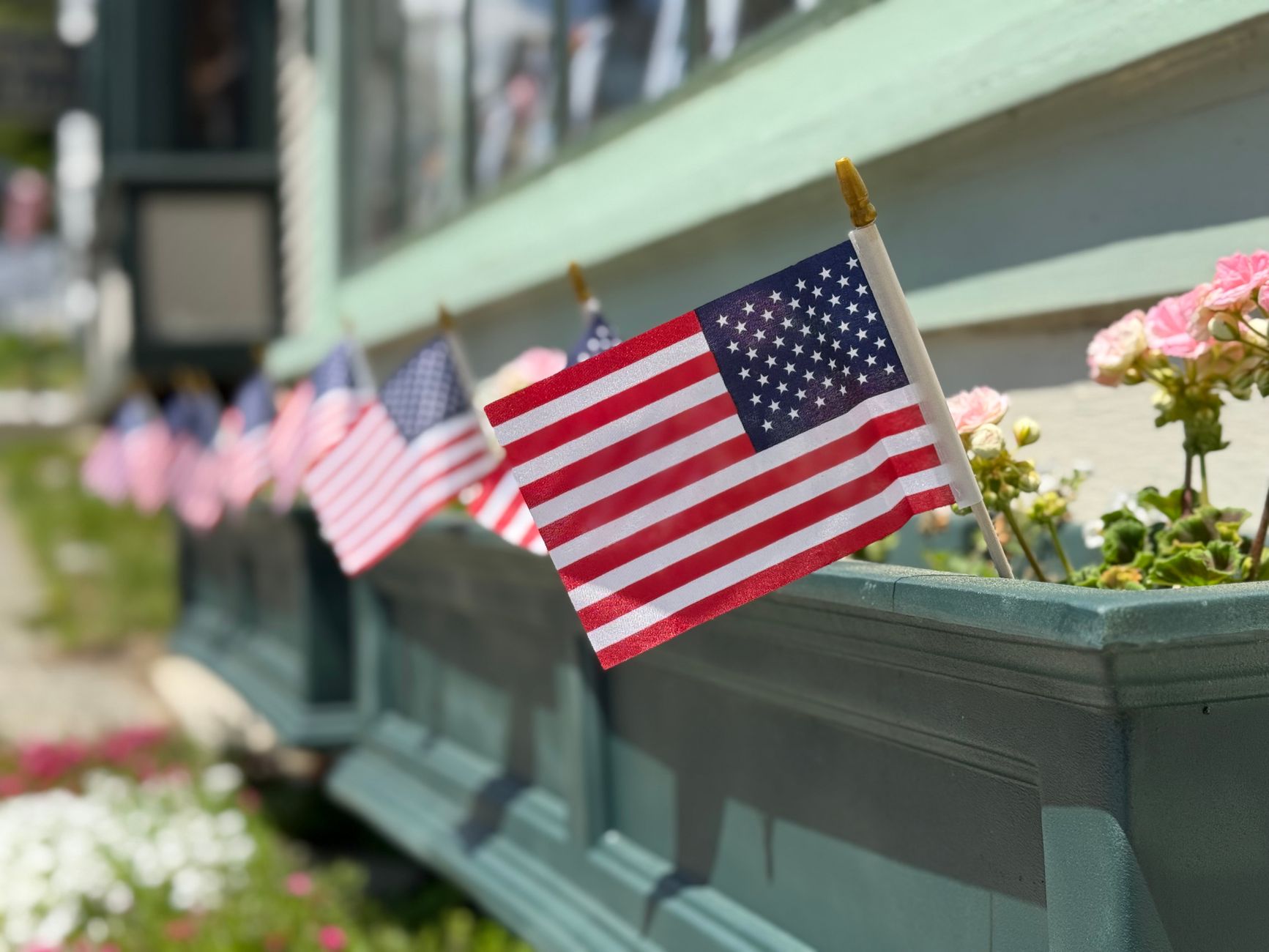
The Fourth They Let Me Belong
Gail Stroud stood up on the courthouse steps with a paper plate in her hand and told the whole square that a certificate does not make somebody American, that I would never really be one of them. She said it loud enough to carry over the band. She said it the day after I raised my right hand in a federal courtroom two counties over and became a citizen of the United States, thirty-one years after I first crossed into this country with a suitcase and a work visa and a fear I never fully put down.
The heat that day was the thick kind we get in July, the kind that sits on your shoulders like a wet towel and makes the air over the brisket smokers wobble. I remember it in my body more than in my head, the sweat under my apron, the smell of mesquite, the flag snapping on the courthouse pole. And I remember the exact moment the whole square went quiet, because a quiet like that is not the same as silence. It has a weight to it. Every person on that grass held their breath at once.
I want to tell you the whole thing, because the moment on those steps was not the beginning and, thank God, it was not the end.
My name is Yolanda Cepeda. I am fifty-eight years old. I have lived in Calder, Texas, for twenty-six of those years, in a small yellow house on Persimmon Street with a lemon tree in the back that I grew from a seed my mother mailed me from Oaxaca in an envelope so thin the light came through it. That tree took eleven years to give me its first lemon, and I cried the morning I found it, because it felt like proof that a thing carried a long way from home could still take root and bear something. I came to this country when I was twenty-seven. I cleaned rooms first, in a motel off the interstate where the manager paid in cash and never once said my name right, then I cooked in other people’s kitchens, and for the last nineteen years I have run the little cafe on the square that everyone in Calder just calls Yoli’s, though the sign out front says Cepeda’s Kitchen in letters my husband painted before he passed. The letters lean a little to the right, and I have never fixed them, and I never will, because those crooked letters are the last thing in this world his hands made.
I need you to understand who Gail Stroud was to me before I tell you what she did, because it would be easy to make her a cartoon, and she was not a cartoon. She was my neighbor. Her house sits three doors down from mine on Persimmon, a white ranch with a flagpole in the front yard and marigolds along the walk, orange and yellow ones she plants every spring in a row so straight you would think she used a string. For twenty-six years Gail Stroud and I have lived on the same street. I have watched her son grow up. I catered the reception when her daughter Lisa got married in the Baptist fellowship hall, three hundred people and a sheet cake and my carnitas keeping warm in foil pans, and I did it at cost because that is what you do for a neighbor. I remember Gail finding me in the church kitchen that night, flushed and happy, squeezing my arm and saying she could not have done it without me. I held onto that memory afterward, trying to make it fit with the woman on the steps. When Gail’s husband, Ronnie, had his knee replaced four winters ago, I brought a pot of caldo to their door twice a week for a month, the good caldo with the marrow bones and the extra lime, and Gail took it from me at the screen door and said thank you, Yolanda, and I believed she meant it. I still believe she meant it. That is the part that is hard to carry.
So when I say what she said hurt me, I do not mean the way a stranger’s cruelty hurts. A stranger you can shake off. Gail knew the color of my kitchen curtains. She had eaten my food at her own daughter’s wedding. That is a different kind of wound.
Let me back all the way up, because you cannot understand the Fourth of July on that square unless you understand what it took me to get there.
I did not decide to become a citizen lightly, and I did not decide it quickly. For most of my years here I had a green card, and a green card felt like enough. I could work. I could own the cafe. I could pay my taxes, which I did, every single year, on time, with a woman named Brenda at the tax office who knew me by name. The green card sat in my wallet behind a photograph of my husband, and I told myself citizenship was a formality I did not need. The truth, if I am honest with you the way I have promised myself I would be in telling this, is that I was afraid. I was afraid of the test. I was afraid of the interview. I was afraid of standing in front of an officer of this government with my accent and my nerves and being told that after all these years I still was not enough. That is the thing about fear. Carry it long enough and it stops feeling like fear and starts feeling like good sense.
What changed me was my mother’s death.
She died in Oaxaca three years ago, in the spring, in the house I was born in, and I could not get back in time. The paperwork, the timing, the fear of leaving and not being let back in the way I needed to be, all of it tangled together, and by the time I untangled it she was already buried in the little cemetery on the hill where three generations of my family lie. I stood in my kitchen at Cepeda’s at four in the morning with the phone still in my hand and my brother’s voice still in my ear telling me it was over, and the ordinary sound of the coffee going on making itself while my mother lay in the ground a thousand miles away broke something loose in me. I understood something I had spent thirty years not letting myself understand. I had built a whole life in a country I had never fully committed to, the way you might live for years in a house you refuse to hang pictures in because some part of you believes you will not be allowed to stay.
I decided that day. I was going to hang the pictures.
I started studying that fall. I bought the booklet with the hundred civics questions, a thin blue booklet that cost almost nothing and frightened me more than anything I had held in years. I taped flash cards to the mirror in my bathroom and to the register at the cafe, and my regulars quizzed me over their coffee. Old Dell Hutchins, who has had the same booth by the window for nineteen years and who fought in a war before I was born, took it more seriously than I did. He would come in and instead of good morning he would say, “How many amendments to the Constitution, Yoli?” and I would say twenty-seven without looking up from the grill, and he would grunt like a man satisfied and open his newspaper. He never told me why he cared so much, and I did not ask. I think I understood even then that for a man like Dell Hutchins there are debts to a country that never get paid off, and helping an old woman at a cafe grill learn her civics was one small way he had left to keep paying his.
I learned the three branches of government. I learned who wrote the Declaration of Independence and what happened at the Constitutional Convention and why we fought the British and what the Emancipation Proclamation did. I learned the name of my representative and both my senators. I learned it the way I have learned everything hard in my life, at the counter of that cafe, early in the morning, with my hands busy and my mind holding on.
I want to tell you about the day of the interview, because I carried it onto that courthouse square more than anyone there could have known.
It was in a federal building in a city two hours north, gray carpet and fluorescent light and a metal detector at the door. I wore the blue dress I save for funerals and important things, and I had ironed it twice the night before because I could not sit still. I got there early and sat in the car praying the rosary my mother left me until it was time. My hands were shaking so badly in the waiting room that I sat on them. There were maybe a dozen of us in that room, none of us speaking, all of us with that same look, like people waiting outside a hospital room for news. When they called my name they mispronounced it, Cep-EE-da, and I did not correct them, and then I was angry at myself for not correcting them, because a woman about to swear an oath to this country ought to be able to make it say her name. My mother named me. Yolanda Cepeda. And following that officer down the hall I promised her that this would be the last time I let this country say my name wrong without saying something back.
The officer was younger than my own children would have been if I had had children. He asked me the civics questions and I answered every one. He asked me to read a sentence in English and write a sentence in English and I did. And then, at the end, when the hard part was over, he looked up from his papers and he asked me why I wanted to become a citizen after all these years, and I had an answer ready, something practical about voting and about belonging, and instead what came out of my mouth was the truth.
I told him about my mother. I told him about the pictures I had never hung. I told him that I had loved this country quietly for thirty years, the way you love a person you are afraid will not love you back, and that I was done being afraid. And that young officer, who I am sure hears sad stories all day long until they must run together like water, put down his pen and looked at me for a moment like I was a person and not a file, and he said, “Mrs. Cepeda, welcome home.”
I cried in the parking lot for twenty minutes before I could drive.
The oath ceremony was three weeks later, on the third of July, in a courtroom with a flag on a stand and a judge who had done this a hundred times and still seemed to mean it. There were forty-one of us that day, from I do not know how many countries. There was a young man from Nigeria in a suit that was a size too big, the sleeves swallowing his hands. There was a whole family from Vietnam, three generations, the grandmother in a wheelchair. There was a nurse from the Philippines still in her scrubs because she had come straight from a shift. Each one of us had a story like mine, a mother somewhere, a booklet studied at a kitchen table, a fear carried for years. We did not know one another and we will never see one another again and for twenty minutes we were the most united people in America, standing in a rented courtroom raising our right hands.
I said the words. I renounced and abjured and I swore to support and defend, and my voice cracked on it, and I did not care. When the judge said congratulations and called us fellow citizens, the whole room came apart into laughing and crying at once, and a man I had never met, the father from the Vietnamese family, turned and shook my hand and said congratulations, neighbor, and I have thought about that word ever since. Neighbor. He did not even know my name and he called me neighbor.
They gave us small flags. I still have mine.
I drove the two hours home on the third of July with the windows down and that flag on the passenger seat, and I called Dell Hutchins from a gas station to tell him I had passed, that it was done, that I was a citizen, and I heard that old man’s voice go thick over the phone. He said, “Well, it’s about time this country made it official, Yoli. The rest of us have known for years.” I had to stand at that gas pump a while before I could get back in the car.
I got home to Persimmon Street near dark, the porch lights coming on up and down the block and the first sparklers already fizzing in a yard down the way. Gail Stroud was out watering her marigolds in the blue evening light, the hose making that soft hiss against the flower bed. I waved, the way I have waved at Gail ten thousand times over twenty-six years, and I called out across the warm air that I had good news, that I had become a citizen that day. Gail turned off her hose. The hiss stopped, and the evening got very quiet. She looked at me for a moment across the two lawns between us, and something crossed her face that I did not have a name for then and think I do now. And then she said, not cruelly yet, just flat, “Well. Isn’t that something,” and she went inside, and the screen door clapped shut behind her, and I stood on my own walk feeling the good news curdle a little in my chest.
I told myself it was nothing. I told myself Gail was tired, that people are strange sometimes, that not everyone knows what to say. I went into my little yellow house and I put my new flag on the mantel next to the photograph of my husband, and I hung, at long last, a picture I had bought years ago and never put up, a small framed print of the Oaxacan hills where I was born, right there in my American living room, both of my worlds on one wall. I went to bed a citizen for the first night of my life.
The next day was the Fourth of July.
Calder does the Fourth the way small Texas towns have always done it, on the courthouse square, under the live oaks that are older than the town, with the whole town poured out onto the grass. The Rotary sells brisket plates, the smoke from their pits hanging low over the square all morning so the whole downtown smells like mesquite and burnt sugar. The high school band plays in the gazebo, more heart than skill, the tuba always a half beat behind and nobody minding. The little kids run around with sparklers their mothers pretend not to see, and the old men sit in a row of lawn chairs by the war memorial arguing about the same things they argued about last year. There is a flag ceremony at noon, the VFW color guard marching stiff and slow, and the mayor says a few words nobody remembers, and then everyone eats until the fireworks after dark. I have worked that square every Fourth of July for nineteen years. Cepeda’s Kitchen sets up a table under the big oak on the east side, and I sell my tamales and my agua fresca and my tres leches to half the county, and it is, I will tell you plainly, my favorite day of the year to be alive. There is no day I feel more a part of this town than the day I stand behind that table feeding it.
This year was different, and everybody knew it. Word had gone around the way word goes around a small town, faster than any newspaper, passing over coffee counters and church steps and the feed store loading dock. Yoli became a citizen. Dell Hutchins had made sure of it. So when I set up my table that morning, unfolding the legs and laying out the corn husks and lighting the burner under the tamale pot, people I had known for twenty years came by not just for tamales but to shake my hand. The Presbyterian minister’s wife hugged me. A rancher named Cole Denman, a man of maybe four words on a talkative day, took off his hat when he congratulated me, and I nearly dropped my ladle. Little Marisol Tovar, whose quinceañera I had cooked for, stuck a paper flag in my apron pocket and ran off giggling.
I felt, for the first time in all my years here, like the ground under me was solid. Like I had finally been let all the way inside a house I had stood on the porch of for three decades. Like I could hang the pictures and they would stay on the wall.
And then it was a little after noon, right after the flag ceremony, and the band had stopped for a break, and there was that quiet lull you get on a hot afternoon when everyone is eating and the cicadas are loud in the oaks. I was behind my table wiping my hands on my apron. And Gail Stroud climbed up two steps onto the base of the courthouse steps, where the mayor had stood an hour before, with a paper plate of brisket in her hand, and in that quiet she raised her voice and she said my name.
“You all want to make a big fuss over Yolanda today,” she said, and heads turned, because Gail was not a woman who made speeches. “But I’ll say what everybody’s too polite to say. A piece of paper doesn’t make you one of us. She can get all the certificates she wants. She’ll never really be an American, not like we are. You can’t just print that out.”
I have played that moment back so many times. The band silent. The cicadas loud and steady in the oaks, not caring, the way the world never stops for the worst moments of your life. My own hands gone still on the apron. The brisket smoke hanging in the heat. Fifty, sixty, seventy people on that grass, and every one of them looking at Gail Stroud, and then, slowly, one head at a time, looking at me. I have never in my life felt so alone in the middle of so many people.
I did not say a word. I want you to know that. In every version of this I have imagined since, I say something magnificent, I put her in her place, I quote the Constitution I had just learned back at her, all twenty-seven amendments, the three branches, the whole booklet fired back at her like a rifle. But in the real moment, the actual moment, I said nothing at all. I just stood there behind my table in my apron on the best day of my life and I felt thirty-one years of that old fear come up out of the ground and close around my throat. Every fear I had ever swallowed at the motel and in other people’s kitchens and in that federal waiting room with my hands under my legs, all of it came back at once, and it had Gail Stroud’s voice. She had said the exact thing I had been most afraid of, out loud, in front of my whole town, on the one day I had let my guard all the way down. Not enough. After everything, after thirty-one years, still not enough.
I looked down at my hands. I could not look at the faces. I did not want to see them agree with her.
And then Dell Hutchins stood up.
He is eighty-four years old. He fought in Korea. He has a bad hip and a worse knee and it takes him a while to get out of a chair, and the whole square watched this old man in his VFW cap push himself up off the folding chair by my table, and it went so quiet you could hear him breathing.
“Gail,” he said, and his voice was not loud, but it carried. “I carried a rifle for this country when I was nineteen years old. I have got the paper that says what I gave and the knee that proves it. And I am telling you, and I am telling everybody standing here, that woman is more American than you have been all afternoon.”
Nobody moved.
“I have watched Yoli Cepeda for nineteen years,” Dell said. “I have watched her feed people who couldn’t pay. I watched her cook for your husband when his leg was cut open. I have watched her stand at that grill at five in the morning every single day this town has needed feeding. She studied harder for that test than my own grandkids studied for anything, and she can name more of the Constitution than you can, Gail, and I know that because I quizzed her on it. She earned it. Every word of that oath. She earned it standing right where you’re standing, and you have got no business up on those steps.”
And that is when Cole Denman, the rancher who could not manage four words, stood up too. He did not make a speech. He just took off his hat again, the second time that day, and he held it against his chest and he looked at me and not at Gail, and he said, “Welcome home, Yoli.” The same two words the officer had said. The same word the man from Vietnam had used. Welcome home.
Then the Presbyterian minister’s wife stood, smoothing her skirt, her chin up. Then Brenda from the tax office, the woman who had signed my returns for nineteen years and knew to the penny what I had paid into this country. Then a young mother I had sold a dozen tamales to an hour before, with her baby on her hip. Then more rose behind Cole Denman, the rancher’s wife, two of the old men from the row of lawn chairs by the war memorial, pushing up on their canes. One by one, all across that grass, people got up out of their folding chairs, and it was not angry and it was not a mob, it was quieter than that and it was worse than that, for Gail. Nobody shouted. Nobody pointed. They just stood, in the heat, under the oaks. It was the whole square rising to their feet, and not one of them was rising for her.
Old Dell started to clap. Slow, at first, those big worn hands coming together, the sound flat and hard in the quiet. And the square picked it up, first the people nearest him, then further out, the clapping spreading across the grass the way fire moves through dry pasture, until it was everybody. It rolled across the grass under the live oaks, that applause, wave on wave of it, and it was for me, and I stood behind my table in my apron with the tears just running down my face and dropping off my chin onto the corn husks, and my new country clapped for me on the Fourth of July until my ears rang with it.
Gail Stroud stood on those steps with her paper plate and her face going red and white by turns. And then a strange thing happened, a thing I did not expect and that has stayed with me more than the applause. She did not storm off. She did not shout back. She stood there and she took it, and something in her face came apart, and I realized, watching her, that Gail Stroud was not a woman full of hate. She was a woman full of fear, the same fear I had carried, only turned inside out. She was afraid there was not enough of this country to go around. She was afraid that if I belonged, she belonged a little less. She had spent her whole life on Persimmon Street being sure of exactly one thing, that she was an American and I was a guest, and I had just gone and taken the last thing she was sure of.
I could have let her stand there in it. Lord knows the square would have let me.
Instead I did the only thing I have ever really known how to do. I came out from behind my table. I walked across that grass, past all those standing people, up to the base of the courthouse steps where Gail Stroud stood shaking with her ruined plate of brisket. And I held out a tamale, wrapped in its corn husk, still warm.
“Gail,” I said, loud enough for the square to hear, because the square had heard the other thing and it deserved to hear this thing too. “I brought you soup when Ronnie couldn’t walk. I cooked for your Lisa’s wedding. Twenty-six years we have lived on the same street. I am not your guest, and I never was. I am your neighbor. I have always been your neighbor. Now come down off there and eat something with us. It’s the Fourth of July.”
I do not fully know what I expected. I half expected her to slap the tamale out of my hand.
Gail Stroud looked at the tamale. She looked at me. And this hard, frightened woman who had just tried to unmake my whole life in front of the town she and I both loved, this woman came apart the rest of the way, and she started to cry, up there on the steps, in front of everybody. And she said, so quiet I am the only one who heard it, “I’m sorry, Yolanda. I don’t know why I said it. I’m so sorry.” And she took the tamale.
And she came down off the steps.
I would love to tell you that Gail Stroud and I are best friends now, that we drink coffee together every morning, that the whole thing knit us into something beautiful. Life is not that tidy and I promised you the truth. Gail and I are not best friends. But we are neighbors again, real ones. She waves when I water the lemon tree. Last month she brought back my caldo pot, the one from four winters ago, that she had kept all this time, washed and dried, and she left it on my porch with a note that just said thank you, and I understood it was about more than the pot.
I think about that Fourth of July almost every day. Not the cruel part, though that is in there. What I think about is Dell Hutchins pushing himself up off that folding chair on his bad knee. Cole Denman’s hat against his chest. Sixty people rising in the heat under the live oaks for a woman who cooks their tamales. I spent thirty-one years in this country afraid I would never really belong here, afraid that some Gail Stroud somewhere would always be right, that a paper could not make me one of them.
It turned out the paper never was the thing that made me belong. The paper was just the government catching up to what a small Texas town had already decided about me, one brisket plate and one bowl of caldo and one early morning at a time, for twenty-six years, without any of us noticing it was happening. I did not become one of them on the third of July in a federal courtroom. I became one of them slowly, in the only way anyone ever really does, by staying, by showing up, by feeding people, by being there.
I am a citizen of the United States now. I have the certificate framed on the wall of Cepeda’s Kitchen, right where my regulars can see it over their coffee. But that is not the day I tell people about. The day I tell people about is the day my whole town stood up.
That fall, for the first time in my life, I voted. Dell Hutchins drove me to the polling place at the Methodist church himself, because he said a first vote is a thing you ought to have a witness for. I stood in that little curtained booth with the flag they gave me at the oath ceremony tucked in my purse, and I filled in the circles, and I put my ballot in the box, and I walked out into the Texas sun a citizen who had cast her vote in the country she had loved quietly for thirty-one years and was not afraid of anymore.
Dell was waiting by his truck. He took off his VFW cap when I came out, the way Cole Denman had taken off his hat, and he did not say welcome home this time. He said something better. He said, “Well, Yoli. Now you’re one of the bosses too.” And he laughed his old man’s laugh, and he drove me home to Persimmon Street, past Gail Stroud’s marigolds, to my little yellow house with the lemon tree and the flag on the mantel and the pictures, at long last, hung on the walls to stay.
This story is a dramatization. Names, characters, and details are invented, and any resemblance to real people or events is coincidental.