
I have lived in the same building on Larkspur Street for nineteen years, and for eighteen of them I would have told you I knew exactly what I was doing the week of Thanksgiving. I had a list. I had a turkey. I had a system. And then, on the Saturday before the holiday, I went down to the shared basement freezer to check on my bird, and I came back upstairs with a turkey that was not mine, and within about seventy-two hours I had managed to scramble the Thanksgiving plans of an entire block of people I had spent years politely nodding at in the stairwell.
Let me start at the freezer, because the freezer is where everything went sideways.
Our building is one of those old brick walk-ups where nothing fancy works but everything important does. The radiators clank, the elevator has been “coming soon” since the Clinton administration, and the laundry is in the basement next to a freezer the size of a small car that the building has kept running since before I moved in. The freezer is shared. That is the whole point of it. People keep their overflow in there, the things that won’t fit in the little apartment-sized freezers upstairs that can barely hold a tray of ice and a bag of peas. Around the holidays, that freezer fills up with turkeys. Big ones, small ones, kosher ones, the cheap ones the grocery gives away free when you spend forty dollars. Everybody labels their bird with a strip of masking tape and a name written in marker, and everybody trusts everybody else not to take the wrong one.
I am here to tell you that the masking tape system has a flaw, and the flaw is me.
My name is Loretta. I am sixty-seven years old. I wear readers on a chain around my neck precisely so that I am never without them, and on the Saturday in question, I went down to that basement without them, because I was only “popping down for a second,” and a woman of my age should know by now that there is no such thing as popping down for a second when frozen poultry is involved.
The light in the basement is one bare bulb that swings when the furnace kicks on. I opened the freezer, and the cold came up at me like a slap, and there were the turkeys, all stacked and frosted over, their masking-tape labels gone soft and fuzzy with freezer burn. I squinted. I could not read a single name. I told myself I knew which one was mine. Mine was the one on the left, near the front, a respectable fourteen pounds for myself and whoever I could talk into coming over, which most years was nobody, but I always bought for a crowd out of stubbornness.
I grabbed the bird on the left near the front. It felt about right. I hugged it to my chest like a sleepy toddler, kicked the freezer shut, and hauled it up three flights, stopping twice to catch my breath and once to glare at the elevator. I set it in my kitchen sink to thaw, the way my mother taught me, and I went on with my Saturday feeling accomplished.
The turkey in my sink was not my turkey.
I did not know that yet. I would not know it for almost a full day. But the wheels were already turning, because down in that basement, the bird I had left behind was the bird I was supposed to take, and the bird I had taken belonged to a man two floors up named Wilbur, and Wilbur, it turned out, had been counting on that turkey more than I had any way of knowing.
The first sign that something was wrong came Sunday morning.
I went to baste my thawing bird with a little oil, the way I do, just to get the skin started thinking about Thursday, and I really looked at it for the first time, with my readers on. It was enormous. It was the kind of turkey you see on a magazine cover with a family of nine around it and a golden retriever hoping under the table. It was, I would later learn, a twenty-two pound bird. I do not buy twenty-two pound birds. I am one woman with a fourteen-pound habit and a stubborn streak. Twenty-two pounds would not even fit in my roasting pan. I stood there in my kitchen holding the lid of the pan in one hand and staring at this giant frosted thing in my sink, and I felt the first cold trickle of understanding go down my spine.
I had taken the wrong turkey.
Now, a sensible woman would have marched straight back down to the basement, returned the giant, and retrieved her own modest bird. I tried. I went down with my readers on this time, and I opened the freezer, and I dug through every single turkey in there, and my fourteen-pounder was gone. Just gone. Somebody had already taken it.
So now I was standing in a freezing basement holding the lid to a roasting pan, the owner of a turkey I could not cook and could not return, and the victim of a thief who had made off with my own. I went back upstairs and I sat down at my kitchen table and I did what any reasonable person does in a crisis. I made tea and stared at the wall.
Here is the thing about a building like ours. You can live in it for nineteen years and still not really know the people in it. I knew faces. I knew that the man in 4B hummed in the elevator and that the young couple in 2A fought about money on Thursdays and that there was a woman on the first floor named Dot who I had said “good morning” to roughly four thousand times without ever once having a conversation longer than the weather. We were a building full of strangers stacked on top of each other, breathing the same radiator air, and we kept it that way because keeping it that way was easy.
Get a new story in your inbox every morning.
Facebook doesn’t show you every story we post. Our free newsletter does. Join 2,500+ readers.
The turkey was about to make easy impossible.
I knew I had to find out whose giant bird was thawing in my sink, and I knew I had to find out who had walked off with mine, and there was only one way to do that, which was to start knocking on doors. I am not a door-knocker by nature. But it was Sunday, and Thanksgiving was Thursday, and somewhere in this building was a person planning a feast around a turkey that was currently dripping into my sink, and they deserved to know.
So I put on my good cardigan, the way you do when you are about to embarrass yourself, and I started with the first floor.
That is how I met Dot properly, after four thousand good-mornings.
I knocked on her door, and when she opened it the smell of cinnamon came out around her like a warm coat, and I said, “Dot, I have to ask you something strange. Did you lose a turkey?” And Dot, God bless her, did not even blink. She said, “Honey, I lost a husband, two cats, and most of my hearing in this building. A turkey would be the least of it. Come in, you look frozen.”
I went in. Dot’s apartment was small and crowded with the warm clutter of a long life, photographs and doilies and a recliner with a dent shaped exactly like Dot. She had been baking. She baked, she told me, because it was Sunday and her kids lived three states away and the oven made the place feel less quiet. And no, she had not lost a turkey, because Dot was not making a turkey. Dot, it turned out, had not made a turkey in six years, not since her husband passed, because what is the point of a twelve-pound bird when there is only one of you. She was going to have cinnamon rolls and watch the parade and call her grandchildren and that was going to be her Thanksgiving, and she said it the way people say things they have decided not to be sad about.
I told her about the freezer. About the giant turkey in my sink and my own modest bird gone missing. Dot laughed so hard she had to sit down in the Dot-shaped recliner. “Oh, that freezer,” she said. “That freezer has been causing trouble since before you moved in. One year the man in 3C took somebody’s brisket and there was nearly a fistfight at the mailboxes.”
And then Dot, who I had said good morning to four thousand times and never once really looked at, said the thing that started turning the whole disaster into something else. She said, “You want help finding the owner? I know everybody in this building. I’ve outlived half of them. Let me get my shoes.”
So now there were two of us.
We went up together, Dot and I, knocking on doors, and this is where I have to tell you about Wilbur, because Wilbur is where the comedy and the heartbreak got all tangled up together in a way I still think about.
Wilbur lived in 4C. I knew him to nod at. He was a tall, stooped man in his late seventies who always wore a cardigan more buttoned than the weather called for, and who carried himself like a man apologizing for taking up space. When he opened the door, the apartment behind him was tidy and dim and very, very quiet, and on his counter I could see a roasting pan sitting out, ready, with nothing in it.
“Wilbur,” Dot said, because Dot knew everyone, “did you lose a turkey?”
His face did a thing I will not forget. Relief and embarrassment fighting it out. “I did,” he said. “A big one. Twenty-two pounds. I went down this morning and it was gone, and I thought, well, someone took it, and I didn’t want to make a fuss.” He said “I didn’t want to make a fuss” the way Dot had said her Thanksgiving was going to be cinnamon rolls. There is a particular flatness lonely people use when they are pretending something does not matter.
I said, “Wilbur, it’s in my sink. I took it by mistake. I’m so sorry. You can have it back this minute.”
And here is where it got complicated, because Wilbur looked at me, and then he looked away, and he said the thing that broke my heart a little. He said, “It’s all right. It’s too big anyway. I don’t know what I was thinking. It was going to be just me.”
A twenty-two pound turkey. For one man. I understood it instantly, because I had done the same arithmetic my whole life with my stubborn fourteen-pounders. You buy for the crowd you wish you had. You buy the big bird and you set the big table because some part of you cannot quite admit that the people are gone, that the kids moved away, that the husband passed, that the holidays got smaller and smaller until they fit on a TV tray. Wilbur had bought a twenty-two pound turkey for a Thanksgiving table that was going to have exactly one chair at it.
I stood there in his doorway, and Dot stood next to me, and something passed between the three of us that I did not have a word for yet.
But the mystery was not solved. Because Wilbur had his turkey accounted for now, sort of, but where was mine? Somebody still had my fourteen-pounder. And so the three of us, because Wilbur put on his coat and came too, kept knocking.
We found my turkey on the second floor, in the apartment of the young couple, 2A, the ones who fought about money on Thursdays. They were young and tired and overwhelmed, and the young woman opened the door already apologizing before we said a word, because she had a turkey in her kitchen that she had grabbed from the freezer Saturday night, my turkey, and she had only just realized from the masking tape that it said “Loretta” and not the name she’d written. She had been too anxious to come find me. She had a whole family coming, his side and hers, the first time they were hosting, and she had been lying awake panicking that fourteen pounds would not be enough for everyone, and now here was a delegation of senior citizens at her door and she thought she was in trouble.
She was not in trouble. But the math, oh, the math was a mess. She had my fourteen-pound bird and needed more. Wilbur had a twenty-two pound bird he could not face cooking alone. Dot had no bird at all and a sad little plan of cinnamon rolls. I had a giant turkey in my sink, a pan it would not fit in, and a Thanksgiving I had told myself for the eighteenth year in a row that I did not mind spending alone.
We all stood in that second-floor hallway, the five of us, holding the pieces of a broken puzzle, and there was a silence, and then Dot, who had outlived half the building and was not afraid of anything, said the sentence that fixed everything.
She said, “Well, this is just foolish. We have all this food and all these tables and not one of us has anybody to sit at them. Why don’t we just do it together?”
I want to tell you that we all leapt at it. We did not. There was a pause, the long awkward pause of people who have spent years being careful not to need each other. The young woman looked at her husband. Wilbur looked at his shoes. I looked at the giant turkey thawing in my mind’s eye. It is a strange and tender thing to be offered exactly what you have been quietly starving for and to feel your whole body want to say no thank you out of pure habit.
It was Wilbur who broke it. Wilbur, the most buttoned-up man in the building, the one who didn’t want to make a fuss. He said, very quietly, “I haven’t cooked for anybody in four years. I would like to cook for somebody.”
And that was that.
We had three days and a plan that grew like bread dough every time we touched it. The young couple’s apartment was the biggest, so the dinner would be there, but they could not fit everyone, so Wilbur volunteered his folding tables, and Dot volunteered her good tablecloth, the one she had not used since her husband, and word started to spread the way word does in a building when something is actually happening.
And let me tell you, word moves fast in a building when the thing moving it is loneliness with somewhere finally to go.
It started in the laundry room. Dot, who knew everyone, parked herself down there Monday afternoon with a basket she was in no hurry to fold, and she told every single person who came through about the dinner. The woman from 4B, who I had passed in the elevator for nine years and never once spoken to, heard about it over the spin cycle and asked, very shyly, whether she could bring her flan. She said it was the only thing her mother ever taught her to make before she passed, and that she had not made it in three years because there had been no one to make it for. She said it casually, the way you mention a thing that is actually breaking your heart. I told her we would all riot if she did not bring the flan. She laughed, and her whole face changed, and I thought, nine years, nine years I have ridden an elevator with this woman and never knew she had a flan inside her, never knew she had a mother she missed, never knew one true thing about her at all.
The man who hummed in the elevator turned out to play the accordion, and he stopped me on the stairs Tuesday to ask, with the same shyness, whether music would be welcome. He said he used to play at weddings and parties when he was younger and his hands still worked, and that the accordion had been sitting in its case in his closet so long he was not even sure he remembered the songs, but he would like to try. I told him yes. I told him a thousand times yes. I did not know I was about to make every person at that table cry into their mashed potatoes, but I was, and it was the accordion that did it.
And there was the vegetarian. A young man from the fifth floor, new to the building, who had been planning to eat a sad pan of roasted vegetables alone in front of his laptop. He heard there was a potluck and he came down and stood in my hallway looking thoroughly confused, asking me three separate times whether he was really invited and whether he had to eat the turkey. I have thought a lot since about why he asked three times. I think when you are young and alone in a new city, you stop believing an invitation can be real, that it can be for you, that there is not some catch you have not spotted yet. I told him no, honey, you bring your vegetables and you eat whatever you want, that is the entire point of a potluck, nobody is checking your plate. He asked if he could bring two things. I said bring twelve. He brought a roasted squash with maple and sage that I still ask him to make, and he has made it every year since.
By Tuesday the giant turkey had become a feature instead of a problem. We needed a big bird now. Twenty-two pounds was suddenly not too much, it was barely enough, because the guest list had grown to fourteen people from seven different apartments, most of whom had been planning to spend Thursday alone with the television, telling themselves they did not mind.
Wilbur took charge of the turkey like a man given back a piece of himself. He came down to my apartment, where the bird was still thawing because his pan was busy, and he announced, with a seriousness I had never seen on him, that a turkey this size would need to be brined. I said I had never brined a turkey in my life. He said his late wife had, every single year, and that he had watched her do it forty times and never once done it himself, and that he thought it was about time he learned the thing she always did while he stood in the doorway being useless.
So we brined a twenty-two pound turkey in a cooler in my bathtub.
I wish you could have seen it. This tall, stooped, buttoned-up man, sleeves rolled to the elbow, kneeling on my bathroom floor like a boy building a sandcastle, dissolving salt in warm water and slicing oranges and crushing peppercorns with the bottom of a juice glass because neither of us owned a proper thing for it. He talked the entire time. More words than I had heard from him in nineteen years of nodding in the stairwell. He told me his wife’s name and how they met and how she always added something extra to the brine that she would never tell him, some secret, and how he had spent four Thanksgivings since she passed trying to remember what it might have been and never getting it right, and how he had finally decided this year that the secret did not matter, that the secret was probably just that she was doing it for somebody, and now, look, he was doing it for somebody too.
He cried a little, right there on my bathroom floor, with his hands in the brine. He apologized for it. I told him there was nothing to apologize for, that I had cried on more floors in this building than I could count, and that the bathroom with the fan on was the official crying room of every apartment I had ever lived in. He laughed at that, wet-eyed, and we finished the brine, and we set the cooler in the cold by the window, and we had tea, and a friendship that should have started nineteen years ago started instead on a Tuesday over a turkey neither of us was even supposed to have.
My fourteen-pound turkey went to the young couple, who needed the extra, and the panic went out of the young woman’s face once she understood that fourteen people meant fourteen people bringing fourteen dishes and she did not have to feed an army single-handed. She had been so frightened of failing at her first hosting, of doing it wrong, of the families judging her small apartment and her smaller budget, and somewhere in those three days she stopped being frightened, because you cannot stay frightened of a thing the whole building has decided to carry with you. Her husband, who I had only ever known as a slammed door and a raised voice on Thursdays, turned out to be a quiet, anxious young man who was scared of money the way I was scared of holidays, and who spent the three days hauling Wilbur’s folding tables up and down the stairs and asking me, almost as often as the vegetarian did, whether all of this was really all right.
Dot took over the desserts like a general taking a hill. Pies and her cinnamon rolls and the flan and a thing involving canned cherries that I will not describe except to say it was magnificent. She ran her command center from the Dot-shaped recliner, phone in hand, calling apartments, assigning dishes, settling a small war between two floors over who was bringing the green beans. I was put in charge of stuffing and gravy, because I confessed in a weak moment that my gravy was the one thing in this life I had never once messed up, and the kitchen of 2A became a place where, over three days, a building full of strangers became something I can only describe as a family that had been standing in the same stairwell for years without ever once introducing itself.
Thanksgiving morning I woke up earlier than I had in years and I was not dreading the day. I want you to understand what a strange and enormous thing that was for me. For eighteen years I had treated Thanksgiving like weather, something to get through, something to survive with a fourteen-pound turkey I cooked out of pure stubbornness and ate alone over two newspapers with the parade on low so the apartment would not be so quiet. That morning I got up and put on my good blouse, the one with the little covered buttons that I save for occasions and almost never have occasions for, and I made my gravy in two batches because one pot would not be enough, and I carried it down three flights, stopping twice to rest my arms, and the whole building smelled like every Thanksgiving I had ever read about in books and longed for and never once had.
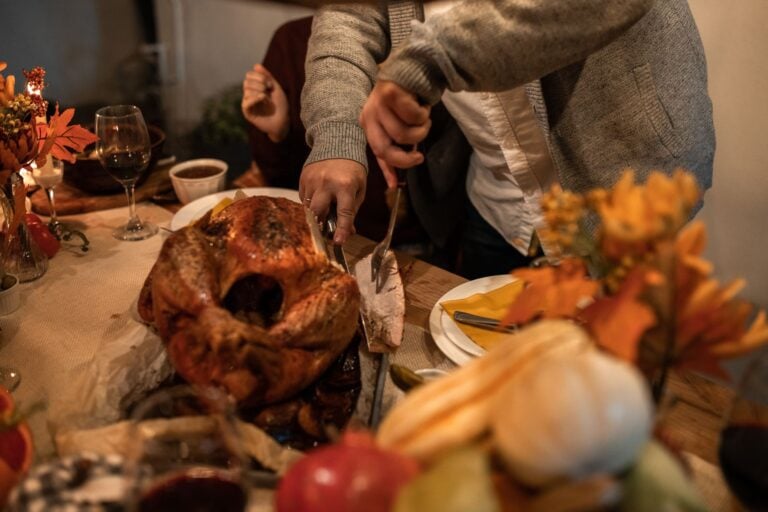
The dinner itself was chaos, the good kind, the kind I had forgotten existed. Wilbur’s giant turkey came out of the young couple’s oven golden and enormous and crackling, and he carried it to the table with an oven mitt on each hand, and the look on his face was the look of a man who had been handed back a reason to exist on a Thursday. People actually applauded. He set it down and stood there a second with his hand resting on the edge of the platter like he did not quite want to let go of it, and then he picked up the carving knife his wife used to use and he carved, slowly, carefully, the way you do a thing that matters, and he served the first plate to the woman from 4B and the second to the vegetarian, who he made sure got the squash first.
We crammed fourteen people around folding tables pushed end to end through two rooms, with Dot’s good tablecloth covering the seams in the middle and two mismatched ones from other apartments covering the rest. There were not enough matching chairs, so there were kitchen chairs and a piano bench and a step stool, and nobody minded, and the accordion man set up in the corner and played the songs he was not sure he remembered, and it turned out his hands remembered everything his head had forgotten. The vegetarian boy ended up next to Wilbur, and the two of them fell into a conversation about gardening that lasted an hour, the old widower and the lonely young man comparing tomatoes, and I watched Wilbur write something down for him on a napkin, some piece of growing wisdom, and I thought my heart might come apart.
The flan disappeared in four minutes. The woman from 4B watched it go and put her hand over her mouth, and I went and sat by her, and she told me quietly that her mother would have liked this, all these people, all this noise, and that she had not made the flan in three years because grief had convinced her that nobody would want it, and look, fourteen people had wanted it, it was gone, there was none left even for her, and she was so happy about it she could hardly speak. Somebody’s grandchild, on a video call propped up against the salt shaker, waved at all of us and asked who all the people were, and the young woman said, “These are our neighbors,” in a voice like she was surprised and proud to be able to say it, like the word neighbors had grown three sizes in a week.
And then we went around the table the way you are supposed to, and people said what they were thankful for, and most of them said some version of the very same thing, which knocked the wind out of me to hear over and over: I thought I was going to be alone today. Wilbur said it, looking at his wife’s carving knife. Dot said it, chin up, daring anyone in the room to feel one ounce of pity for her. The woman from 4B said it. The vegetarian boy said it, his voice cracking on the word alone. The young couple said it together, holding hands under the table where they thought we could not see. The accordion man said it, and then played something that made the whole room go quiet.
And then it came to me, and I opened my mouth to say my piece, the thing I had planned, something light about the turkey, something to keep it from getting too heavy, and instead my voice did a thing I had not given it permission to do, and what came out was just the truth: that I had spent eighteen years in this building convinced I was alone, and that I had been wrong the entire time, that they had all been right here, on the other side of a wall, the whole while, and that I had needed to grab the wrong turkey in the dark to find them. Dot reached over and put her hand on mine without a single word, the way you do for someone in your own family, and the young woman cried, and the vegetarian cried, and Wilbur looked at me and nodded once, slow, the nod of a man who understood every word of it from the inside.
Here is the thing I keep coming back to. None of this would have happened if I had remembered my readers. If I had read the masking tape, I would have taken my own modest bird upstairs, cooked it Thursday in my spite, eaten it over two newspapers, and gone to bed, the same as eighteen years before, and Wilbur would have sat alone in 4C with a turkey too big to face, and Dot would have had her cinnamon rolls, and the young couple would have drowned trying to feed an army, and the vegetarian boy would have eaten his sad pan of vegetables, and not one of us would have known that the people we needed had been stacked right on top of us the whole time, breathing the same radiator air, just on the other side of a wall and a habit of not knocking.
A swapped turkey did that. A dumb, frozen, twenty-two pound mistake.
We do it every year now. This was four years ago, the first one, and we have not missed one since. The guest list grows. We have lost two people from that first table, which is the price of a table full of old neighbors, and we set their places anyway and tell stories about them until we are laughing instead of crying. Wilbur does the turkey every year, and every year he brines it in my bathtub, and every year he talks the whole time, and he is not a buttoned-up apologetic man anymore, he is the loud uncle of a building, and I do not know where that man came from except that I think he was in there the whole time, waiting for somebody to need his turkey.
And the freezer in the basement still does not have working labels, and the masking tape still goes soft and fuzzy with freezer burn, and every November somebody takes the wrong bird, and now, instead of a crisis, it is the official start of the season. We tell the new people, when they move in, the same thing. Don’t worry about labeling your turkey too carefully. Around here, the wrong turkey is how you find your people.
I am sixty-seven, going on seventy-one as I write this, and I have a Thanksgiving table again, and a building full of family I found by accident, and it all started because I went down to a basement without my readers and grabbed the bird on the left near the front. I have never once been sorry I forgot those glasses. Some mistakes are not mistakes at all. Some mistakes are just the long way around to the table you were supposed to be sitting at all along.
Pass the gravy. There is always room for one more. We have learned that the hard way, and the warm way, and we are not going back.
A dramatization, inspired by the small mix-ups that turn lonely neighbors into a family.