
For most of my life I thought my father was a man who fixed things because he could not say things.
I want to start there, because that is the version of him I carried for fifty-one years, and it is the version I was wrong about. My father, Wendell, was a quiet man. Not cold, not mean, just quiet in the way some men of his generation were quiet, as if words cost money and he had been raised to be careful with them. He worked at the county equipment yard for thirty-four years, keeping the road graders and the salt trucks running through every winter I can remember. He came home smelling of diesel and cold metal, ate his supper, and went out to the garage. That was the shape of my whole childhood. Supper, and then the garage.
The garage held the workbench.
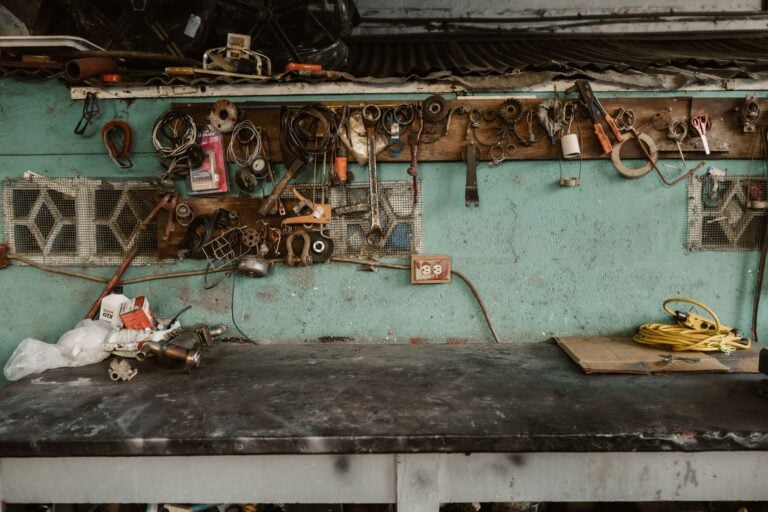
I have to tell you about the workbench, because this whole story turns on it, and because for most of my life I did not understand it at all. It was an enormous thing, built into the back wall of his two-car garage, eight feet of scarred maple top on a frame of four-by-fours my father had bolted together himself sometime before I was born. The top was gouged and stained and burned in places where a soldering iron had rolled. Above it hung a pegboard so crowded with tools that you could not see the board behind them. Below it were drawers, and bins, and coffee cans full of screws sorted by a system only he understood. And on the bench itself, always, was a clutter that drove my mother to distraction. A bicycle wheel with a bent rim. A radio in pieces. A child’s wagon with a broken axle that sat there for what felt like a year. A lawnmower carburetor in a bread pan of solvent. A doll with one arm. Always something. The bench was never clear.
My mother called it junk. She said it kindly, mostly, the way you call a thing junk when you have given up the fight against it, but she said it. “Wendell and his junk.” When she died, eleven years before he did, I think a small part of her went to her grave never having understood what that bench was. I am ashamed to say I did not understand it either. I grew up thinking my father simply liked to tinker, that the garage was where he went to be alone, that the broken things on his bench were the hobby of a man who could not sit still. I thought it was about him. I thought it was a way of not being in the house with us.
I was wrong about all of it. I learned how wrong on the Saturday we cleared out the garage, two weeks after we buried him, and I am going to tell you exactly how it happened, because I have told it to almost no one, and because it is the truest thing I know about who my father really was.
My name is Faye. I am fifty-one. I am Wendell’s only child, which means that when he died, the house and everything in it became my responsibility, and the everything in it was overwhelming. He had lived in that house for fifty-three years. My mother had been gone for over a decade, and in that time the rooms had filled the way a widower’s house fills, with newspapers and almanacs and a recliner worn to the shape of him and a refrigerator with three condiments and a carton of buttermilk in it. The house was sad in the ordinary way that the houses of the recently dead are sad. But the house I could handle. The house was just sorting.
It was the garage I dreaded.
Because the garage was the workbench, and the workbench was fifty years of accumulated clutter, and I had decided, somewhere in the gray fog of the week after the funeral, that I was going to clear it out and have a dumpster hauled away and be done with it. I told my husband, Paul, that we would do it on Saturday. I told him it would take all day and probably break my heart, and that I wanted it over with. I remember saying the word junk myself. I remember saying, “I have to deal with Dad’s junk in the garage.” I remember saying it the way my mother used to, with that same tired affection, never once suspecting that within a few hours the word would shame me down to my shoes.
Saturday came up gray and cool, an early autumn morning with the smell of wet leaves in it. Paul backed his truck up the driveway and we rolled up the big garage door and stood there looking at it, the bench and the pegboard and the bins and the smell of the place, which was diesel and 3-in-One oil and sawdust and something underneath all of that that was just my father, the way a place holds the smell of a person long after the person is gone. I stood there and I cried for a minute, the easy crying that comes and goes that whole first month, and then I wiped my face and said, “Okay. Let’s start at the bench.”
We had been at it maybe twenty minutes when the first truck slowed at the curb.
I did not think anything of it. People had been slowing at the curb for two weeks. It is what a neighborhood does when one of its old men dies, it slows down, it brings a casserole, it pays its quiet respects. So I did not think anything of it when the truck stopped and a man got out, a big man somewhere in his fifties with gray in his beard and a flannel shirt, and stood at the foot of the driveway looking up at the open garage. I did not know him. I assumed he was a neighbor I had forgotten, somebody who had known my father.
Get a new story in your inbox every morning.
Facebook doesn’t show you every story we post. Our free newsletter does. Join 2,500+ readers.
And then I saw what he was carrying, and I stopped.
He was holding a bicycle. A child’s bicycle, an old one, the kind they made in the seventies, a blue boy’s bike with a banana seat and high handlebars and a little spot of rust on the chrome fender. He held it out in front of him with both hands the way you would carry something to an altar. He came up the driveway slowly, and he stopped a few feet from me, and he looked at the bike, and then he looked at me, and his eyes were wet.
“You’re Wendell’s daughter,” he said. It was not a question.
“I am,” I said. “I’m Faye.”
“My name’s Dexter,” he said. “Dexter Hollings. I grew up on Mercer Street, two blocks over. I heard about your dad. I’m sorry. I am so sorry.”
“Thank you,” I said. I was looking at the bicycle. I could not stop looking at the bicycle. It was clearly old, clearly a thing he had kept a long time, and he was holding it like it was made of glass.
“I wanted to bring this back,” he said. “I don’t know why. I’ve had it forty-three years. I thought maybe you should see it.”
And then Dexter Hollings, a man I had met thirty seconds earlier, a man the size of a refrigerator with gray in his beard, started to cry in my father’s driveway. Not loudly. Just standing there, holding a child’s bicycle, with the tears running down into his beard, trying to talk and not being able to for a moment.
“I was eight,” he said, when he could. “My dad was gone. My mom worked nights at the cannery, and we didn’t have anything, Faye. I mean we didn’t have anything. And every kid on the block had a bike but me. And one day this bike just appeared on our porch. This exact bike. Fixed up, cleaned, the chain oiled, a new seat on it. And I rode that thing till the wheels came off, and I never knew where it came from. My mom said somebody from church, but it wasn’t church. Nobody at church had the money either.”
He ran his hand along the handlebars.
“It was twenty years before I found out,” he said. “I was grown. I ran into Mr. Hardy, who lived next to us back then, and he told me. He said he’d watched it happen. He said your dad used to drive the alleys behind the houses on the poor end of the neighborhood on trash day, and he’d see the bikes the families had thrown out, the broken ones, and he’d put them in his truck. And he’d fix them up in his garage at night. And then he’d find out which kid didn’t have one, the quiet way, asking around, and he’d leave it on the porch. Never knocked. Never said a word. Never let anybody thank him. He did it for me. He did it for half the kids on Mercer Street and he never told a living soul.”
I did not say anything. I could not. I was looking at the workbench, at fifty years of broken things, and the floor of my understanding was tilting under me.
“I always meant to thank him,” Dexter said. “And I never did. And now he’s gone, and I can’t. So I brought the bike back. I’ve kept it in my garage my whole life, Faye. My kids learned to ride on it. I couldn’t ever get rid of it. And when I heard he passed, I knew I had to bring it here. I’m sorry. I know that’s strange.”
“It’s not strange,” I managed to say. “It’s not strange at all.”
And that was when the second truck pulled up.
I want you to understand that I had told no one we were clearing the garage. I had told Paul. That was it. There was no announcement, no notice, nothing. But a neighborhood the age of ours is a kind of nervous system, and word that Wendell’s girl had the garage open and a truck in the drive had moved through it overnight the way news moves through old neighborhoods, over fences and through kitchen windows and across church pews, and what it had stirred up, I was about to learn, had been waiting a very long time to come.
The man who got out of the second truck was older than Dexter, maybe sixty-five, walking with a cane. And he was carrying a wagon. A child’s red wagon, an old Radio Flyer, the paint worn down to the metal at the corners, one wheel newer than the others.
“You won’t remember me,” he said to me. “I’m Earl. Earl Pruitt. Your dad fixed this wagon for me in 1968. I was the oldest of six and we didn’t have two nickels. The axle was bent and my dad tried to straighten it cold and snapped it clean off, and we couldn’t afford another one, and I cried about it like it was the end of the world, because when you’re a kid a wagon is the whole world.” He set it down gently on the driveway. “And it disappeared off our porch one night, and three days later it came back with a new axle in it, welded, that wheel you see there replaced, and it never broke again. I hauled my little brothers and sisters around in this wagon for ten years. I never knew who fixed it. I found out at your father’s wake, two days ago. A fellow there told me. So I went home and I got it out of my barn, where it’s sat for fifty years, and I brought it to him.” His voice cracked. “I’m too late to say thank you. But I wasn’t going to let him go without bringing it back.”
By the time Earl finished talking, there was a third truck at the curb.
I am going to try to tell you the rest of that morning the way it actually happened, which is to say slowly, and one at a time, because that is how it came, one man at a time, all morning long, the whole neighborhood emptying its garages and its barns and its attics and bringing the broken things back to the bench where they had been mended, and every single one of them carrying a piece of a story my father had never told me.
There was a man named Coleman who brought a scooter, a steel scooter from before I was born, who said my father had built it for him out of two-by-fours and a pair of roller skates because his family had nothing and Christmas was coming. Wendell had left it on the porch on Christmas Eve, Coleman said, and he had ridden it down the middle of Mercer Street at six in the morning on Christmas Day, the only present he got that year, the happiest he had ever been in his life, and he had never known who left it until he was a grown man with children of his own.
There was a man named Reuben who brought a model airplane, balsa wood and tissue paper, yellowed and fragile, that my father had built to replace one Reuben’s older brother had crushed in a fit of meanness. “I cried for two days over the one my brother broke,” Reuben told me, holding the little plane in his two hands like a bird. “And then this one showed up. Better than the first one. And I knew it wasn’t my mom, because my mom couldn’t build a sandwich, God rest her. It was a mystery my whole childhood. Your dad was the mystery.” He looked at the workbench. “He was the mystery the whole time.”
There was a man, a doctor now I was told, retired, who brought a pedal car with the seat reupholstered. There was a man in a city utility uniform who had taken the morning off and brought a tricycle. There was a man who brought a sled. There was a man who brought a doll’s high chair, who said it had been for his little sister, who had died young, and who could barely get the words out at all. One by one they came up the driveway of the house I grew up in, men in their fifties and sixties and seventies, grandfathers most of them now, carrying the toys of the poor children they used to be, and they set them down on the grass and the driveway in a growing line, and they stood there, and most of them cried, and I stood at the mouth of that garage and I cried with all of them, because I was learning, in real time, in the space of a single gray morning, that I had not known my father at all.
Forty years. He had done this for forty years. I did the arithmetic later, standing in the garage that night, and it made me sit down on the cold concrete floor. The men who came that Saturday spanned five decades of children. The oldest was a wagon from 1968. The most recent was a bicycle a young man brought near noon, a man only about thirty, who said my father had fixed it for him when he was twelve, which would have been less than twenty years ago, when my father was already an old man. He had never stopped. He had been doing it the whole time. Through my childhood, through my mother’s life and her death, through his own old age, the quiet man who went out to the garage after supper had been driving the alleys of the poor end of the neighborhood on trash day, lifting broken bicycles into his truck, and fixing them in secret for children who had nothing, and leaving them on porches in the dark, and never, not once, in fifty years, taking the credit.
The clutter on the bench that my mother called junk was not junk. It was never junk. It was the next child’s bicycle. It was the next repair, in progress, waiting for a part. Every broken thing I had ever seen on that bench had been on its way to a porch I never knew about, to a kid I never met, on a street I drove past without a thought. The doll with one arm. The wagon with the broken axle that sat there for a year. The bicycle wheel with the bent rim. They were not a hobby. They were a ministry. They were the longest, quietest act of love I have ever heard of, conducted in total secrecy by a man who came home smelling of diesel and ate his supper and said almost nothing, for forty years, in a garage I thought was where he went to get away from us.
I had it exactly backwards. He did not go to the garage to be alone. He went to the garage to take care of children. He had been pouring himself out, night after night, the whole time, into the lives of kids the world had overlooked, and the reason he never told us was the same reason he never knocked on the porches, never let himself be thanked, never let his name be attached to a single one of those bicycles. He did not do it to be loved. He did it because a child without a bicycle was a wrong he had the hands to fix, and so he fixed it, and then he went on to the next one, and he expected nothing, and he got nothing, and that, I understand now, was the entire point. The not-being-thanked was not a side effect. It was the shape of the gift.
I have thought a great deal, since that Saturday, about why he never told me.
I used to think, in the first raw days after I understood, that it was a kind of tragedy, that he had carried something so beautiful entirely alone and died without his own daughter knowing the best thing about him. And there is some truth in that, and it still aches. But I have come to a different place with it, and I want to be honest about that too. I do not think my father saw it as a secret he was keeping from me. I think he saw it as simply none of anyone’s business, including mine. I think to him a kindness announced was a kindness spent, that the moment you let someone thank you, you have been paid, and he did not want to be paid. He wanted those children to have the bicycles. That was all. He wanted it so purely that he was willing to give up being known for it, even by the people who loved him, even by me. There is a kind of person who does good in order to be seen doing good, and the world is full of them, and I have been one of them more often than I would like to admit. My father was the other kind. The kind that does it in the dark and drives away before the porch light comes on.
A man named Otis came late in the morning, one of the oldest of all of them, in his eighties, brought by his son because he could no longer drive. He had no toy to bring. He came up the driveway slowly on his son’s arm and he stood in front of the workbench for a long time without saying anything, and then he reached out and put his palm flat on the scarred maple top, just rested it there, the way you would touch the side of a horse, or a coffin.
“I learned to fix things on this bench,” he finally said. “Did you know that? Your dad caught me trying to steal a bicycle out of a yard when I was eleven. Caught me red-handed. And he didn’t holler and he didn’t call the law. He took me by the collar and he walked me back here to this garage and he said, you want a bicycle, I’ll teach you to fix one. And he did. He stood me right here at this bench and he taught me how to true a wheel and patch a tube and set a chain. Took him a whole winter. And at the end of it he gave me the bicycle I’d fixed with my own hands and he said, now it’s yours, you built it. And I never stole another thing in my life. I’m eighty-three years old. I never stole another thing in my life because of this man and this bench.” He patted the wood, twice, gently. “You ought not to call this junk,” he said to me, though I had not said it out loud, though I would never have said it again. “There’s not a thing in this garage that’s junk. There’s not a thing in this garage your father didn’t love something through.”
I did not get rid of the dumpster I had ordered, but I sent it away empty. I want you to know that. It came that afternoon, the man backing it down toward the driveway, and I walked out and stopped him and gave him fifty dollars for his trouble and told him I had changed my mind, that I would not be needing it after all. Because by then the line of returned toys stretched halfway across the lawn, and the men were still coming, and I understood that there was nothing in that garage to throw away. There never had been.
We did clear the bench, in the end. But we cleared it the way you clear an altar, not the way you clear a junk pile. Paul and Dexter and Earl and Coleman and half a dozen of the men stayed all afternoon, and we went through every drawer and every coffee can and every bin, and the men told stories the whole time, stories of streets and winters and porches, and we laughed as much as we cried, which surprised me. They knew things about my father I had never known. They knew he kept butterscotch candies in the top left drawer for the kids who came around. They knew he hummed hymns while he worked, off-key, the same three or four, over and over. They knew, because they had been those kids, that he never once made any of them feel like a charity case, that he handed a fixed bicycle to a poor boy as if the boy were doing him a favor by taking it off his hands. “He made you feel like you’d helped him out,” Coleman said, wiping his eyes. “That was his gift. Not the fixing. Anybody can fix a bike. He could fix a bike and leave a kid his dignity. That’s the part I never learned how to do.”
There was a thing in the bottom drawer that undid me, and I will end with it, because it is the truest thing of all.
It was a ledger. Not a fancy one. A worn spiral notebook, the cheap kind, fifty cents at the drugstore, and there were a whole stack of them, going back decades, rubber-banded together, the rubber bands gone dry and snapping when I touched them. And I opened the oldest one expecting names, expecting some record of all the good he had done, some accounting of the children and the bicycles, some part of him after all that had wanted to be remembered. And there were no names. That is what undid me. There were no names at all. There were only repairs. Page after page after page in my father’s small square pencil. “Blue boy’s bike, Schwinn, bent rim and chain, 3rd house Mercer.” “Red wagon, snapped axle, welded, Pruitt corner.” “Scooter, built, 2×4 and skates, Christmas.” “Tricycle, repainted, new pedal.” Forty years of repairs, logged in a private hand, with the streets and the houses but never the children, never a name, as if even in his own private notebook, even in a record only he would ever read, he refused to take possession of those kids, refused to make them his project, refused to turn his love into a list of his own good deeds. He just wrote down what was broken and how he fixed it. Because to him that was the whole of it. Something was broken, and he had the hands, and so he fixed it, and then he wrote it down the way you write down what you did so you remember where you left off, and he started the next one.
I have those notebooks now. They are the most precious thing I own. I read them sometimes, the long lists of broken things made whole, and I think about all the men who came that Saturday and all the men who did not come because they had moved away or died or never knew it was him, the whole secret country of children my father quietly rescued from going without, fifty years of them, scattered now across the whole map of their grown lives, riding bicycles in their memories that a quiet man fixed in the dark and never signed.
People ask me sometimes what my father was like, and for fifty-one years I would have said, oh, he was quiet, he kept to himself, he liked to tinker in the garage. I cannot say that anymore. Now when someone asks me what my father was like, I tell them the truth, which I learned too late to tell him I had learned. I tell them my father was the most generous man I ever knew, and that he spent forty years making sure poor children had something to ride, and that he did it so quietly that his own daughter thought his life’s work was a pile of junk on a bench. And then I tell them about the morning the whole neighborhood came up the driveway carrying their childhoods in their arms to bring them home to him, and I tell them they should have seen it, the line of grown men crying on the lawn over a wagon and a scooter and a blue boy’s bike, and I tell them that I would give anything, anything in this world, to have known one tenth of it while he was alive, so that just once I could have walked out to that garage after supper, and stood beside him at that scarred old bench, and said, Dad. I see you. I see what you are. Keep going.
I never got to say it. But I think, in his way, he knew I would have. And I think that the men coming home that Saturday, carrying the proof of him across the lawn, was the thanks he spent his whole life refusing, finally catching up to him two weeks too late, and arriving anyway, the way the good you do in the dark always arrives, eventually, at the door of the people who loved you, whether you let them thank you or not.
The bench is still there. I could not bring myself to take it out. Paul oiled the top and tightened the legs and we left it bolted to the back wall of that garage exactly where it has been my whole life. And on it, in the middle, where the clutter always was, I keep one thing now. Dexter let me keep the blue bicycle. He said it belonged there more than it belonged in his garage, and he was right.
It is the first thing you see when you raise that garage door. A blue boy’s bike with a banana seat and a little rust on the fender, sitting on a scarred maple bench, in a garage that smells of diesel and oil and my father, waiting, the way it always was, to be carried out to some kid who has nothing.
It is not junk. It was never junk. It was the truest thing he ever made, and he made it out of the only material he ever fully trusted, which was the dark, and his own two hands, and the absolute certainty that the work itself was payment enough.
A dramatization, inspired by the quiet kindnesses ordinary people do for children who have nothing, and the way those kindnesses come home decades later.