
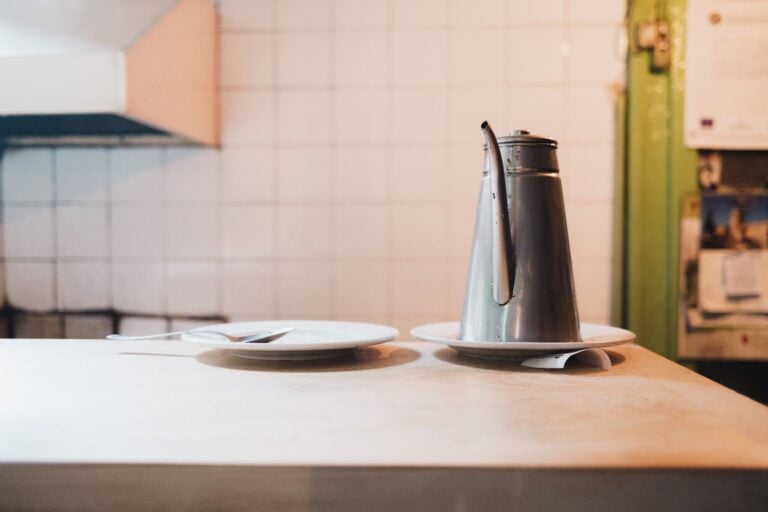
For thirty years I ran a diner on Route 9 and I never once kept a tab.
People think that is a saying. It is not a saying. I mean it the way I would mean it if you asked me whether the coffee was hot. There was a drawer under the register where a tab book was supposed to live, and that book existed, and in thirty years it held the names of suppliers and the propane company and the man who fixed the walk-in cooler. It never once held the name of a person who walked in hungry and walked out without paying. I want to be honest about that from the first line, because the thing that happened to me in the spring I turned sixty-three only makes sense if you understand that I did not keep score. I really did not. That was the whole point of the thing, and it is also the reason I was so unprepared for what the town did.
My name is Marlene. The diner is called Marlene’s, which was not my idea. When I bought the place in 1993 it was called the Route 9 Grill, and I painted my own name on the window because the sign company gave me a discount on shorter words and Marlene is shorter than Route 9 Grill. That is the kind of decision my whole life has been made of. Small, practical, a little bit funny if you tilt your head. I was thirty-three. I had eleven thousand dollars, a divorce that was mercifully clean, and a recipe for chicken and dumplings that my mother swore could end a war. I had no business plan. I had the idea that a town this size needed one warm room that stayed open, and that I could be the person who kept it warm.
The town is called Hartwell. You have driven past a hundred Hartwells and never slowed down. One stoplight, a feed store, a Methodist church and a Baptist church glaring at each other across the same intersection, a school that combined the elementary and the high into one building the year the mill closed. The mill closing is the thing you need to know about Hartwell, because it is the thing that made my diner what it became. When the mill went, in 1998, half the town lost its paycheck in a single Friday. And those men, those proud men who had never taken a thing they did not earn, started coming into my diner and ordering coffee and nursing it for two hours because the diner was warm and home had gotten cold and quiet and full of fear.
I started feeding them. Not with a speech. I never made a speech in my life. A man would order coffee, just coffee, and I would set down a plate of eggs and toast in front of him and say the kitchen made a mistake on an order and it would only go to waste. That was the lie I told for thirty years, in a thousand small variations. The kitchen made a mistake. We over-prepped. This was supposed to go to a table that left. I made too much of the special and I would rather you ate it than I threw it out. It was never charity, the way I said it. It was always an accident, an overage, a happy little failure of inventory management. And the men, who could not have taken charity, could take an accident. They could eat an accident with their heads up. So they did. And I never wrote a thing down.
That is the part I need you to sit with, because it is the part that broke me open later. I did not keep a list. There was no ledger of who owed me. There was no mental tally I was waiting to cash in. I had decided a long time ago, in a way I never put into words until this spring, that the second you keep score, the food stops being a gift and starts being a loan, and a loan is a weight you hang around a hungry man’s neck. So I refused to know. If you had asked me, in March of this year, how many free meals I had served in thirty years, I could not have told you a number within ten thousand. I had made myself not know on purpose. I thought that was generosity. I have since learned it was something a little more complicated, and a little more selfish, and I will get to that, because it is the thing the whole town taught me on one Saturday morning.
Let me tell you about Sal first, because you cannot understand the morning without Sal.
Sal Petrocelli came into my diner the second week I owned it and ordered a patty melt and never really left. He was a long-haul driver then, gone four days out of seven, and Marlene’s was the place he came back to. When his wife Donna got sick in 2009, Sal moved her care into the back booth, the big one by the window, because the house felt like a hospital and the diner felt like a life. He would bring Donna in and she would do her crossword and I would keep her decaf coming and Sal would hold her hand across the formica. When she passed, in 2011, the reception was in my diner because Sal said it was the only building Donna ever relaxed in. I closed for the day. I made enough food for two hundred people. I did not charge him. I told him the church had covered it, which was not true, and he never checked, and that was the only lie I ever told Sal that I am not sure he believed.
Sal is seventy-one now. He has a bad hip and a good heart and the kind of face that looks angry until it smiles. He took the corner stool nearest the register as his own about fifteen years ago, and from that stool he has appointed himself the unofficial mayor of Marlene’s, which means he greets every regular by name, refills the coffee when I am slammed, and tells the same four jokes on a rotation so reliable you could set a clock by it. I did not know, until this spring, that Sal had been keeping the list I refused to keep. I will get to that too.
Get a new story in your inbox every morning.
Facebook doesn’t show you every story we post. Our free newsletter does. Join 2,500+ readers.
Now Harlan.
Harlan Voss came to Hartwell about two years ago, and you knew what he was before he opened his mouth. He drove a truck that had never seen a job site, the kind that is washed more than it is used. He wore a quarter-zip and good shoes and a watch that cost more than my walk-in cooler. He bought up the old mill land first, which everyone expected, because the mill land had sat dead for twenty-five years and someone was always going to come for it eventually. Nobody minded that. The mill was a corpse and Harlan was within his rights to buy a corpse.
What people minded came later. Harlan’s company, which had a name like a law firm, started buying the block. The empty hardware store. The lot behind the feed store. And then he came for my building, because my building sits on the corner of Route 9 and Main, and a man who is building a strip of franchises and a gas station with twelve pumps wants the corner. The corner is the whole game. My diner was sitting on the corner he wanted, and I did not own the land. I want to be clear about that, because it is the hinge of the entire story. I rented. I had rented for thirty years from a man named Earl Sutton, who owned the building and charged me a rent that had not changed since 2004 because Earl was a Hartwell man and the diner was a Hartwell thing and that was simply how Earl saw the world. Earl died in February. His kids live in Phoenix and Atlanta and have never eaten my chicken and dumplings. And Harlan Voss made Earl’s kids an offer for the building in March.
The first I heard of it was from Harlan himself, which tells you everything about the man. He did not have to come tell me. The decent thing, the small-town thing, would have been to let Earl’s kids handle it, to let the news come gently. Harlan came in person, on a Tuesday, at the two o’clock lull when the diner was empty except for Sal on his stool. He sat down at the counter. He did not order anything. He folded his hands and he smiled at me and he said, and I will remember this until they bury me, “Marlene, I’m going to do you a favor and tell you early. I’m buying the building. The lease ends in September. I’m not renewing it. I’d start thinking about what’s next for you, because at your age you don’t want to be scrambling.”
At your age.
I was sixty-two years old standing behind a counter I had stood behind for thirty years and a man I had never fed in my life told me that at my age I should start thinking about what was next. Sal set his coffee cup down on the saucer with a click I can still hear. I told Harlan the coffee was on the house and he should drink it on his way out, which is the closest I have ever come to throwing a man out of my own diner. He left it untouched. He left a card on the counter. I threw the card away after he was gone and then I went into the walk-in cooler, the cold dark one, and I stood in there for ten minutes so that nobody would see my face do the thing it was doing.
Here is what Harlan knew and used. He knew I had no land. He knew the lease ended in September. And he knew, because he had done his reading, that the diner was not exactly swimming in money. That was the part that shamed me most. For thirty years I had been giving food away, accident by accident, and the accidents add up. I had no savings to speak of. The diner ran close to the bone every single month and always had, because every plate I gave away was a plate I did not sell, and I had given away a town’s worth of plates. There was a number Harlan’s people had found, a payoff on the building that Earl’s kids would accept, and a chance, a real chance, for me to buy the building myself and keep my corner. But the number was a hundred and forty thousand dollars, and to buy it I had until September, and I had, when I sat down with a calculator the night after Harlan’s visit, almost exactly nothing. I had a diner that fed everyone and saved nothing. I had made sure of it. I had built my whole life so that I would never have a cushion, because a cushion is just a tab you keep on yourself, and I did not keep tabs. The cruelty of it was almost funny. The thing that made me good at my life was the exact thing that was about to cost me my life.
I did not tell anyone. That was my mistake and my pride both. I have spent my life feeding people who could not pay and telling them it was an accident so they would not feel the weight of it, and when the weight landed on me I did the same thing I always told them not to need to do. I carried it alone. I smiled across the counter. I kept the coffee coming. I told Sal, when he asked what Harlan had wanted, that it was nothing, that Harlan was just being Harlan. Sal looked at me over the top of his glasses for a long second and said, “Marlene, I have known you since Clinton was president, and that is the first time you have ever lied to my face.” And then he let it go, because Sal is the kind of man who lets you keep your dignity in the moment and goes around the back to fix the actual problem. I did not know that is what he was doing. I thought he had let it go.
He had not let it go.
April was the worst month. I am not going to dress it up. There were nights I closed the diner and sat in the dark with the calculator and ran the same numbers I had already run, as if they would change. I called the bank. The bank was kind and useless, which is what banks are to people like me. I had no collateral, because I owned no land and the diner equipment was old and the bank’s appraiser looked at my thirty-year-old griddle the way Harlan had looked at me. At my age. I thought about what was next, the way Harlan told me to. I thought about it at three in the morning more nights than I will admit. What was next was nothing. I am sixty-three. I have no children. The diner was not just my job. The diner was the only argument I had ever made for my own existence, the only proof I could point to that Marlene had been here and had been worth something, and a man in good shoes was going to scrape it off the corner to put up a gas station.
And the worst of it, the part I could not say out loud to a single person, was a thought that started visiting me in those April nights and would not leave. The thought was this. If I had charged. If I had, even once a week, even just for the easy ones, the people who could have paid and I waved off anyway, written it down, taken the money, saved a little. If I had kept score like a sensible woman, I would have the hundred and forty thousand dollars now. I would be able to buy my own building and tell Harlan Voss to drive his washed truck off a short pier. My own generosity was the thing strangling me. I started to feel, in those nights, that I had been a fool for thirty years. That all that quiet feeding had been vanity dressed as virtue, and now the bill was due, and there was no one to wave it off and tell me the kitchen had made a mistake.
I am telling you the ugly inside of it because I want you to feel the size of the turn, and the turn is the only reason I am writing this at all.
Sal came in one Saturday morning in early May, and he did not take his stool. That alone made me look up. Sal in motion is a sight. He stood in the middle of the diner and he said, loud enough for the whole room, the breakfast rush, every booth full, “Marlene, come out from behind that counter for a minute. There’s something out front.”
I thought a car had hit the building. That is honestly what I thought. I dried my hands and I came around the counter and Sal took my arm, my arm, with that gentleness that big rough men have, and he walked me to the front door and he opened it.
The street was full of people.
Not a crowd the way a crowd gathers at an accident. A line. An actual line, the kind you see outside a church on Christmas Eve, running down the sidewalk from my front door, past the empty hardware store, around the corner toward the feed store and out of sight. And every person in that line was holding something. An envelope. A jar. A folded check. A coffee can with the lid taped down. A little girl near the front, maybe eight years old, was holding a sandwich bag with quarters in it, both hands, like it was the most important thing she had ever carried.
I did not understand. I am ashamed to say I did not understand for a full minute. I stood in my own doorway in my apron with my hands still smelling like the griddle and I looked at the line and I looked at Sal and I said, “What is this.”
And Sal, who never in my hearing made a speech in his life either, made one then. He said, “Marlene. You have been telling this town for thirty years that the kitchen made a mistake. Every single person in this line knows the kitchen never made one mistake. You fed us. You fed my Donna in that back booth for two years and told me the church paid for it and the church did not pay for it, you paid for it, and I knew, and I let you have the lie because you needed to give it more than I needed to be honest about taking it. And when Harlan Voss came in here and told you what was next at your age, I went home and I made some calls. And then those people made some calls. And here we are.”
I want to tell you exactly how it worked, because Sal had organized the whole thing and it deserves to be told right, not blurred into a nice feeling.
After Harlan’s visit, after I lied to his face, Sal had gone to Pastor Reyes at the Methodist church, not for a sermon but because Pastor Reyes has the church directory and a printer. Together they made a single sheet of paper. It did not ask for anything. Sal was firm about that, I learned later, because Sal knew me, and Sal knew that if it read like charity I would have stood in the doorway and refused it the way I would have refused it my whole life. The sheet just told the truth. It said: Marlene is going to lose the diner in September. The building is being sold out from under her. She has never once charged anyone in this town who could not pay, and most of you reading this are one of those people, whether you knew it at the time or not. There is no collection plate. There is no envelope to put on a table. If the diner ever fed you, and you would like the diner to keep feeding the next person the way it fed you, come to Marlene’s on Saturday morning the tenth of May and bring what you can. That is all. Come in person. She needs to see your faces more than she needs your money.
She needs to see your faces more than she needs your money. Sal put that line on the sheet himself. He told me later he put it there because he was afraid that if it was only money, only checks in the mail, I would have found a way to send it all back. He was right. I would have. But you cannot send a face back. You cannot mail back a man standing in your doorway with his hat in his hands.
And they came. Sal and Pastor Reyes had printed maybe two hundred sheets, expecting, Sal said, that on a good day fifty people might show. The two churches put it in their bulletins. The school put it in the Friday folder that goes home with every kid. The feed store taped it to the register. And on the morning of the tenth of May, the line down Main Street had more than three hundred people in it, and it kept growing while I stood in the door, because once a thing like that starts in a town like Hartwell, the phone tree does the rest, and people drove in from the county to stand in it.
I started down the line because I did not know what else to do with my body. And the line became the thing that taught me what I had spent thirty years refusing to learn.
The first man in line was Hank Dillard. Hank is eighty now. Hank was a mill man, one of the proud ones, one of the first ones I fed an accident to in the winter of 1998. He took my hand in both of his and he said, “Marlene, you fed me eggs every morning for eight months when I couldn’t look my wife in the eye, and you told me the kitchen made a mistake, and we both knew there was no mistake. I never paid you back. I’m eighty years old. Let me pay you back.” And he put an envelope in my apron pocket himself because my hands had stopped working.
Behind Hank was a woman I did not recognize at first, a woman in her forties, and she said, “You don’t know me grown up. I’m Carrie Whitfield. I was eleven. My mom worked nights at the gas station after my dad left and you let me sit in the back booth and do my homework every single afternoon and you always brought me a grilled cheese and a chocolate milk and you said it was extra from a wrong order, and Miss Marlene, I am a nurse now, I have my own kids, and there was no wrong order, was there. There was never a wrong order.” And she was crying and I was crying and the line behind her stretched out of sight, and that was when it started to come apart inside me, the thing I am trying to tell you about.
Because I had spent thirty years building a careful machine for giving without keeping score. I had told myself that the not-keeping-score was the purest part. I had been so proud of the drawer with no tab book in it. And standing in that line, shaking hand after hand, I understood that I had been wrong about what I was doing, all of it, wrong in a way that had cost me something I did not even know I was losing.
I had thought I was sparing those people the weight of a debt. What I was actually doing, for thirty years, was refusing to let them love me back. Every time I said the kitchen made a mistake, I was not just protecting their dignity. I was protecting my own loneliness. I was making sure that the love only flowed one direction, out of me and into them, and that nothing ever came back, because if nothing came back then I never had to feel how much I needed it. I had built a whole life of giving precisely so that I would never have to risk receiving. And it took three hundred people standing in a line down Main Street, each one holding the proof of a meal I had refused to remember, to show me the ledger I had been keeping all along without knowing it. Not a ledger of money. A ledger of love. It had been adding up the whole time, in a book I could not see, in a town that had been quietly writing my name down for thirty years even as I refused to write down theirs.
I got to the little girl with the quarters in the sandwich bag. Her name was Sophie. Her grandmother was behind her, and her grandmother said, “Tell Miss Marlene why you wanted to come.” And Sophie looked up at me, very serious, and she said, “Because Grandma said you feed people and now people are going to feed you.” And she held up the bag with both hands. There were eleven dollars in quarters in it. She had broken her own piggy bank. I knelt down on the sidewalk in front of my diner, sixty-three years old, both knees, and I took that bag from her and I told her it was the most important money I had ever been given, and it was true, it is still true, I have those quarters in a jar on the diner counter to this day and I will never spend them.
The town raised the hundred and forty thousand dollars.
I am going to say it plainly because Sal earned the plain telling of it. By the time the line ended, near noon, after I had walked the whole length of it twice and shaken every hand and heard a hundred versions of the same sentence, you fed me, you fed my father, you fed my kids, and there was never a wrong order, was there, Pastor Reyes and two of the church ladies had counted what was in the envelopes and the jars and the coffee cans, and it was not enough. It was eighty-one thousand dollars, which is a staggering thing for a town like Hartwell to put in a pile in one morning, and it was not enough to buy the building, and I saw Sal’s face fall, just for a second, when Pastor Reyes whispered him the number.
And then Hank Dillard, eighty years old, the first man in line, who I did not know had anything, walked back to the front of the diner where Sal was standing and he said, loud, “How short are we.” And Pastor Reyes told him. And Hank said, “I sold my back forty to Harlan Voss myself last fall, for sixty thousand dollars, and I have not spent a dime of it because I did not know what it was for. Now I know what it was for.” And he wrote a check, standing at my counter, on his knee, for the difference. Sixty thousand dollars from a man who ate my eggs for free in 1998 and never forgot it.
I tried to stop him. Of course I tried to stop him. I said Hank, no, that is your money, that is everything you have. And Hank Dillard looked at me with those eighty-year-old eyes and he said the thing that ended me, the thing I will carry to my own grave, he said, “Marlene. For thirty years you told this whole town the kitchen made a mistake. Let me tell you something. The kitchen never made a mistake. You did. You forgot that you were one of us. You’re done forgetting today.”
You forgot that you were one of us.
We bought the building. The check cleared. Earl’s kids in Phoenix and Atlanta took the town’s money over Harlan Voss’s money, and I would like to think that some part of them, some Hartwell part their parents put in them, was glad to do it, though I expect the truth is the town simply matched his offer and they took the path of least resistance. It does not matter. The corner of Route 9 and Main belongs to Marlene’s now, and it belongs to me, and the deed has my name on it, the same name I painted on the window in 1993 because it was shorter than Route 9 Grill.
Harlan Voss built his gas station two blocks down, on the mill land, which is where it should have gone all along. He comes in sometimes, actually. The first time he came in after, the whole diner went quiet, and Sal stood up off his stool, and I put my hand on Sal’s shoulder and sat him back down, and I went over to Harlan’s booth myself and I set down a plate of chicken and dumplings he did not order, and I told him the kitchen had made a mistake, and it would only go to waste. He looked at me for a long moment. He understood exactly what I was doing. He ate every bite. He left a hundred dollar bill under the plate and he has never once mentioned it and neither have I, and that is between Harlan and me and I will leave it there, because a man can change and it is not my job to decide he cannot.
I keep a tab book now. This is the part that matters, the thing the line taught me, so I will end on it. I keep a tab book now, but it does not have money in it. After that Saturday I bought a black ledger from the feed store and I started, finally, at sixty-three, writing names down. Not what people owe me. What I owe them. Hank Dillard, sixty thousand dollars and eight months of eggs. Sophie, eleven dollars in quarters and the lesson of my life. Carrie Whitfield, a thousand afternoons of homework in the back booth. Sal Petrocelli, thirty years of a corner stool and the one time he refused to let me lie my way out of being loved. I write them down now. I keep score now. Because I learned, standing in that line, that refusing to keep score was never humility. It was a wall. And the town tore my wall down with their own hands on a Saturday morning in May, one envelope and one jar and one sandwich bag of quarters at a time, and they did it in person, where I could not send it back, where I had to stand there and let it land.
The diner is still warm. It is still open. The coffee is still hot. And the kitchen, I want you to know, still makes mistakes, all the time, every single day, big generous mistakes that land on the plates of people who cannot pay. That has not changed and it never will. What changed is that now, when someone tries to thank me, I do not wave it off and tell them it was an accident. I let them thank me. I let it land. I let myself be one of them.
That is what the whole town came to teach me, and it only took thirty years and a man in good shoes telling me what was next at my age. There is no next. This corner is mine. These people are mine. And I am, finally, theirs.
I should have let them feed me a long time ago.