
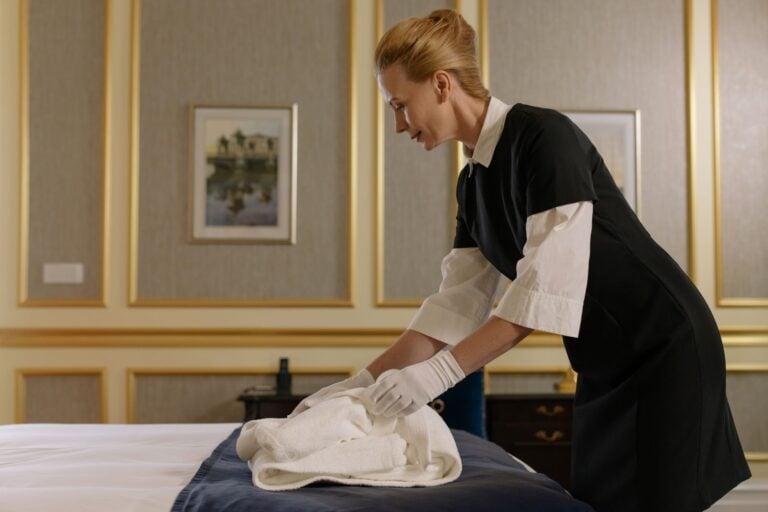
For eleven years I cleaned the Ashford house, and on the morning they accused me of stealing from it, Vivian Ashford did not raise her voice once. That was the part that broke me. I had braced for screaming. Screaming I could have stood up under, because screaming is hot and messy and it burns itself out. What I got instead was cold. She stood at the top of her own staircase in a cream silk robe, her hands folded in front of her like a woman about to give a toast, and she looked down at me the way you look at a stain you have just noticed on a rug you paid too much for.
“Rosa,” she said. “We need to talk about the brooch.”
I want to tell you the whole thing from the beginning, because the way it ended is the only part of my life I am still proud of, and you cannot understand the ending without sitting inside the rest of it first. My name is Rosa Delgado. I am fifty four years old. I have cleaned other people’s houses since I was nineteen, and for the last eleven of those years I cleaned one house in particular, a big white colonial up on Linden Hill with black shutters and a circular drive and a chandelier in the front hall that took me forty minutes to dust because I would not let a single drop crystal go cloudy on my watch.
The Ashfords were old money in our town. Vivian had married into it. Her late husband’s family had owned half of Main Street back when Main Street meant something, and Vivian carried herself like a woman who had been told her whole life that she was the most important person in any room and had never once been given a reason to doubt it. She was not always cruel. I need to be fair, because being unfair would make me no better than her, and being better than her is the entire point of this story. For years she was simply distant. She paid me on time. She remembered my name and the names of my grandchildren. Once, when my knee went out, she sent her own doctor to my apartment and paid the bill without ever mentioning it again. I was grateful for that. I am still grateful for that. People are not all one thing, and a woman can be kind on a Tuesday and ruin your life on a Saturday, and both of those things can be true at the same time.
The brooch was the centerpiece of her collection. An emerald and diamond piece her husband’s grandmother had brought over from the old country, set in old gold, the kind of thing that goes in magazines when a museum borrows it for an exhibit. Vivian kept it in a velvet box in the top drawer of her dressing table, and twice a year, before the spring gala and before the Christmas party, she would take it out and hold it up to the light and tell me the whole history of it again as if I had never heard it, and I would say it was beautiful, because it was beautiful, and because that was my job.
I never touched it. I dusted around it. I cleaned that house top to bottom every Tuesday and Friday for eleven years and I never once put my fingers on that brooch, because I knew what it was and I knew what people like me get accused of, and I had built my whole reputation in that town on the simple fact that nothing ever went missing on my watch. That reputation was the only thing I owned that was worth anything. I want you to understand that before I tell you what they did to it.
Vivian had two children. The daughter, Margot, was sixteen that year, a quiet girl with her father’s dark eyes who read paperback novels in the window seat and never gave anybody any trouble. The son, Tripp, was twenty two, home from a college he had been asked to leave for reasons nobody in the house ever said out loud. Tripp was the kind of young man who had never been told no and had decided early that the word did not apply to him. He wore his collar up. He drove a car his mother paid for. He looked through me like I was a piece of furniture, which I did not mind, because the ones who look through you are easier than the ones who watch you, and Tripp always made my skin crawl when he watched.
I had seen Tripp in his mother’s bedroom more than once that spring. I told myself it meant nothing. A grown man can walk into his own mother’s room. But he never seemed to have a reason, and twice I had come up the back stairs with an armload of folded towels and found him standing at her dressing table with the drawer open, and both times he had closed it slow and easy and smiled at me and said something about looking for his mother, and both times I had felt that cold finger go up the back of my neck and I had said nothing, because what was I going to say, and to whom, and who would believe a housekeeper over a son.
That is the part I have had to forgive myself for. The knowing, and the saying nothing. I knew something was wrong in that house and I told myself it was not my business, and I have learned since that telling yourself a wrong thing is not your business is its own kind of lie.
The brooch went missing on a Thursday in May, the week before the spring gala. I was not even working that day. Vivian opened the velvet box to take it to the jeweler for a cleaning, and the box was empty, and the first name out of her mouth, before she called the police, before she called anyone, was mine.
She called me at home. I remember I was standing at my own kitchen sink with my hands in dishwater when the phone rang, and I remember the exact tone of her voice, smooth and even and certain, when she said, “Rosa, I think you know why I am calling.”
Get a new story in your inbox every morning.
Facebook doesn’t show you every story we post. Our free newsletter does. Join 2,500+ readers.
I did not know. That is the truth. I stood there dripping on my own floor and I told her I did not understand, and she told me the brooch was gone and that I was the only person other than family who had access to that room, and she said it like a closed door, like a thing already decided, and I felt the floor of my whole life tilt under me.
I want to be careful here about what I felt, because anger came later and it would be easy to put it where it does not belong. In that first moment I did not feel angry. I felt afraid, the deep animal afraid of a person who has nothing and is watching the little they have get taken. I had two thousand dollars in a savings account and a granddaughter starting college in the fall and a reputation that was the only collateral I had ever been able to offer the world, and I understood, standing there in my own kitchen, that all of it was now hanging by a thread that Vivian Ashford held in her cool manicured hand.
She asked me to come to the house the next morning. She said it would be better to handle it privately. I should have heard the trap in that word, privately, but I was raised to believe that if you have done nothing wrong you have nothing to fear, and I held onto that belief all the way up Linden Hill and through the front door I had walked through ten thousand times.
That was the morning she stood at the top of the stairs in the cream silk robe and told me we needed to talk about the brooch.
I am not going to pretend I remember every word of what she said, because grief does something to memory, it keeps the shape of a thing and loses the detail. But I remember the shape of it exactly. She did not accuse me outright, not at first. She was too smart for that. She talked around it. She said the piece was irreplaceable. She said the family was very upset. She said she had always trusted me, and she leaned on the word always the way you lean on something you are about to take away. And then she said the line I have never been able to put down.
She said, “Rosa, I am giving you a chance to do the right thing, for both our sakes, before this becomes something neither of us can take back.”
The right thing. She wanted me to confess to a thing I had not done so that she would not have to be embarrassed by the truth of where her precious brooch had actually gone. She wanted a clean story. A housekeeper who stole and was quietly let go is a clean story. It is a story that does not touch her name. The real story, the story that was standing right there in her own house in a college boy’s blazer, was not clean, and Vivian Ashford had not spent her whole life keeping her name out of the dirt to start rolling around in it now.
I told her I had not taken the brooch. I told her I would never. I told her I had cleaned around that box for eleven years and never once opened it, and I felt my own voice shaking and I hated it for shaking, because a shaking voice sounds like guilt to a person who has already decided you are guilty.
She looked at me for a long moment. And then she said the thing that ended my time in that house. She said, “I am very disappointed in you, Rosa. I expected you to have more character than this.” And she turned and walked back down the hall to her bedroom and closed the door, and a moment later her assistant came down the stairs with my coat over her arm and told me, not unkindly, that it would be best if I left and that they would be in touch about the matter through their attorney.
That was it. Eleven years, and they handed me my coat.
I would like to tell you the worst of it was the firing. It was not. I could have survived the firing. I had cleaned houses my whole life and I could clean other houses. The worst of it was what came next, which was the talk.
A town like ours is small, and a name like Ashford carries. I do not know exactly how it spread, whether Vivian let it slip on purpose or whether it leaked the way these things leak, through hairdressers and book clubs and the long quiet wires that run under every small town. But within two weeks everyone knew that Rosa Delgado had been let go from the Ashford house under a cloud, and a cloud, in a small town, does not need rain to ruin you. The Hendersons, whose house I had cleaned on Mondays for six years, called to say they were going in a different direction. The Prices canceled. Mrs. Okafor, who I had thought was my friend, stopped meeting my eyes at the grocery store. By the end of June I had lost four of my six houses, and the two that kept me did it with a new watchfulness, following me from room to room, counting their spoons, and I cleaned those houses with my face burning, knowing what they thought of me, knowing I had earned none of it.
My granddaughter Sofia found me crying at my kitchen table one night in July. She was eighteen, sharp as a tack, the first in our family bound for a four year college, and when she saw me she put down her bag and she said, “Abuela, you didn’t do this. You know you didn’t do this. Why are you letting them make you feel like you did.”
I told her that being innocent does not mean very much when everyone has already decided you are guilty. I told her that the truth was a small quiet thing and a rumor was a loud one, and that the loud thing wins. She did not accept that. She is young and she still believes the world can be made to be fair if you push on it hard enough. I did not have the heart to tell her that I had pushed on the world for fifty four years and it had mostly not moved.
But I will say this. There was one thing I refused to do, even at the bottom of it, even when the lawyer’s letter came offering me a small sum to sign a paper saying I would make no claims and no statements, a paper that was really asking me to agree, in writing, that the whole thing should be buried. I did not sign it. I sat at my kitchen table with that letter and a pen and the small sum was more money than I had in the bank, and I tore the letter in half and I put it in the trash. I did not have my reputation anymore. But I still had the one thing under it, which was the knowledge of what was true, and I was not going to sell that. A person can take everything from you and you can still refuse to hand them the last thing, the thing that makes you yourself. I refused. It was the only power I had left and I used it.
Now I have to tell you about Margot, because this is really her story as much as it is mine, and what she did is the reason I can tell it at all.
I did not know, that summer, what Margot had seen. I found it all out later, in pieces, some from her and some from her brother’s own undoing, and I have put it together the way you put together a thing you were not in the room for. Here is what happened.
Margot had been home the day the brooch disappeared. She had been sitting in the upstairs hall window seat with a book, the way she always was, so quiet and so still that people forgot she was there, the same way they forgot I was there, and I have thought many times since that the two invisible people in that house, the housekeeper and the watchful daughter, were the only two who ever saw anything true in it. From that window seat Margot had a clear line of sight down the hall and into her mother’s open bedroom door. And she had seen her brother Tripp go into that room, and she had seen him at the dressing table, and she had seen him take the velvet box out of the drawer and take the brooch out of the box and put the box back empty and the brooch in his jacket pocket and walk out whistling.
She was sixteen. Try to hold that in your mind. She watched her own brother steal the most valuable thing in the house, and three days later she watched her mother blame me for it, and she said nothing.
I do not hate her for that silence. I have had two years to think about it and I have come out the other side of hating her, all the way to understanding her, because understanding is harder and worth more. Think about what it would have cost a sixteen year old girl to speak. Tripp was the prince of that house. He could do no wrong in his mother’s eyes, and everyone in that family had spent years bending themselves into the shape that kept Tripp comfortable and kept the peace. For Margot to speak was not just to accuse her brother. It was to call her mother a liar and a fool to her face. It was to break the one rule that family lived by, which was that the family’s name and the family’s comfort came before the truth, before fairness, before a housekeeper, before anything. She would have been calling down the whole weight of that house on her own sixteen year old head, and she would have been doing it for a woman who scrubbed her toilets, a woman the family had already decided did not matter.
So she stayed quiet. And the rumor spread, and I lost my houses, and Margot Ashford sat in her window seat and watched a woman she had known her whole life get destroyed for a thing she knew her brother had done, and I have to believe, because I knew that girl, that it ate at her every single day.
What I did not know was that it was eating at her enough to change her.
It came to a head at the end of August, and the way it came to a head was Tripp himself, because the guilty almost always undo themselves in the end, given enough rope. He had not sold the brooch. He had pawned it, in a city two hours away, for a fraction of what it was worth, to cover a gambling debt he had been hiding, and the pawn ticket was in a drawer in his room, and the kind of young man who pawns his great grandmother’s brooch to cover a card debt is not the kind of young man who is careful about pawn tickets. Margot found it. She was looking for tape, she told me later, just looking for a roll of tape in her brother’s desk, and she found a pawn ticket dated the day the brooch went missing, in a city she knew her brother had no other reason to visit, and she stood in his room holding it and she understood that she was now the only person in the world who could prove what she already knew.
And she had a choice to make. She could put the ticket back and close the drawer and keep the peace and let me stay ruined. Or she could blow up her own family.
I want to tell you what she did, because she was sixteen, and because she did the harder thing, and because the world does not give enough credit to the people who do the harder thing when the easier thing was right there and would have cost them nothing.
There was a dinner party. The last big one of the summer, on the back terrace, the Ashfords and a dozen of the important people of our town, the same people who had heard the rumor about me and decided it was true. Vivian was at the head of the table in her pearls, holding court, and at some point in the evening the conversation came around, the way it does, to staffing, to how hard it is to find people you can trust, and Vivian said, with a little sigh, that she had learned that lesson the hard way this spring, and everyone at the table knew exactly what she meant, and several of them nodded, and that was the moment, Margot told me, that something in her finally broke clean.
She stood up at that table, in front of all of them, and she said, “Mom. Rosa didn’t take the brooch. Tripp took it. I saw him take it. He pawned it in Ashbury to pay off a debt, and I have the ticket upstairs, and you’ve let everyone in this town think a woman who never did anything but take care of us is a thief, and I can’t sit here and listen to you do it one more time.”
You could have heard a pin drop on that terrace.
I was not there. I have only Margot’s telling of it, and the telling of one of the guests who could not keep it to herself afterward, which is the thing about a small town, the same wires that ruin you can also carry the truth once it finally gets loose. But I have built that moment in my mind so many times it is almost a memory of my own. The girl on her feet. The mother’s face going white and then red. The brother starting to laugh it off and then realizing, as he looked around the table, that the laugh had nowhere to land. The guests frozen with their forks halfway to their mouths. And the truth, finally, out in the open air, where Vivian Ashford could not fold her hands and talk it back into a box.
Tripp tried to deny it. Of course he did. But Margot had the ticket, and the ticket had a date and a city and a description, and the pawnshop had records, and once a thing like that starts to come apart it comes apart fast. Within a week the brooch had been recovered from the pawnshop. Within two, the truth had run the same wires through the same town that the rumor had run through in June, and this time the truth was the loud thing, because there is nothing a small town loves more than the story of the prince who turned out to be the thief.
Vivian Ashford called me herself. The first time since the morning she handed me my coat. I let it go to the machine, and I listened to her message standing at the same kitchen sink where I had been standing the day she first accused me, and her voice was not cold anymore. It was small. She said there had been a terrible misunderstanding. She said she hoped we could put it behind us. She said she would like to make things right, and she said the brooch’s value, and she let the number hang there like a check she was holding out, and I understood that even now, even at the bottom of her own undoing, Vivian Ashford believed that everything, including her own cruelty, could be cleaned up with money.
I want to tell you what I did with my vindication, because Sofia thought I should sue, and the lawyer who had once sent me the letter to sign now wanted to send me a very different kind of letter, and there were people in town, the very people who had crossed the street to avoid me in June, who now wanted to take me to lunch and tell me they had never believed it for a moment, which was a lie, but a lie I let them tell because the truth would have embarrassed them and I was done being in the embarrassment business.
Here is what I did.
I did not sue. I thought about it for a long time, and I want to be honest that I thought about it partly because I wanted Vivian Ashford to feel one tenth of what I had felt at my kitchen table in July. That is not a noble thing to want and I am not going to pretend I did not want it. But I sat with it, and I prayed on it, and I came to understand that a lawsuit would have made the rest of my life about her. It would have tied me to that family for years, in courtrooms, in depositions, in the same posture of begging the powerful to admit they had wronged me, and I had spent enough of my life in that posture. The thing I wanted most was not her money and not her punishment. The thing I wanted most was to be free of her. And you do not get free of someone by spending three years suing them.
So I did not take her money for the brooch, and I did not take her settlement, and I did not take the lunches from the women who had abandoned me. What I took back was simpler and it was the only thing that had ever been mine to begin with, which was my name. I let the truth do the work. I did not have to say a word against Vivian Ashford. The town said it all for me, and louder than I ever could have. My phone started ringing again. The Hendersons called, mortified, asking me back. Mrs. Okafor cornered me at the grocery store, the same store where she had not been able to meet my eyes, and she cried and apologized, and I told her it was alright, not because it was alright but because holding onto it would have cost me more than letting it go, and I had decided I was finished paying for that family’s sins.
I took back the houses I wanted and I let go of the ones I did not. I raised my rate, because a woman who has been proven honest in front of the whole town is worth more than one who has not, and they paid it, every one of them, gladly, and there was a justice in that I will admit I enjoyed.
But the thing I am proudest of has nothing to do with the houses or the money or the apologies.
It is Margot.
After it all came apart, that family did not hold together. It could not. Vivian sent Tripp away, to a program, to a relative, to somewhere out of sight, and she pulled the curtains and stopped giving her parties, and Margot, who had told the truth at that table, found out very quickly what the truth costs a person in a family built on lies. Her mother did not thank her. Her mother could barely look at her. She had broken the one rule, and even though she had been right, being right was not the same as being forgiven, and Margot spent that fall in a house that had gone cold toward her for the crime of honesty.
She came to find me in September. She showed up at my door, this sixteen year old girl, and she stood on my step and she did not know what to say, and finally she just said, “I’m sorry it took me so long. I should have said something in May. I knew, and I didn’t say anything, and you lost everything, and I’m so sorry.”
I brought her inside and I made her a cup of tea and I sat her down at the same kitchen table where I had cried in July, and I told her the truth, which was this. I told her that she was sixteen, and that she had done, in the end, the bravest thing I had ever seen a person do, and that she had done it knowing exactly what it would cost her and she had done it anyway, and that almost nobody in this world does that, almost nobody, not at sixteen and not at fifty four. I told her that the silence in May was not her sin. The theft was Tripp’s sin and the cruelty was her mother’s sin, and a frightened girl staying quiet in a house that had taught her to stay quiet was not a sin at all, it was just being sixteen in a hard place. And I told her that what mattered was not the silence but what she did when she finally could not stay silent anymore, and that on that count she had passed a test that her mother and her brother had both failed.
She started coming around after that. She would do her homework at my table while I cooked. She came to Sofia’s high school graduation party and the two of them, my granddaughter and the Ashford girl, became something like friends, which is a thing I never would have believed possible the morning Vivian handed me my coat. When Margot turned eighteen and left for college, far away, on a scholarship she had earned herself and not a dime of Ashford money, she sent me a letter, and at the bottom of it she wrote that I was the first adult who had ever told her that doing the right thing was worth what it cost, and that she had carried that with her, and that she always would.
I have that letter in a drawer in my kitchen. Not the velvet drawer where a brooch sits waiting to ruin somebody. A plain drawer, in a plain kitchen, in the plain honest life I built back from the bottom. And on the bad days, the days when the world still does not move when I push on it, I take that letter out and I read it, and I remember that the thing they tried to take from me, my name, my character, the only thing I ever truly owned, was not theirs to take after all, and that in the end it was a sixteen year old girl who stood up at a dinner table and gave it back to me.
People ask me sometimes if I forgave Vivian Ashford. I tell them the truth, which is that forgiveness was never really the question. I do not spend my days thinking about Vivian. That is its own kind of freedom and I worked hard for it. She is a woman who valued her name over the truth, and she got to keep her name, and she lost everything that ever made it worth having, and I do not need to add anything to that. The world balanced that account without my help.
What I forgave, what I had to forgive, was the part of me that knew something was wrong in that house for months and said nothing. And I forgave her, that frightened careful woman at the sink with her hands in the dishwater, because she did the best she could with what she had, and because at the very end, when the truth came for her, she did not sell it, she did not sign the letter, she tore it in half and put it in the trash, and she held the line.
That is what I have. A plain kitchen, a granddaughter in college, my houses back and my rate up, a letter in a drawer, and my name, returned to me clean, in the same town that took it. I did not get it back by getting even. I got it back by being, for as long as it took, exactly who they accused me of not being. Honest. Steady. A person whose word was worth something.
And a girl who finally told the truth.
That, in the end, was enough. It was more than enough. It was everything.