
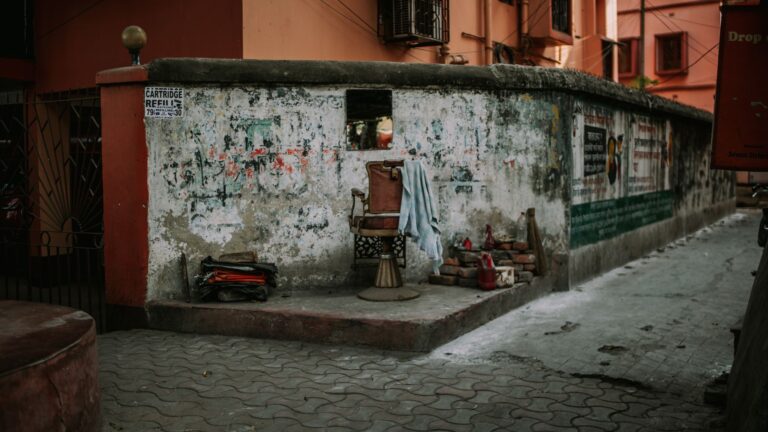
I have been cutting hair in the same chair, in the same shop, on the same square in the same small town for fifty years. I know the back of more heads than I will ever know names. I have buried customers and shaved their grandsons. I have learned that a barbershop is not really about hair. It is about the twenty minutes a man cannot get up and walk away, and what you choose to do with that time.
My name is Wendell. I am seventy-one years old. On the morning I am going to tell you about, I had decided it would be my last day standing behind that chair. I had not made a speech about it. I had not put a sign in the window. I had just told my wife, Ruth, over coffee, that I thought it was time, and she had reached across the table and put her hand over mine the way she does when she already knows something I am only now figuring out.
I want to tell you about the day I retired. But to tell you that, I have to tell you about a boy named Darnell, and I have to start fifty years back, because the two things are the same story. They were always the same story. I just did not understand that until a grown man walked through my door and said it out loud in front of everyone.
Let me take you back.
When I bought the shop, I was twenty-one and I did not have two nickels to rub together. The previous barber, a man named Earl, had let me sweep his floors for three years before he sold me the place for almost nothing and a handshake. Earl had a saying. He used to point his comb at me and say, “Wendell, anybody can cut hair. The trick is to be worth coming back to.” I did not understand him then either. I thought he meant give a good fade. It took me decades to understand he meant something else entirely.
The boy came in the first time when he was maybe nine years old. This was a long time ago. He came in by himself, which was unusual, and he stood in the doorway like he was not sure the door was meant for him. He had on a coat that was too big and shoes that were too small, and I could see he had been crying somewhere recently because his face had that scrubbed, swollen look that boys get when they have decided they are done crying for the day.
“You need a haircut, son?” I asked him.
He said he did, but he said it the way you say something you already know you cannot afford. He had a fistful of change. I could see it. Pennies and a couple of dimes, the kind of money a boy gets from looking under cushions and along the curb.
Now, I had a rule in those days, the same rule every shop has. You pay for a cut. But there is a thing you learn if you stand in one place long enough and pay attention, and the thing is this. Some people walk in needing a haircut. And some people walk in needing somebody to act like they are worth the trouble. This boy needed the second thing so badly it came off him like heat.
So I did what I would do a thousand more times over fifty years. I patted the chair and I said, “Climb on up. First one’s on the house. We run a special for new customers.”
There was no special. There has never been a special. But he climbed up, and I pumped the chair up high, and I put the cape on him and I started to cut. And while I cut, I did the only other thing I know how to do besides cut hair. I talked to him like he mattered.
His name was Darnell. He told me that much. I asked him about school and he got quiet, and I asked him about home and he got quieter, and so I stopped asking him questions he did not want to answer and I just talked. I told him about Earl. I told him about the time I cut a man’s hair so badly the man cried, back when I was learning, and how Earl made me apologize and gave the man his money back and then told me, privately, that every barber ruins a few heads before he is any good, and the only sin is to quit before you get good. Darnell almost smiled at that. Almost.
When I was done I held up the mirror behind his head, the way you do, and I watched his face in the big mirror while he looked at the back of his own head in the little one. And I will tell you, he sat up a little straighter. A clean cut does that to a person. It is the cheapest dignity in the world and most people have no idea how much it is worth.
“Come back anytime,” I told him. “You’re a good customer. Quiet. I like a quiet customer.”
He came back. He came back every few weeks for the better part of ten years.
Get a new story in your inbox every morning.
Facebook doesn’t show you every story we post. Our free newsletter does. Join 2,500+ readers.
Now, this was a small town, and a small town talks, and I knew Darnell’s situation better than he ever told me, because in a small town you cannot help but know. His daddy was not around. His mama was sick, the kind of sick that does not get better, the kind that takes a parent’s attention and money and patience all at once and leaves a child to raise himself in the gaps. There was a grandmother for a while, and then there was not. The town had a word for boys like Darnell, and the word was “trouble,” and they used it freely, in the diner and at the gas station and after church.
I heard them say it. I heard them say it more than once. “That Darnell, he’s headed for trouble. You watch.” People said it the way you talk about weather, like it was already decided, like the boy was a storm coming and the only smart thing to do was get your laundry off the line.
I never believed it. I want to be careful here, because I do not want to make myself out to be a saint. I was not. I missed plenty. There were weeks I was tired and short with people and did not give anybody the twenty minutes they deserved. But about Darnell, I was stubborn, and my stubbornness took one shape. Every time that boy sat in my chair, I treated him like a young man with a future, because it seemed to me that if the whole town was going to spend his childhood telling him he was trouble, then somebody had better spend twenty minutes every couple of weeks telling him he was not. I figured I was as good a somebody as any. I had the chair. I had the time. I had the cape.
So that is what I did.
We talked about everything in that chair. Baseball, mostly, because a boy will always talk about baseball when he does not want to talk about anything real, and you let him, because the talking is the point, not the subject. But over the years the real things came out sideways, the way they do. He told me when he was failing a class. He told me when he got in a fight.
I remember one winter he came in shivering, no coat at all that time, just a sweatshirt gone thin at the elbows, and his hands were so cold I could feel it through the cape when I draped it on him. I did not say anything about the coat. You do not, with a boy like that, because the worst thing you can do is make him feel pitied. Instead I turned the little space heater toward the chair and I let it run the whole cut, and I talked extra long, took my time, found things to neaten that did not need neatening, just so he could sit in that warm a little longer. When he left I told him I had a coat in the back somebody never came back for, which was a lie, it was my own, and I made him take it because, I said, it was just taking up space and doing me no good. He wore that coat for two years. I saw it on him at his own high school graduation, under the gown, and I had to look at the floor for a second.
Another time, and this is the one that still makes me angry, he came in right after the diner. He had gone in to spend a few coins on a hot lunch, a boy with money he had earned somehow, and the woman behind the counter had made a show of watching his hands the whole time like he was going to walk off with the sugar dispenser. He told me about it flat, no tears, like it was just weather, and that flatness was worse than crying. A child should not be able to report being treated like a criminal in the same voice he reports the score of a ballgame. I told him that woman did not know him and never would, and that the not knowing was her loss and not his shame, and I do not think he believed me, not that day. But I said it anyway. You say the true thing whether or not it lands. Sometimes it lands years later.
And then he told me, one terrible afternoon when he was about fourteen, that he was thinking about quitting school and finding some way to make money, because, he said, looking at the floor, “Everybody already knows how I’m gonna end up. Might as well get a jump on it.”
I remember I stopped cutting. I set the scissors down on the counter. I turned the chair so he was facing me instead of the mirror, and I crouched down so I was looking up at him a little, because a man should never look down at a boy he is trying to lift.
And I told him the thing. The one piece of advice. I am going to tell you what it was, because it is the center of this whole story, but I want you to understand that when I said it, I did not think I was saying anything special. I thought I was just saying the truth, the way Earl would have. I had no idea it would become the load-bearing wall of another man’s whole life. You never do know which of the things you say is going to be the one that holds somebody up. That is the terrifying and beautiful part of getting twenty minutes with a person. You are building something and you cannot see the blueprint.
Here is what I said.
I said, “Darnell, the whole town has already decided how your story ends. They told you the ending before you got to write a single page. So here is what you are going to do. You are going to make them wrong. Not with a speech. Not with a fight. You are going to make them wrong one ordinary day at a time, by getting up and doing the next right small thing, over and over, until one morning they look up and the boy they wrote off is a man they have to respect. You don’t owe them an argument. You owe yourself a different ending. Write it. Make me wrong too if I’m wrong about you. But I’m not wrong. I have cut a thousand heads and I know the good ones. You are one of the good ones. Now sit still, I’m not done with this side.”
He did not say anything. He just nodded, once, hard, the way you nod when you do not trust your own voice. I finished the cut. I held up the mirror. He sat up straighter. And he went back to school the next Monday. I know, because I asked him two weeks later when he came in, and he told me, and I said good, and we talked about baseball, and neither of us ever brought it up again.
That was the whole thing. A boy in a chair. A man with a pair of scissors. Twenty minutes, every couple of weeks, for ten years, and a handful of sentences on one bad afternoon. That is all it was. I never thought of it as anything. It was just my job, the way I understood my job, which was the way Earl taught me. Be worth coming back to.
Darnell graduated high school. I cut his hair before the ceremony, no charge, told him it was a graduation special, and there was no special then either. He shook my hand like a man. Then he left town for the service, and after that for school on the GI Bill, and after that the visits got farther apart the way they do when a young man’s life finally gets big enough to fill itself. He would come in when he was back to see what was left of his people, every couple of years, and he was always taller in some way that had nothing to do with height. I cut his hair and we talked baseball and I never charged him, not once, in all those years, and he stopped trying to make me after a while because he understood it was not about the money. It had never been about the money.
And then the visits stopped, more or less, and I read about him here and there. The town reads about its own. I knew he had done well. I knew it the way you know a far-off thing, with pride but no detail. I did not know how well. I did not know the half of it. I want to be honest about that, because what happened on my last day knocked the wind out of me precisely because I did not see it coming.
Now. My last day.
I had told Ruth, and I had told nobody else, but you cannot keep a thing like that quiet in a small town, and so by the time I opened the shop that last morning there were already more people on the square than a Tuesday deserves. My regulars came in, one after another, and a lot of them did not even need a cut. They came in and sat in the waiting chairs and told stories, and I let them, because that is what the shop is for. Frank, who I have been cutting since the Nixon administration. The Pollard brothers. Old Dr. Hennessey, who is older than I am, and that is saying something. They came to sit in my shop one more time while it was still my shop.
It was a good morning. It was a sad and good morning. I cut hair and I listened to the same lies I have been listening to for half a century, and I thought, this is enough. A man could do worse than this. A man could do a lot worse than fifty years of being trusted with the back of people’s heads.
It was a little after noon when the bell over the door rang and a man walked in that the room did not recognize, but I did. I would know him anywhere. He was in a good suit, but that is not how I knew him. I knew him by the way he stood in the doorway for half a second, like he was checking that the door was really meant for him, the same way he stood there when he was nine years old with a fistful of pennies.
It was Darnell.
The shop went a little quiet, the way a room does when somebody who clearly does not belong to the everyday of the place walks in. Some of them placed him slowly. You could see it move across their faces. That Darnell? The one who was headed for trouble?
He did not come to the chair. He stopped in the middle of the room, where everyone could see him, and he turned so he was talking to the whole shop, not just to me. And then he said the thing I am going to carry with me until they put me in the ground.
He said, “I heard Wendell was hanging it up. And I could not let him do it without this town hearing something it never bothered to learn the first time around.”
You could have heard a pin drop. Frank stopped mid-sentence. Dr. Hennessey took his glasses off.
Darnell looked around the room, slow, at all of them, the men who had grown up here same as he had, and he said, “Most of you knew me when I was a kid. And most of you had me written off. I’m not saying that to shame anybody. I’m saying it because it’s true, and because it’s the whole point of what I came to say. By the time I was fourteen, I had heard the word ‘trouble’ attached to my name so many times that I believed it. I had decided I was going to quit school and prove all of you right, because being right felt like the only thing this town was ever going to let me be.”
He turned and looked at me then.
“And there was exactly one place in this town,” he said, “where a man treated me like I was already somebody worth being. It was this chair. It was him.”
I had to put my hand on the counter.
He told them. He told the whole room about the free haircuts, which most of them had never known about, because I never told a soul. He told them I cut his hair for ten years and never took a dime, and that I did it without ever once making him feel like charity, which he said was the rarer gift. He told them about the afternoon I set my scissors down. And then he told them the advice, almost word for word, fifty years later, and I will tell you, hearing my own words come out of that grown man’s mouth, words I had forgotten I ever said, was the strangest thing that has ever happened to me.
“He told me,” Darnell said, “that the whole town had already decided how my story ended, and that they’d handed me the ending before I’d written a single page. And he told me I was going to make them wrong. Not with a speech. Not with a fight. One ordinary day at a time. By getting up and doing the next right small thing, over and over, until one morning the boy they wrote off was a man they had to respect.”
He stopped. He had to. So did I.
“I built my whole life on that,” he said, quieter now. “Every hard morning. Every time I wanted to quit something. Every time somebody in a uniform or a classroom or a boardroom looked at me like I was the trouble walking in. I heard Wendell’s voice. The next right small thing. Over and over. I am standing here in this suit because of twenty minutes at a time in that chair, and because one man in this town decided I was worth the trouble when nobody else would.”
Now I have to tell you what Darnell does, because it is the part that took my breath, and because it is the proof that you never know, you never know, which twenty minutes is going to change the world a little.
Darnell runs a foundation. I had read the word “foundation” in the paper and not understood it. What it is, is this. He takes boys. Boys the way he was. Boys a town has already decided about, boys with a sick parent and a missing one and a word like “trouble” hung around their necks before they are ten. And he gets them through. Mentors, tutors, a path to school, a hand on the shoulder when they want to quit. He has done it for hundreds of them. Hundreds. He named the thing after his grandmother, but he told me later, when the room had cleared and it was just us, that the whole shape of it, the whole idea, was the barber chair. Twenty minutes. The next right small thing. Make them wrong one ordinary day at a time. He took what I gave one boy and he gave it to hundreds.
“You think you gave me a haircut,” he said to me, when we were alone. “You gave me a blueprint. I’ve just been building from it ever since.”
But I am getting ahead of myself, because before the room cleared, before it was just us, Darnell did one more thing, and it is the thing the whole town is still talking about.
He reached into his coat and I thought, here it comes, here is where he tries to pay me back, and I had already decided I would not take a check, because that would have made it about money and it was never about money. But it was not a check.
It was an old photograph. Creased to softness, the way a thing gets when it has lived in a wallet for thirty years. He held it up so the room could see, and then he brought it over and put it in my hands.
It was a picture of him at nine years old, in my chair, in the too-big coat, mid-haircut, with the cape on. I do not know who took it. I do not remember it being taken. But there he is, a scared little boy getting a free haircut, and there I am behind him, younger than I can stand to look at, caught in the middle of saying something to the back of his head.
“My mama took that,” he said. “On a disposable camera. It’s the only picture I have of those years where I’m smiling. I’ve carried it every single day of my life. When things were at their worst, I’d take it out and look at it, and I’d remember that there was one place I was somebody. I wanted you to know it existed. I wanted you to know what those twenty minutes were.”
And then he turned to the room one last time, and he said the line I think they will put on my headstone if I let them.
“This man will tell you he was just a barber,” Darnell said. “Don’t you believe it. Anybody can cut hair. He was worth coming back to. And there are hundreds of men walking around in this world today who are okay because, fifty years ago, one barber decided a throwaway kid was worth twenty minutes.”
Earl’s words. Coming out of Darnell’s mouth. Words I had said to Darnell, that Earl had said to me, traveling down the years like that, from an old dead barber to a scared boy to a roomful of grown men on a Tuesday afternoon. I had to sit down in my own chair. Somebody, I think it was Frank, started to clap, and then they were all doing it, all my old regulars, all these men who fifty years ago talked about that boy like weather, standing up in my shop and clapping for him, and for me, and for what we had done together without either of us knowing we were doing it.
I have thought a lot, in the weeks since, about why this story matters, about why I am even telling it. And I think it is this.
We spend a lot of time looking for the big moment. The grand gesture. The thing that will change a life. And we miss the truth, which is that lives are not changed by grand gestures. They are changed by somebody being reliably kind in a small way, over and over, on the ordinary days, when no camera is rolling and no one is keeping score. The twenty minutes. The next right small thing. I did not save Darnell. He saved himself, every single day, for years. All I did was refuse to agree with the town about how his story ended. All I did was hand him a different ending and tell him it was his to write.
But maybe that is everything. Maybe that is the whole job. Maybe Earl was telling me the secret of the entire world when he pointed his comb at me and said, be worth coming back to.
I closed the shop that day for the last time. Ruth came and helped me sweep up, and I took the broom and I ran it across that floor the way I did the first day Earl let me, fifty-three years ago, and I cried a little, and Ruth let me. And on the wall, by the mirror, where every customer can see it for as long as I have a wall to hang it on, I put up that old creased photograph. A scared boy. A young barber. Twenty minutes that neither of us knew were holy.
People ask me now if I miss it. I do. I miss the chair and the bell over the door and the same old lies. But I will tell you what I do not miss, because I never lost it. I never lost the thing I actually did for fifty years, which was not cutting hair. I was in the business of telling people they were worth the trouble. You do not need a chair for that. You do not need a license or a square or a bell over the door. You just need to find the somebody in front of you who has been told too many times how their story ends, and you need to look them in the eye and tell them the truth.
You are one of the good ones. Now sit still. I’m not done with this side.
Darnell calls me every Sunday now. We talk about baseball, mostly, because that is what you talk about when you do not want to talk about how much you love somebody. And every once in a while, before we hang up, he says the same thing, and it gets me every time.
“The next right small thing, Wendell.”
“The next right small thing,” I tell him back.
And then we go and do it. Both of us. One ordinary day at a time.