
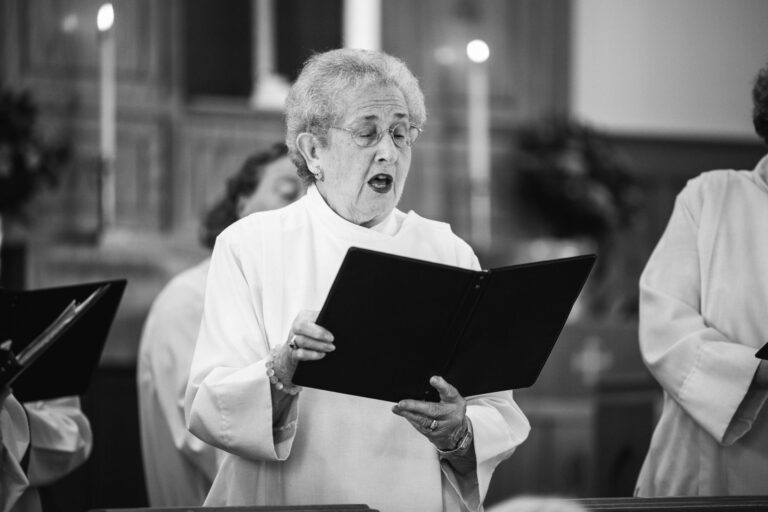
A dramatization, inspired by the kinds of quiet partings that happen in churches everywhere.
For thirty-one years I stood in the same spot in the choir loft at Bethel Grace, second row, third from the end, on the alto side. I could have found that spot in the dark. I had found it in the dark, plenty of mornings, before the lights came up and the heat kicked on and the sanctuary smelled like cold coffee and lemon oil. My name is Marian. I was sixty-eight years old the Sunday they took that spot away from me, and they did it so gently, with such soft and careful hands, that it took me three days to understand I had been let go.
I want to tell it the way it happened, because the gentleness was the part that nearly broke me. Cruelty you can brace against. You can get angry at cruelty, and anger holds you up like a splint. But kindness used as a door closing, kindness as the wrapping paper around the word no, that is a harder thing to stand inside of. I did not have anything to push against. I just had to feel myself slide.
It started with Pastor Reed asking me to stay after rehearsal on a Wednesday in March. The others filed out with their coats and their casseroles and their car keys, and I sat in the front pew with my hymnal still in my lap because I had not thought to put it down. He sat beside me, not across from me, which I should have noticed. People sit beside you when they are about to say something they do not want to say to your face.
“Marian,” he said. “You have given this choir more than anyone alive.”
I knew the shape of that sentence before he finished it. It is the sentence you say to someone right before you take something from them. You hand them the whole of the past so your hands are full and you do not have to give them any of the future.
He told me the worship team was “moving in a new direction.” That was the phrase. A new direction. They wanted a “fuller, more contemporary sound,” and they were bringing in younger voices, and they thought, the leadership thought, that it might be a season for me to “step back and just worship from the pew.” He said I had earned a rest. He said it like it was a gift, like he was handing me a vacation I had been too stubborn to take.
I asked him, and I am not proud of how small my voice was, “Is it my voice? Is something wrong with my voice?”
And he did the worst possible thing. He hesitated. Just a half second. Just long enough for me to hear the truth underneath the half second. Then he said, “Your voice is beautiful, Marian. It always has been. It’s just, the tone we’re going for now is a little brighter. A little more, you know. Young.”
Young. There it was, set down on the pew between us like a stone.
I told him I understood. I told him of course, the church comes first, and I would do whatever served the worship best. I said all the right things, the things a faithful woman says, because thirty-one years of standing in that loft had trained me to put the church above my own pride, and I was not going to let it train me out of me in one Wednesday night conversation. I drove home with the radio off. I let myself into a dark house. My husband Earl had been gone four years by then, and I had gotten used to the dark house, but that night it felt different. It felt like the dark had moved closer to the bed.
Let me tell you what that loft had been to me, so you understand the size of the thing they retired.
Earl and I started attending Bethel Grace in 1989, when our daughter Caroline was seven and our son Danny was four. I joined the choir within the month. I had sung in school and in my parents’ little country church before that, and singing was the one thing I did that felt like it had always been waiting in me, like it predated me, like I was just the latest person to carry it. The director back then was a woman named Florence Ott who wore reading glasses on a beaded chain and could hear one flat voice in a section of twenty and would find it without ever embarrassing the singer. Florence taught me to read four-part harmony. She taught me that the alto line is the line nobody notices and the whole song falls apart without, and that there is a holiness in being the part that holds and never gets the melody.
Get a new story in your inbox every morning.
Facebook doesn’t show you every story we post. Our free newsletter does. Join 2,500+ readers.
Florence is the one who told me, my second year in the loft, that I had what she called a kept voice. I asked her what that meant and she peered at me over the beaded chain and said, “Some voices are for showing. Yours is for keeping. You don’t sing to be heard, Marian. You sing to hold a thing steady so the showing voices have something to stand on.” I did not understand it then. I was thirty-three and I wanted, if I am honest, to be a showing voice. I wanted the solo and the spotlight and the people turning in their pews. Florence never gave me a solo, not in eleven years of directing me. She gave me the alto line, the kept line, every Sunday, and I sulked about it for the first three years and then one Sunday I stopped sulking, because I felt what she had been telling me. I felt the sopranos lift off my note like a porch lifts off its foundation, and I understood that the foundation does not get admired and the foundation is the reason the porch does not fall into the yard.
Florence died in 2001. I sang at her funeral, the kept line, holding it steady under the showing voices the way she taught me, and I thought that was the most important singing I would ever do. I was wrong about that, but I would not find out how wrong for another nineteen years.
That loft saw everything. It is a strange high vantage, the choir loft, up behind and above the congregation, and you spend your Sundays looking at the backs of people’s heads and the tops of their bowed shoulders, and over thirty-one years you learn to read a back the way other people read a face. I watched marriages from up there. I watched the Hadley boys grow up and ship out and one of them come home folded in a flag, and I sang over that too. I watched old Mr. Pruett stop coming and then come back a widower and sit alone in the pew that used to hold two, and I watched the women of that church close around him without a word, a casserole here, a ride there, the body taking care of its own. From the loft you see the church do what a church is for, and you sing the soundtrack to it, the kept line under all of it, holding it steady.
I sang at my own children’s baptisms from that loft. I sang at Caroline’s wedding. I sang, God help me, at Earl’s funeral, standing in my spot, second row, third from the end, with my son’s hand gripping my elbow so I would not go down. I did not make it through the second verse. The woman next to me, Dot Pruitt, picked the line up and carried it while I cried, and then I found my breath and came back in on the chorus, and that, that right there, is what a choir is. It is a body. When one of you cannot stand, the others sing your part until you can stand again. For thirty-one years I had been one of the others. I had carried Dot through her divorce and Lillian through her son’s overdose and a dozen sopranos through a dozen sorrows, picking up the line they dropped, holding the note until they came back.
And now the body had decided one of its old parts was slowing it down, and the kindest thing, the most loving thing, was to quietly set that part aside.
The next Sunday I sat in the pew. Fourth row, on the left, where Earl and I used to sit before I joined the choir. I had not sat in a pew during a service in three decades. I did not know what to do with my hands. The new worship team came up, four young people with in-ear monitors and a fog machine that someone had finally talked the deacons into, and a young woman named Brooke sang lead. She had a lovely voice. I want to be honest about that, because the easy version of this story is the one where I tell you the young people were terrible and the church got what it deserved, and that is not what happened and it would be a lie. Brooke was good. The sound was full and bright and modern and the young families loved it, and a few of them even raised their hands, which we had never done at Bethel Grace, and the whole thing was alive in a way the old choir had not been alive in a long time.
I sat in my pew and I clapped when they were done, and I felt something I had never once felt inside that building in thirty-one years. I felt like a visitor.
I went home and I did not sing for two weeks. That was the part that frightened me. I had sung every day of my adult life, in the kitchen, in the car, over the dishes, low and to myself while I weeded the tomatoes. And now there was a stone where the singing had been, and when I opened my mouth to let it out, nothing came, because a voice that has been told it is too old learns very quickly to stay in its room.
My daughter Caroline called every Sunday like she always did, and she could hear it on me. “Mom, you sound flat,” she said, and then she heard what she had said and tried to take it back, and I told her no, no, it was the right word, flat was exactly the word. I told her what had happened. She got that hard tone she gets, my girl, the one she got from me, and she said, “That is the most cowardly thing I have ever heard. Step back and worship from the pew. Who says that to a woman who sang at Dad’s funeral.”
And I said the thing I had been trying not to think. I said, “Caroline, what if they’re right. What if it really is just old. What if the only person who couldn’t hear it was me.”
She didn’t answer right away. Then she said, “Then go find out. Go sing somewhere and find out if it’s old or if it’s just unwanted. Because those are not the same thing, Mom. Those are not the same thing at all.”
I have thought about that sentence more times than I can count. Old and unwanted are not the same thing. The church had blurred them together so smoothly that I had swallowed both as one. But my daughter pulled them apart and held them up to the light, and I realized I did not actually know which one was true. I had been handed a verdict. I had not been handed any evidence.
So I went looking for evidence.
There was a place across town, Cedar Hollow, one of those nursing homes that tries hard with the landscaping out front and cannot quite cover the smell of the inside, the antiseptic and the overcooked vegetables and underneath it the particular smell of a great many people waiting. My friend Lillian’s mother had spent her last years there, and I had visited enough times to know the front desk woman, a tired and decent person named Pam. I went in on a Tuesday with no real plan. I told Pam I used to sing in a choir and I had some free time now and I wondered if anyone there might like a little music. I expected her to give me a form to fill out, or a number to call, or a polite brush-off.
Instead Pam looked at me for a long moment and her eyes filled up, and she said, “Honey, do you have any idea. Most of these people haven’t heard a real voice in months.”
She took me down a hall to a common room that smelled like coffee and Bengay, where maybe fifteen residents were arranged in wheelchairs and recliners around a television playing a game show nobody was watching. The light was that flat fluorescent that makes everyone look already gone. And I stood in the middle of that room, sixty-eight years old, retired from the only loft I had ever sung in, and I had no accompaniment and no pitch pipe and no Florence Ott to find my note for me, and I was terrified in a way I had not been terrified since I was a girl.
I opened my mouth and I sang the only thing that came, which was the song that always comes, which was “Great Is Thy Faithfulness.”
I want to tell you what happened in that room, and I want to tell it carefully, because it is the center of everything, the thing the choir at Bethel Grace decided it no longer needed and the thing those fifteen people had been starving for.
A man by the window, who Pam later told me had not spoken a full sentence in over a year, who had a diagnosis that was slowly closing all his doors one by one, this man turned his head toward me on the first line. By the second line his lips were moving. By the chorus, “morning by morning new mercies I see,” he was singing. Not loud. Not on pitch, not really. But singing, the words coming up out of some room in him that the disease had not yet found, a room where this hymn had been stored sixty, seventy years ago and locked, and my voice had turned out to be the key.
A woman near the front began to cry, the quiet kind, not from sadness. She told me afterward her mother used to sing that exact hymn while she hung the wash, and she had not thought of her mother’s voice in twenty years, and there it was, she said, there it was, you brought her right back into the room.
I sang for forty minutes. I sang every hymn I knew by heart, which after thirty-one years is a great many hymns, and when I ran out I sang the old ones from my parents’ country church, and when I ran out of those I sang Patsy Cline and “You Are My Sunshine,” and they sang those too, every word, because those songs were stored in the same locked rooms as the hymns. An aide stood in the doorway with her hand over her mouth. Pam sat down in an empty chair and stopped pretending she was working.
And here is the thing I felt, the thing I had not felt in two weeks and had been afraid I would never feel again. I felt my voice land. Not bounce off a fog machine, not get folded into a fuller brighter sound, not compete with anybody. I felt it go out across that flat fluorescent room and land in fifteen people and do something. My voice was not too old for that room. My voice was exactly old enough. The very thing the church had retired, the worn and lived-in quality of an alto that has carried other people through their funerals, was the precise thing that reached a man who had not spoken in a year. Brooke with her beautiful bright young voice could have sung in that room and it would have been lovely, but it would not have been a key, because she had not lived long enough to be cut to the shape of those particular locks.
I drove home that Tuesday and I sang the whole way with the windows down.
I went back the next week. And the next. Pam started telling families when I was coming, and the room filled up, twenty, then thirty. They wheeled in residents from the memory wing, the ones who could not be left alone, and those were the ones the singing reached deepest. There is research on this, I learned later, that music is stored in a different place than ordinary memory, a place the worst diseases reach last, so that a woman who can no longer name her own children can still sing every word of the song she was married to. I did not know any of that the first Tuesday. I just knew I had found a door, and behind the door were people, and the people had been waiting in the dark for someone to sing.
By summer Cedar Hollow asked if I would come twice a week, and would I mind doing a little Sunday service for the residents who could not get to church anymore, the ones whose churches had quietly stopped sending anyone. I said yes to all of it. I started bringing printed sheets in large type. I learned their names, all of them, and which song belonged to which person. Mr. Doyle, the man by the window, his song was “Great Is Thy Faithfulness,” and I opened with it every single time, and every single time his lips found the words, and his daughter started timing her visits to my Tuesdays so she could sit beside him and hear her father’s voice come back for forty minutes a week.
I want to tell you about one Tuesday in particular, because it is the day I stopped grieving the loft entirely, and a person should be able to name the day a grief lets go of them.
There was a woman named Esther Vance who came to Cedar Hollow that June. She had been a music teacher, forty years in the county schools, and now she was in the memory wing and she would not let anyone touch her. She hit the aides. She screamed in the night. Her son had not been able to find a placement that would keep her because she frightened the other residents, and Cedar Hollow took her because Pam had a soft spot and an empty bed. The first Tuesday Esther was in the common room she sat against the far wall with her arms crossed over her chest like a woman bracing for a blow, and her face was a closed door with the lights off behind it, and an aide stood near her in case she bolted.
I started, the way I always do, with Mr. Doyle’s song. And I watched Esther out of the corner of my eye the way Florence used to watch the section for the one flat voice, and I saw nothing. No lips moving. No turn of the head. A closed door. I went through “Great Is Thy Faithfulness” and “Blessed Assurance” and “In the Garden” and got nothing from her, and I thought, well, not everyone has a key, not every lock can be reached.
And then, because I had run through the hymns and I was watching her, I tried something. I do not know what made me think of it. I sang “How Great Thou Art,” but I sang it slowly, the way you teach it to a child, the way a music teacher of forty years would have sung it ten thousand times to ten thousand children, breaking on the breath marks, holding the long note in the chorus the way you hold it when you are demonstrating, not performing.
Esther Vance’s arms came down off her chest. Her lips parted. And then this woman who had not let a human being touch her in months, who hit the aides and screamed in the night, lifted her chin and came in on the chorus in a cracked, conducting alto, beating the time in the air with one thin hand, her eyes shut, forty years of standing in front of children rising up out of whatever dark room the disease had locked her in. The aide beside her put both hands over her mouth. Pam, in the doorway, sat down right where she stood, on the floor, against the door frame, and wept.
Esther sang every word. And when it was over she opened her eyes and looked straight at me across that flat fluorescent room and she said, clear as a bell, the first full sentence anyone had heard from her since she arrived, “You’re flat on the bridge, dear. But your heart’s in the right place.” And then the door in her face closed again and she crossed her arms back over her chest and she was gone, back wherever she lived now, and she never sang with me again in all the Tuesdays after. But she sang that once. She came all the way back up out of the dark for one chorus to correct my pitch, because she was a teacher to the bone and a teacher cannot let a flat bridge go by, and I have thought ever since that God knew exactly which key fit Esther Vance and it was not comfort, it was the chance to teach one more time.
I drove home that Tuesday and I did not cry on Route 9. I laughed. I laughed the whole way home, you’re flat on the bridge dear, because Florence Ott had told me the same thing in 1991 and here was a dying stranger telling me again twenty-nine years later, and I understood that my voice had never been about being right. It had been about being a door other people could come back through. Flat on the bridge and the heart in the right place. That is the whole of what I am. I stopped grieving the loft that day. You cannot grieve a thing you have outgrown the need for.
His daughter is the one who told me. We were standing in the hall after, both of us a little wrung out the way you get, and she took my hands and she said, “I don’t know if anyone has told you what you are. You’re not a volunteer. You’re not entertainment. You’re the only thing that reaches him now. You are his church. He lost his church when he lost his mind, and you brought it back in a tote bag full of large-print hymns.”
You are his church. I drove home and I had to pull over on Route 9 because I could not see the road.
Now I have to tell you about the part where Bethel Grace came back into it, because they did, and how that went is the quiet vindication my daughter promised me I would find if I went looking for evidence instead of swallowing a verdict.
It was the following spring, almost a year after the Wednesday in the front pew. Pastor Reed called me. He was warm, a little awkward, the way you are with someone you have wronged and half forgotten you wronged. He said the church had heard about “the wonderful ministry you’ve started” at Cedar Hollow, that Lillian had been telling people, that several members had gone with me on a Tuesday and come back changed, and that the missions committee wanted to know if Bethel Grace could “come alongside” the work. Could they send volunteers. Could they take up an offering for the large-print hymnals and the little portable speaker I had bought with my own money. Could I, and here he got to it, could I come and tell the congregation about it some Sunday. From the front. With the choir.
I sat with the phone in my hand in my kitchen, the same kitchen where I had not been able to sing for two weeks, and I felt the whole thing turn over in me. A year before, this man had sat beside me, not across from me, and told me my voice was a little too old for the direction they were going. And now he was asking me to come stand in the front of that sanctuary and tell everyone about the place my too-old voice had turned out to be exactly the right age for.
I will be honest about the ugly half second I had, because I promised I would tell this true. For one half second, the same half second he had hesitated in a year before, I wanted to make him feel it. I wanted to say, I’m sorry Pastor, my Sundays are spoken for now, I worship from a different pew these days. I wanted to hand him the past with both hands so my hands were full and I did not have to give him any of the future. I wanted, God forgive me, to retire him a little.
And then I thought of Mr. Doyle by the window, and the locked rooms, and the keys, and I understood that bitterness was just another locked room and I was the only one who held that key, and there was no aide in the doorway and no daughter to thank me, there was just me and a choice in a kitchen.
So I said yes. I said I would come.
I came on a Sunday in May. They sat me in the front, and the new worship team played, Brooke and her bright full sound, and they were good, they were still good, and I clapped for them and I meant it. And then Pastor Reed called me up, and I stood in the front of the sanctuary where I had sung at my children’s baptisms and my husband’s funeral, and I did not stand in the loft, second row, third from the end. I stood at the very front, alone, the way I now stood at the front of a flat fluorescent room twice a week, and I told them about Cedar Hollow.
I told them about Mr. Doyle. I told them about the woman whose mother sang while she hung the wash. I told them that a voice does not get too old, it gets too lived-in for some rooms and exactly right for others, and that the church had done me the great accidental kindness of closing a door I would never have left on my own, so that God could walk me down the hall to the door I had been built for the whole time and never knew. I told them I was not bitter, that I had wanted to be, that I had stood in my kitchen and held the bitterness in my hand and put it down, because I had spent thirty-one years in that loft learning to pick up the line other people dropped, and I was not going to start dropping lines now at sixty-nine.
And then I asked them, would they sing with me. And I lifted my too-old voice in that sanctuary and I sang “Great Is Thy Faithfulness,” Mr. Doyle’s song, the one I open with every time, and the whole church stood, the young families and the old widows and the deacons and Brooke with her in-ear monitors, and they sang it with me, and it was the fullest sound I have ever heard in that building, fuller than any fog machine, and not one person in that room could have told you whose voice was old.
Eleven people from Bethel Grace come with me to Cedar Hollow now. The missions committee bought the hymnals and three more portable speakers, and we go to two other homes besides. Mr. Doyle passed last autumn. I sang at his service, his daughter asked me to, and I stood at the front, alone, and I sang his song, and I did not make it through the second verse, and a woman I had brought from the church picked the line up and carried it while I cried, and then I found my breath and came back in on the chorus.
That is what a choir is. It is a body. When one of you cannot stand, the others sing your part until you can stand again. I thought I had lost my body the Wednesday they retired me in the front pew. It turned out I had only been sent to grow a new one, in the rooms where the singing was needed most, among the people the world had also quietly set aside.
I am seventy now. My voice is older than it was when they told me it was too old. And it has never in its life been more exactly the right age for the room it is in. They did not retire my voice. They handed it, without meaning to, to the people who had been waiting in the dark to hear it. And every Tuesday I open my mouth and I let it out, and it lands, and somewhere a locked room opens, and I understand at last that I was never the part nobody noticed. I was always the part that holds. I just had to be sent to the rooms where the holding was the whole of the work.