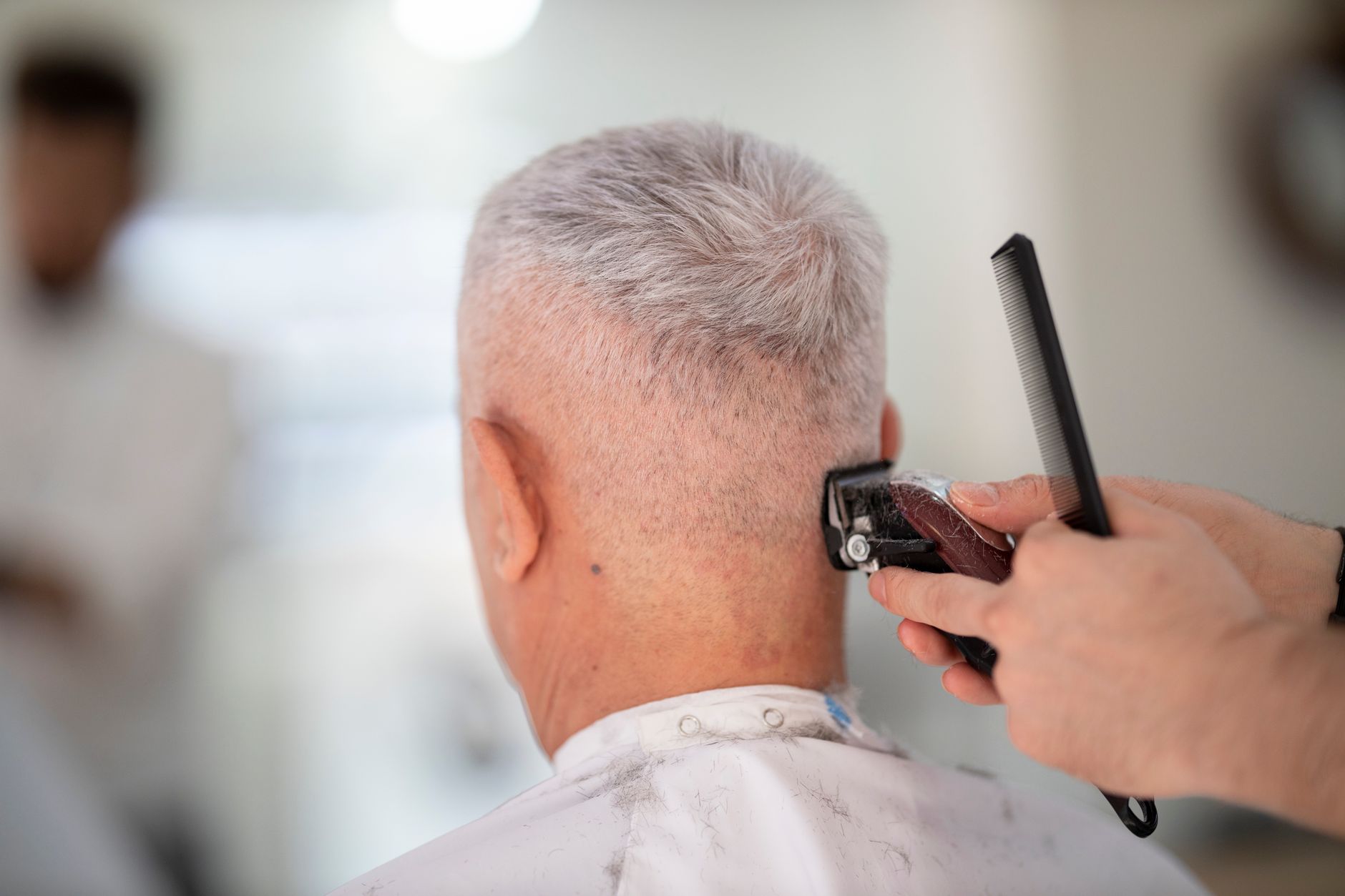
The Haircuts I Gave at the Nursing Home
She is ninety-seven now. She calls me Orin Harlan, which is what she called me when I missed my spelling words, and she still has me trim her bangs to the exact same place, one finger above the eyebrow, tucked behind the left ear.
Mr. Clell Bowling raised tobacco on Wildcat Ridge before his mind began to go. Two years ago he stopped knowing his own son.
The son comes every Sunday and sits with him, and Clell is polite to him, the way you are polite to a man you met at the feed store.
But Clell knows the cape.
I can stand at the far end of the hall, snap it open, and watch his head lift from across the day room like a hound hearing a truck. His whole face settles. He leans back an inch.
“Little off the sides, Harlan,” he says.
I have been Harlan to Mr. Clell Bowling for going on two years. I do not correct him. I cannot see what it would give either of us.
I say, “Yes, sir,” and I give him the little off the sides he asked for, and he tips his head back and shuts his eyes.
Mr. Wendell Tolliver carried the rural mail on Route 3 for thirty-four years, and he knew the name of every dog on it.
The stroke took the left side of him, and what it left was a man who does not trust many people with anything sharp near his ear.
He trusts me. He would never say so. He says, “Mind my ear, Dague,” every single week, and every week I say, “Yes, sir,” and that exchange is as steady as a hymn.
I will not make this out to be more than it was. Most of what I did was ordinary. I held a comb, I cut hair, I talked about the weather and the ball scores.
Nobody in that building ever asked me to lay hands on them or pray over them.
What I did in the truck matters more. Before I went in, every Thursday, I sat for about a minute with my hands on the wheel and asked the Lord to let me be of some use and not in the way.
That was all of it. It was a short prayer. It has been the same one since I was thirty-two, and it never needed a second sentence.
The years went on, as they do. I cut hair for a man who had fought in the Pacific and for a woman who had delivered half the babies in Rockcastle County.
I cut the hair of a boy of nineteen who had been in a wreck on Highway 25, who was there six weeks while his mother held his hand through every minute of it.
I cut hair for the folks who had no one. Those were the Thursdays I understood best.
There were always three or four with no visitor, and I do not think anybody said a word to them about their hair from one week to the next, except me.