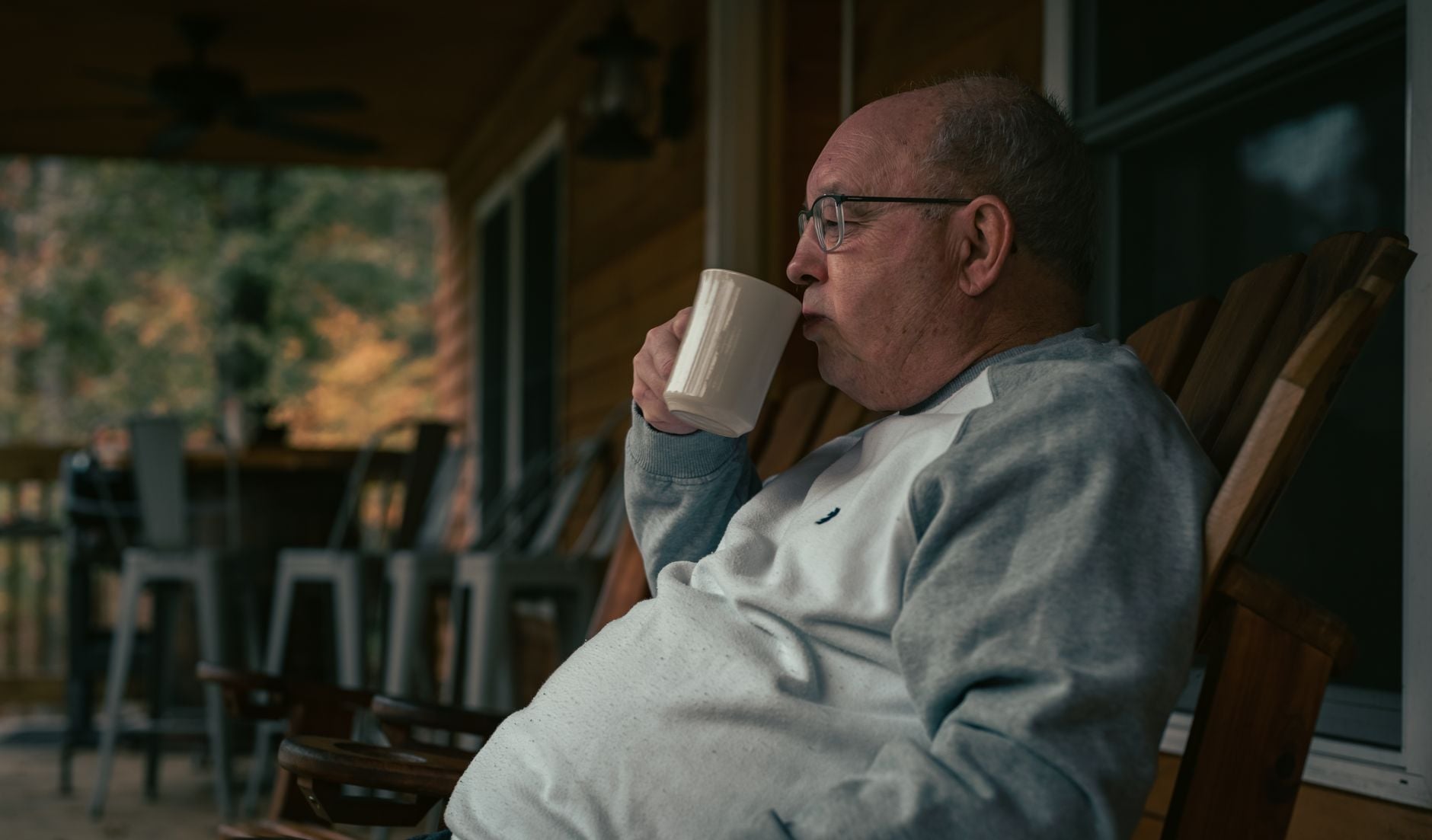
The Coffee Table That Came to My Porch
Headlights
At five minutes to six, the kitchen window turned white.
I thought at first it was the fog catching someone’s lights on the road, a neighbor going by. But the light kept coming, swinging up the lane, and then a second set behind it, and a third.
I went to the window. I could not make out the vehicles, only lights, but I could count them.
Five sets of headlights, coming up my lane in a line at about the speed a funeral goes.
Pete got up off my feet and put his nose against the screen door and did not bark. That surprised me. He had met all of those trucks before.
I went out on the porch in my slippers.
The first one parked in the yard. It was Alton’s Ford, the gray one. The second was Dwight’s flatbed. Then came Marvin’s old Buick, which is the color of a boiled shrimp, and a Chevy with Gene Wiesner and Wendell Stahl in it, and last, Lyle Unruh’s Dodge with Delmar Becker riding shotgun.
They did not hurry. They did not rush up my steps like men arriving at an emergency. They got out the way they get out at the co-op, one door and then another, stiffly, in coats that smelled of feed and diesel and cold.
Each one was carrying a thermos.
Alton was at the back of his pickup, and he lowered the tailgate, and I saw that he had a stack of folding chairs back there, the metal kind from the Lutheran church basement across from the co-op, and a canvas tarp rolled up and tied.
“Morning, Ervin,” Alton said.
“Alton.” I had a lot of things lined up to say, and none of them would come out. “What is this?”
“It’s six o’clock.” He lifted down a chair, snapped it open, and set it on the porch boards. “Coffee’s at six.”
Dwight came up the steps behind him with two chairs under one arm and a thermos in the other hand. He nodded at me like I was a man he saw every day, which, until that morning, he had.
“Mailbox looks rough,” Dwight said.
“I know it does.”
“Wind, probably.”
“There wasn’t any wind.”
“Then the mailbox started it,” Dwight said, and set up his chair. I will confess that I laughed, and it came out wrong, sort of strangled, and I turned away and rubbed my face on my sleeve like a boy.
Marvin lowered himself into a folding chair with a groan and told us all the Buick had been running rough. Gene, who is deaf in one ear and wears two hearing aids that squeal when he turns his head, took the end. Lyle and Delmar came up together, arguing about a fence.
Six folding chairs. Six men in them.
And Wendell Stahl, who is eighty and thin as a rake handle, and who had been the last one up the steps, stood at the edge of the porch with a thermos in each hand.
There was one chair left.
It was Lorraine’s.
She had a ladder-back chair on that porch, with a flat blue cushion she had sewn herself, that sat beside mine and faced east. Every morning for fifty-one years, she sat in it with her coffee and watched the sun come up over the Hammond place, and said good morning to it like it was a neighbor.
Nobody had sat in the chair next to mine since March, nineteen months back, and nobody had moved it. It had been dusted. I would not have said by whom.