The Night His Cattle Got Out
Jenny
“Jenny married a boy at nineteen,” Ray said. “Rick. He had his arms done up just about like yours. Rode a motorcycle. Worked at the elevator in town. Charming as anything at the supper table.”
He stopped. The wind picked up a little and rattled the sleet off the wire.
“He drank,” Ray said. “Joyce and I didn’t see it for a long time. Jenny hid it. She called us one night from a gas station in Ogallala at two in the morning with her lip split open and her car keys in her shoe.”
“I’m sorry,” I said. I meant it.
“I drove there faster than I ever drove anywhere.” He shook his head. “I brought her home and she lived in her old room for a year. She wouldn’t come out. She didn’t eat right. She’s good now. She’s got a good husband and two boys. But it took her a long time.”
He was quiet a minute. Then he looked up at me, straight on.
“I swore that night I’d never trust it again. That kind of a man. The way he looked. And then Hannah brought you home, and you walked in my door with your arms looking just like his, and I saw him. I didn’t see you. I saw him.”
I didn’t know what to say. I don’t think there was anything to say. So I just stood there in the slush and let him finish.
“That’s on me,” Ray said. “That’s not on you. You never gave me one reason. Not one. I kept looking for one, too, and you never gave it to me. And I said that thing at her birthday.” He stopped. “In front of her mother. In front of you.”
“You did,” I said. I wasn’t going to tell him it was all right. It wasn’t all right. It had cost Hannah her birthday and it had cost me two years.
He nodded. “I know it. I’ll say it to her, too. Today.”
Breakfast at the Gate
Joyce came over then. She didn’t say anything to Ray. She came straight to me and put both her hands on my face, the way my grandma used to. Her hands were warm from the truck heater.
“You’re frozen through,” she said. “You stay right here. Don’t you move. Either one of you.”
She drove Ray’s pickup up to the house without him. Ray and I stood at the gate and watched her go. Dutch leaned against my leg.
Ray looked down at Dutch. “Heeler,” he said.
“Yes, sir. His name’s Dutch. He’s nine.”
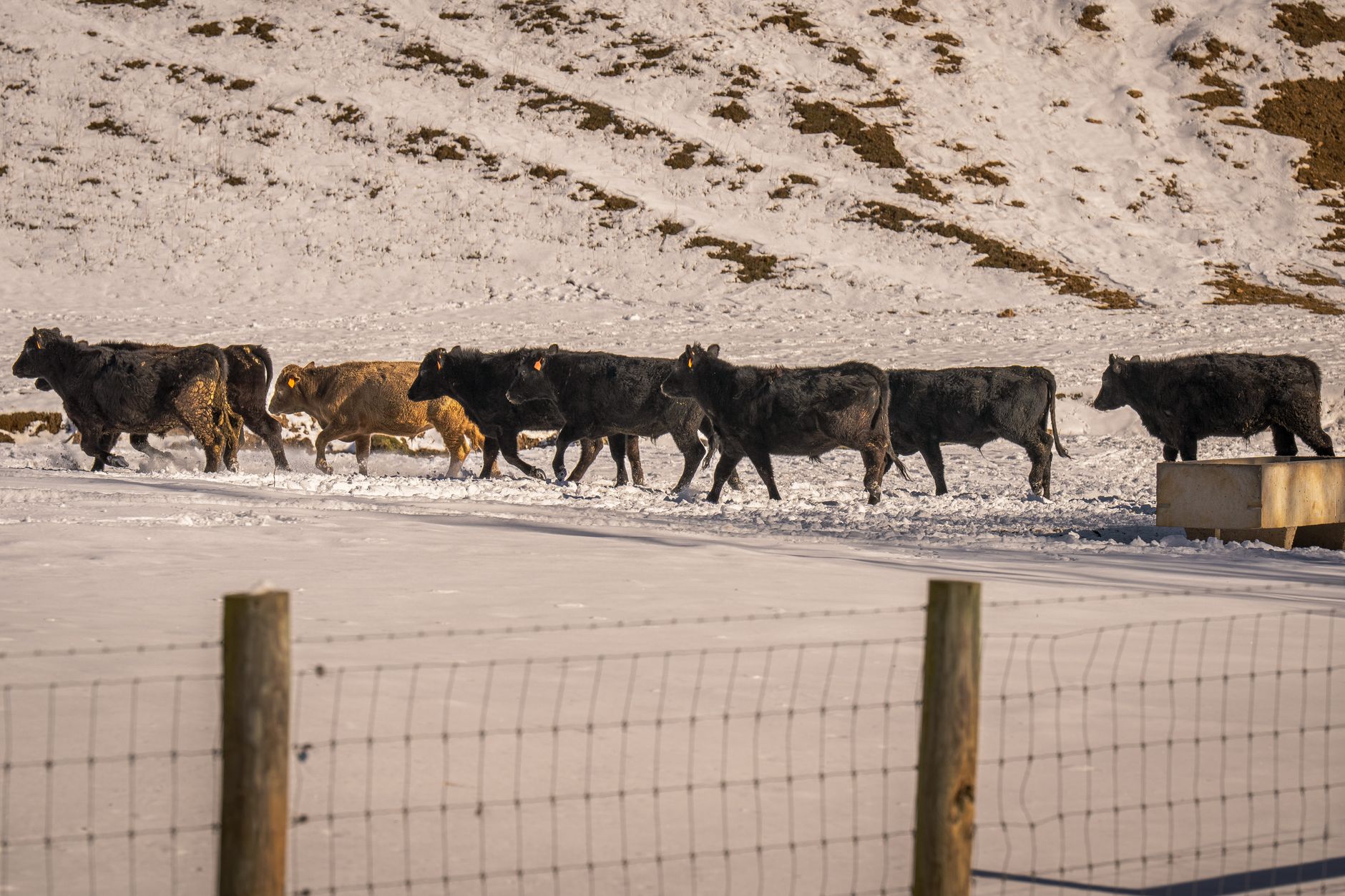
“He bring those five up out of the south ditch?”
“Him and me. Mostly him.”
Ray squatted down, slow, the way a man in his sixties squats down on frozen ground, and held out the back of his hand.
Dutch sniffed it, then put his head under it. Ray scratched his ears for a long time.
“Good dog,” he said quietly. “Good dog.”
Joyce came back in twenty minutes in the side-by-side with a thermos of coffee, a stack of egg-and-sausage sandwiches wrapped in foil, and a plaid blanket. She put the blanket around my shoulders without asking.
We ate standing at the tailgate of my truck. I have eaten a lot of meals in my life.
I don’t think any of them were better than that egg sandwich at Ray Andersen’s gate, with sleet melting off the brim of my cap and the sun trying to come up behind the clouds.
Ray ate two sandwiches and drank his coffee black. He kept looking over at the T-post. Finally he said, “You drive that by yourself?”
“The deputy held the light.”
“That’s not a corner,” Ray said.
“No, sir. It’s not. It’ll hold till you can brace it.”
He nodded. “That post’s been rotten since August. I knew it. I kept meaning to.” He shook his head. “It’s my fault they got out. My fault it was you out here at midnight and not me.”
“You were at the sale,” I said. “You couldn’t help that.”
“I could’ve fixed the post,” he said. “A man ought to fix his own fence.”