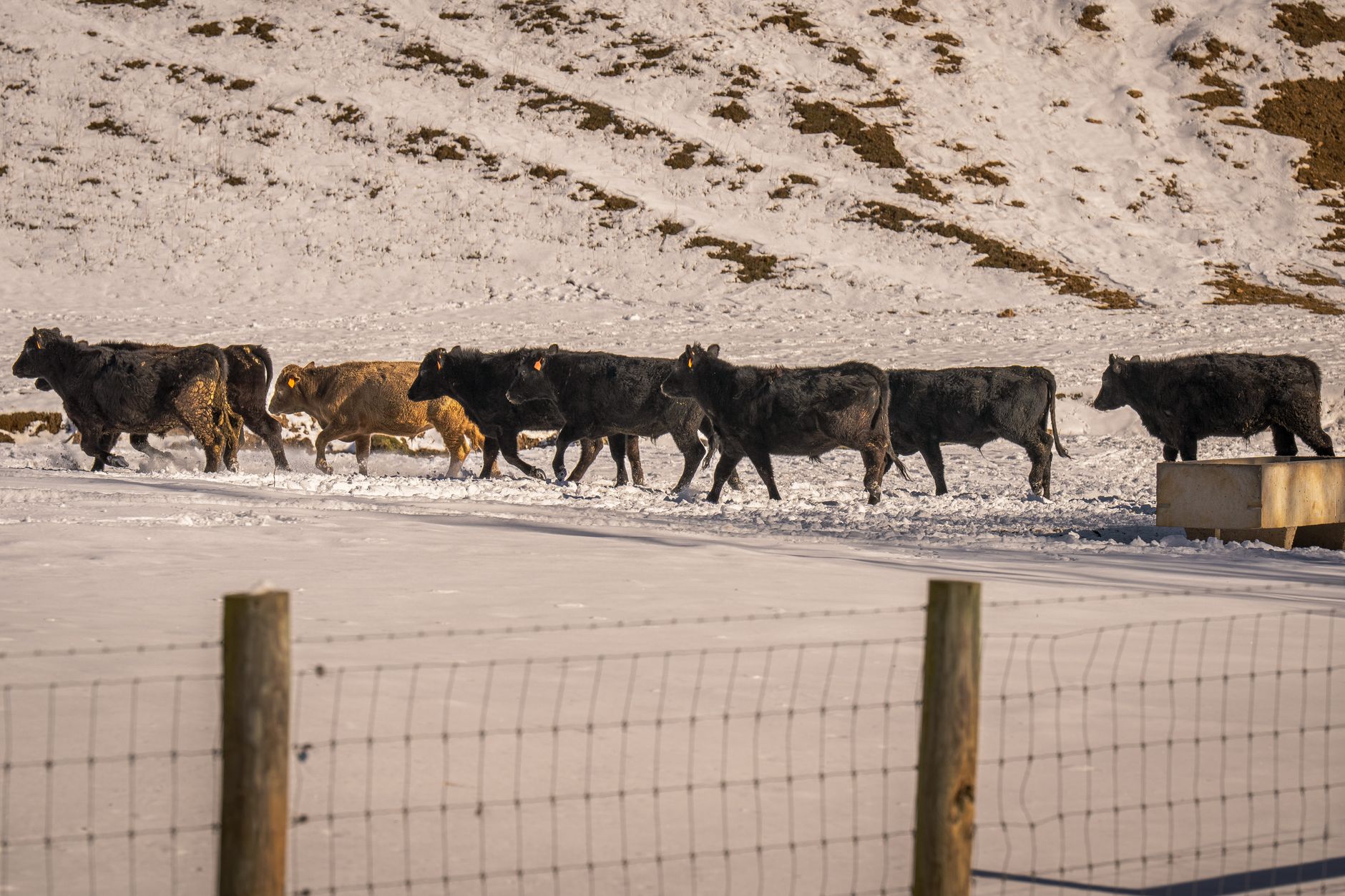
The Night His Cattle Got Out
The Ink
I should tell you about my arms, since they are the whole trouble.
I am a diesel mechanic. I work at a shop on the edge of Thedford, Nebraska, and most of what I do is keep feed trucks, cattle pots, grain trucks and old ranch pickups running through Sandhills winters that try to kill them.
I have tattoos from my wrists to my elbows on both arms. They are not pretty, mostly.
They are not the kind of thing you show a church committee. But every one of them means something to me.
On my left arm there is a wrench with my dad’s initials, because he taught me to turn one.
There is a date for my mom. There is a meadowlark, because that is the state bird and my grandma loved them.
On my right wrist, just above the back of my hand, there is a brand.
It is a capital J with a peaked line over the top of it, like a roof. Cattle people call that a rafter. The Rafter J.
It was my grandpa’s brand. Walt Jensen ran about two hundred cows on the Dismal River for forty-one years, and I spent every summer of my life on that place until I was fourteen.
When he had his stroke, my folks sold the cows and then the land. Nobody else in the family wanted to ranch.
I was too young to have a say. I cried in the back of the sale barn and was too ashamed to tell anyone.
Grandpa lived four more years in a nursing home in North Platte. When he died, I was eighteen.
The week after his funeral I drove to a tattoo shop and had his brand put on my arm where I would see it every day.
So when Ray looked at my arms, he saw a hoodlum. What he was actually looking at, on the right side, was a cattleman’s brand that had been registered in the state of Nebraska since 1961.
He never asked. Not once in two years. I always figured if he ever asked, I’d tell him.
Until then, it wasn’t something I was going to hold up in front of him like a badge.
The Drive Home
Hannah cried for the first ten miles. She does not cry loud. She cries looking straight out the windshield with her jaw set, wiping her face with the heel of her hand.
“I’m sorry,” she said finally. “I’m so sorry. I should have said something. I should have stood up and walked out.”
“It was your birthday,” I said. “You don’t have to walk out of your own birthday.”
“He’s not a mean man, Cody. I know you don’t believe that. But he’s not. He’s scared of something, and it isn’t you. It’s something that already happened.”
I had heard pieces of this before. Hannah had an older sister, Jenny, who lived in Kearney now.
Jenny had been married once, young, and it had gone badly. That was all Hannah would ever say about it.
“It’s his to tell,” she said again that night, the way she always did. “If he ever tells it. I’m not going to make him into the bad guy in a story that isn’t finished.”
I loved her for that, honestly. Even while it stung. She was being fair to a man who was not being fair to me, and I think that is the hardest kind of fair there is.
We drove the rest of the way in the dark with the heater going.
My dog Dutch was asleep on the back seat with his chin on the armrest. Out the windows, the Sandhills rolled by black and endless under a quarter moon.