The Night His Cattle Got Out
Out Into It
I loaded Dutch in the truck. He knows what it means when I grab my insulated bibs off the hook at night.
He was at the door before I had them on, ears up, tail going.
I always keep a roll of barbed wire in the truck bed, plus a fence stretcher, a set of fencing pliers, a bucket of clips and a few steel posts with a driver.
My grandpa taught me to. “You’ll never be sorry you carried wire,” he used to say.
Ray’s place is about twenty-two miles from my house. On a dry night it takes me twenty minutes.
That night it took me thirty-five. The sleet was coming in sideways off the north, and the road was glazing over in patches.
I saw the deputy’s light bar from three miles off. Red and blue, going round and round, bouncing off the sleet so the whole sky around it seemed to flash.
He had his car parked crossways on the shoulder with the lights running.
He was out in the road in a slicker with a big flashlight, waving down a grain truck that had come up from the south. The truck had stopped, thank God.
Then I saw the cows.
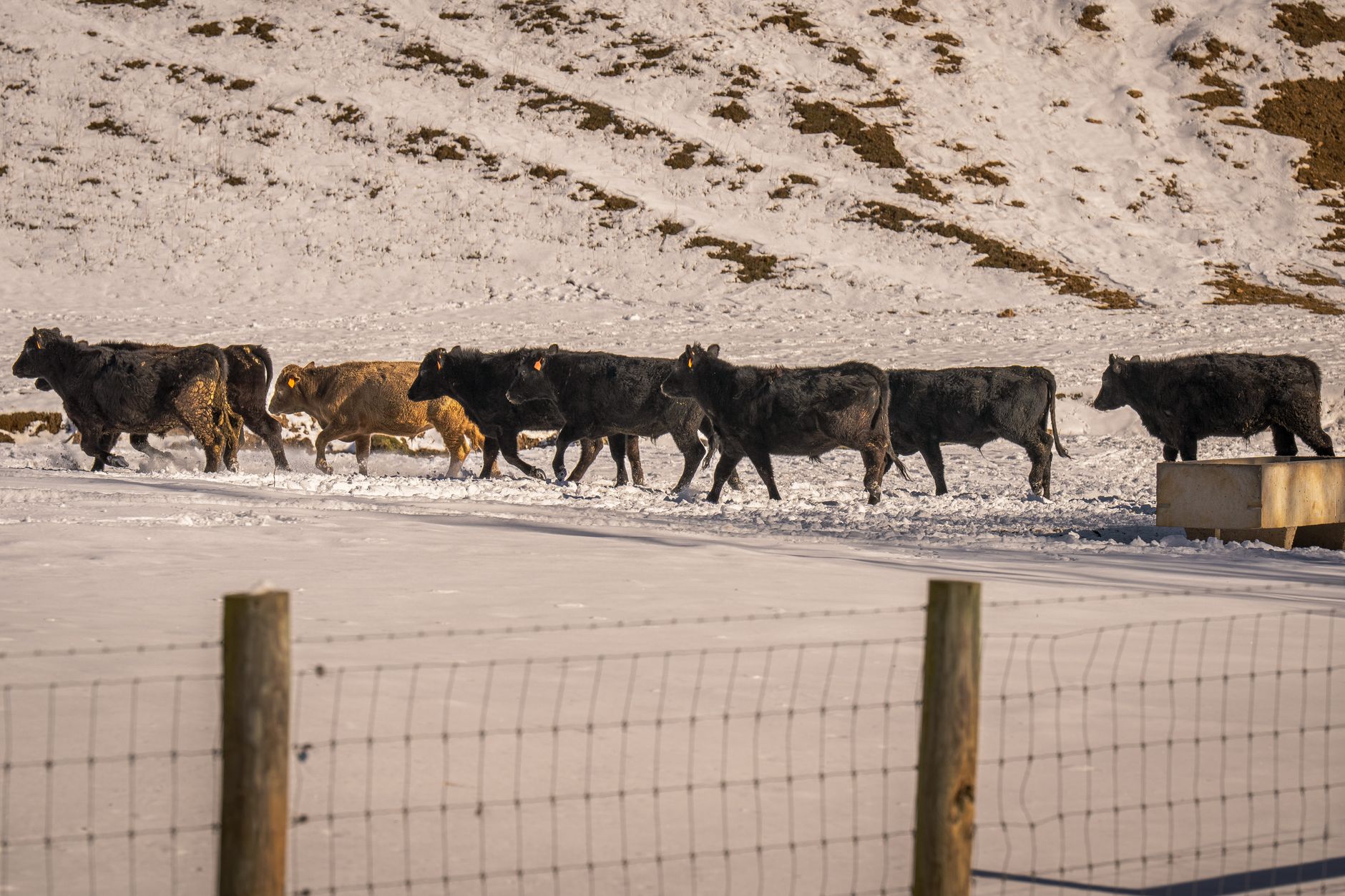
Ray runs black Angus. Black cows on black asphalt at midnight in a sleet storm are almost invisible.
You do not see them until your headlights catch their eyes, and then all at once there are thirty pairs of green eyes looking back at you.
They were spread along maybe a half mile of highway and both ditches. Some were standing in the middle of the road with their heads down against the wind.
A few were still bawling, out toward the place where their calves used to be.
I pulled over behind the deputy’s car and got out. He came over with the flashlight. He was a young guy, younger than me, and his face was red and wet and worried.
“You Hannah’s boyfriend?”
“Cody Jensen.”
“Thank God. I count about sixty out here,” he said. “Ray told me last spring he runs sixty-three. I can keep traffic stopped, but I don’t know the first thing about getting cows to go anywhere.”
“Then we need sixty-three,” I said. “You keep the road. Dutch and I will move them.”
How You Move Cows in the Dark
I need to tell the cattle people reading this that I know what you are thinking.
Nobody in his right mind tries to move sixty-three cows off a highway at night with one man and one dog. You’d want five riders and daylight.
But you take the job you have. There was no one else coming.
The nearest neighbor was an old bachelor named Harold, nine miles north, with a bad hip. The deputy asked if he should wake him. I said no.
First I found the gap. It was at the northeast corner of the pasture, right where Hannah had said.
The old cedar corner post had snapped off at the ground, and the wire was laid down flat in the grass for maybe forty feet.
That was good news, honestly. A big gap is easier to put cows back through than a little one.
I pulled my truck onto the shoulder so the headlights shone straight into the opening, and left them on high.
Cows will go back where they came from if you let them. They know where home is.
They know where the water tank and the hay are. Your whole job is to give them the idea and then get out of their way.
The thing you cannot do is run them. If you run cattle in the dark, they scatter.
Some will go through the next fence. Some will go a mile down the highway. Some will go right over the top of you.
So you walk. Slow, wide, quiet. You come at them from the far side, a long way out, and you lean on them gently from behind.
You let them see you. You let them think it is their idea.
Dutch is nine years old. My grandpa’s last heeler was his grandmother.
He grew up around cattle until we lost the place, and then he grew up around me and a shop full of diesel engines, but he never forgot what he was for.
A good heeler does not rush a cow. People think heelers are all bite and bark. A good one works wide and quiet.
He swings out past the bunch, and when he turns them it looks like nothing, like he just happened to be standing there.
I sent Dutch out to the south end with a whistle. He went low and fast through the ditch, and I lost him in the dark.
Then I saw the far bunch start to drift north toward the headlights.
I walked the middle of the road behind them with my arms spread out.
Sleet was hitting me in the right ear so hard it felt like gravel. The deputy kept the grain truck stopped and another pickup stopped behind it.
The first ones went in by twos and threes. An old brockle-faced cow led them, the kind of old cow every herd has, who has been through that gap before and knows what to do.
When she stepped across the flattened wire into the headlights, I almost laughed out loud. Three more followed her right in, and then six more behind them.
I counted every one out loud. One. Two. Three. I counted until my voice went hoarse.
I didn’t want to get to the end of the night and find out I’d lost track somewhere in the twenties.