Forty Plates on the Tailgate
What Dan Said
That night, after the dryer was running and the crew had gone home, Dan sat at our kitchen table eating the last plate I had saved for him.
It was nearly eleven. His hands were black at the knuckles from greasing the header.
“You’re quiet,” he said.
“I’m tired.”
“Jules.”
I sat down across from him. The kitchen smelled like gravy and the dish soap I buy by the gallon. I said, “She called it plain, Dan. In front of Elmer. In front of everybody.”
He set his fork down. Dan is not a talker, but he is fair, and he does not pretend things did not happen. He said, “I know. I heard it. I didn’t like it either.”
“Then why didn’t you say anything?”
He rubbed his face with both hands. “Because Eric and I have farmed side by side for thirty years without one real fight. Because she’s been in this family six months. And because it’s one supper, on the last day, and then it’s over and we’ve got all winter.”
“It isn’t one supper to me.”
“I know it isn’t.” He reached across and put his rough hand over mine. “Let her have it, Jules. Let her have her pictures. Eric’s happier than I’ve seen him since we were boys. I don’t want to be the one who takes the shine off it.”
I looked at his hand on mine, the wedding ring worn thin from 28 years of gloves. I understood him.
That is the worst part of a marriage sometimes. You understand each other even when you would rather be angry.
“All right,” I said. “I’ll let her have it.”
And I did. I never said one word to Kristin about it.
Not that week, not at church on Sunday, not when she came by the house on Wednesday with a clipboard and asked me where the outlets were in the shop so the caterer could plug in their warmers.
The Rain
What I did not tell anybody, not even Dan, was that I was watching the sky.
On Tuesday of that last week, a storm came across from the west after dinner and put an inch and a half of rain on us in four hours.
The combines sat in the shed for two days. Everyone stood around drinking coffee and staring at the radar on their phones.
The last field of the year was what we have always called the Hagen quarter, after the family who owned it before Dan’s grandfather.
It sits a mile and a half off the gravel, back along a dirt field road that runs between two fence lines.
Halfway down that road there is a low spot where a culvert goes under to drain the slough. In a dry fall, you never notice it.
After an inch and a half of rain, that low spot holds water like a cupped hand. It takes a week of sun and wind to firm up.
I know that because I have been stuck in it twice.
Once in 2004 with the old Chevy, and once in 2013 with a pickup full of chicken and noodles, when Dan had to come pull me out with the loader tractor and the noodles went everywhere.
By Thursday the top of the ground had dried enough that the combines went back in.
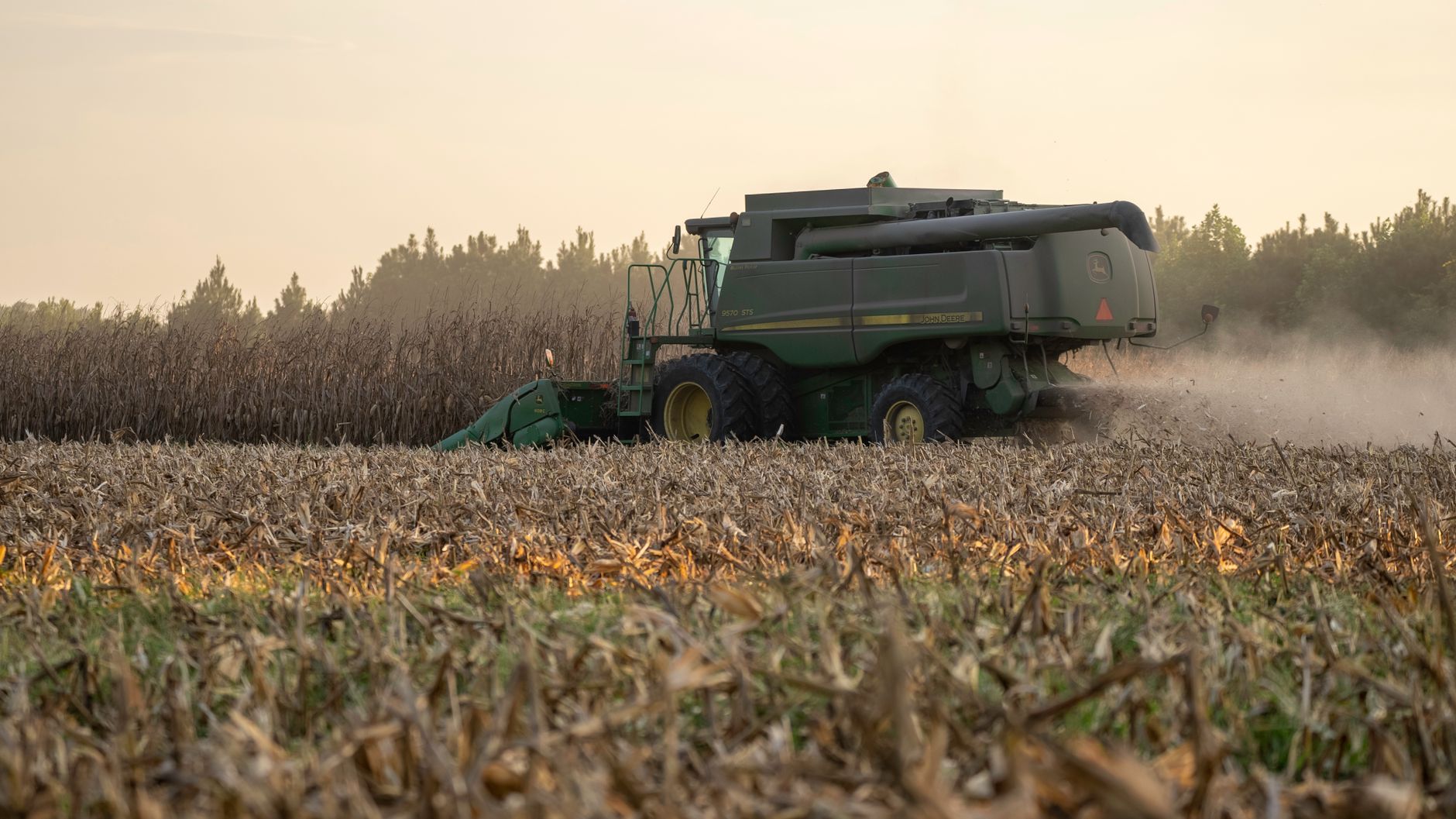
Combines and grain carts ride on big tires and tracks. They float over soft ground that would swallow a regular vehicle whole.
Kristin had told the caterer to meet everyone at the Hagen quarter at six o’clock on Friday.
The idea was that the crew would finish the last rounds as the sun went down, shut off the machines, and walk straight to the linen tables for brisket and pictures.
I heard her on the phone in the shop on Thursday, giving them directions. “You’ll see the bins, then turn on the dirt road past the yellow sign,” she said. “It’s a little bumpy, but you’ll be fine.”
I opened my mouth and closed it again. I had promised Dan. And who was I to say? Maybe they had a truck.
Maybe the road would dry. Maybe I was just a 50 year old farm wife who could not stand to be replaced.
But on Friday morning, I got up at five like I always do, and I took four chuck roasts out of the refrigerator.